


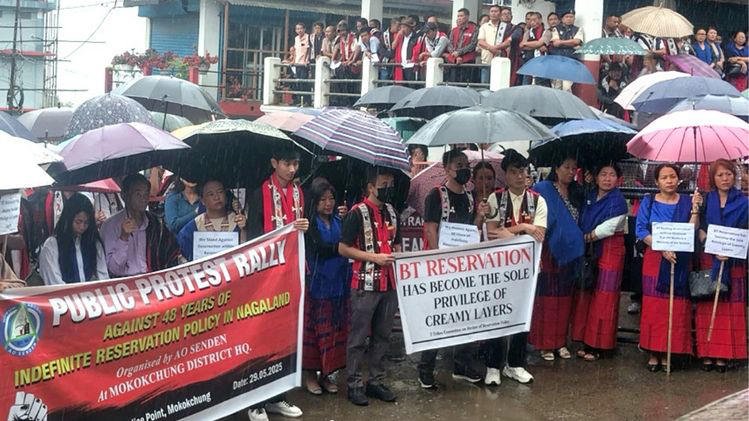
Nagaland reservation policy is once again in the spotlight as the state government formally constituted a commission to review and examine its current framework. This move reflects the administration’s commitment to address longstanding debates on fairness, representation, and the evolving aspirations of diverse communities in the state.
The commission, led by senior officials and subject matter experts, will study the existing policy, identify gaps, and recommend reforms that ensure equitable opportunities. Officials say the review will not only focus on fairness but also take into account the socio-economic realities of different groups.
Read More: Meitei Body Seeks APSC Clarification on Manipur Crisis Question
Commission’s Role in Reviewing Nagaland Reservation Policy
The government stressed that the primary responsibility of the newly formed commission is to undertake a comprehensive review of the Nagaland reservation policy. It will examine how effectively the current structure has served its intended purpose and whether adjustments are needed to align with present-day demands.
According to the government’s notification, the commission will also engage with community leaders, student bodies, and civil society groups. Their inputs are expected to provide valuable insights, as policies of this nature deeply affect the socio-political landscape. By involving stakeholders, the state aims to build consensus and ensure that future reforms carry wider acceptance.
Officials highlighted that the commission’s findings will be tabled before the state cabinet for detailed discussion. This ensures that the final recommendations are not only research-driven but also politically feasible.
Growing Need for a Review
Over the past few years, debates around Nagaland reservation policy have grown louder, particularly among youth and community organisations. While some argue the policy has created avenues for underrepresented sections, others believe it requires changes to reflect new realities.
One major concern raised is the balance between opportunity and merit. With a growing educated youth population, calls for reforms have intensified. Supporters of the review say a periodic re-evaluation ensures the policy remains relevant, while critics worry it might dilute protections for certain sections.
The state government has clarified that the commission’s role is not to dismantle the system but to evaluate and suggest measures that strengthen inclusivity. By adopting a data-driven approach, the state hopes to reduce speculation and provide clarity on how benefits are distributed.
Balancing Equity and Efficiency
Nagaland reservation policy has long sought to balance equity and efficiency in public services and education. However, achieving this balance remains challenging. Rapid social and economic changes in the state have created fresh demands that the current system may not fully address.
The new commission is expected to recommend reforms that maintain fairness while encouraging competitiveness. Officials have pointed out that inclusion and efficiency need not be mutually exclusive. Instead, a well-designed framework can nurture talent across communities while also protecting disadvantaged groups.
Stakeholder Consultations Key to the Process
Community voices are expected to play a major role in shaping the review of Nagaland reservation policy. The government has emphasised its intent to hold consultations in phases, allowing stakeholders to express concerns and offer suggestions.
Student organisations, in particular, are likely to be vocal. In the past, they have called for transparent policies that consider changing social dynamics. Women’s groups and civil society organisations are also expected to seek greater recognition in future frameworks.
The commission’s task will not be easy, as it must weigh diverse perspectives before framing recommendations. Yet, this inclusivity is seen as a vital step towards building a policy that reflects Nagaland’s unique socio-cultural fabric.
Broader Implications for Nagaland
The review of Nagaland reservation policy is more than an administrative exercise; it is a significant step toward shaping the state’s long-term social and political stability. Policies of this nature influence how communities perceive fairness and representation in governance.
By addressing concerns through a transparent review process, the state hopes to reduce potential conflicts and enhance trust among different groups. Moreover, the findings could set an example for other states dealing with similar challenges in balancing equity and merit.
The process is also expected to highlight the importance of adaptive governance. As societies evolve, policies must evolve with them. Nagaland’s decision to revisit its reservation framework demonstrates responsiveness to changing times.
Way Forward
The newly formed commission will soon begin its groundwork, starting with data collection and preliminary consultations. It is expected to submit its findings within a stipulated timeframe, although the government has not announced a specific deadline.
Policymakers say that implementing the recommendations will require political will, as reforms in reservation structures often spark heated debates. However, the government has assured that the process will remain consultative and transparent.
Observers note that the review of Nagaland reservation policy marks an important moment for the state. It reflects an acknowledgment of the changing aspirations of its people and a willingness to adapt governance structures accordingly.
As the commission begins its work, many in Nagaland await its findings with anticipation. Whether it leads to minor adjustments or significant reforms, the process itself is a step towards inclusive governance.
Read More: Assam DGP Urges Public to Join I-Day Celebrations