


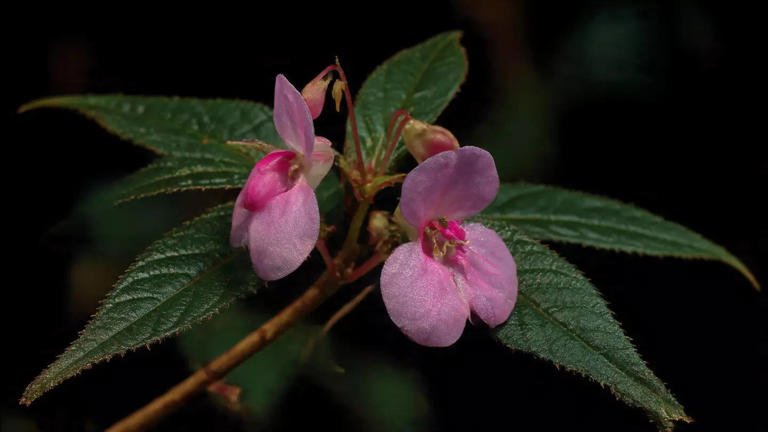
A stunning botanical discovery has brought Arunachal Pradesh into the global spotlight once again. Scientists have found a new flowering plant species, Impatiens Rajibiana, in the lush hills of the state. This finding adds another chapter to India’s remarkable biodiversity and highlights the ecological richness of the Eastern Himalayas.
Read More: Tripura Civil Society Calls Bandh Over Tiprasa Accord, Infiltration
Discovery of Impatiens Rajibiana
The Impatiens Rajibiana discovered in Arunachal Pradesh belongs to the family Balsaminaceae, widely known as the touch-me-not family. The vibrant species, which blooms in shades of pink and purple, was spotted thriving beside a shaded stream in the Lower Subansiri district.
Researchers from Rajiv Gandhi University and the Botanical Survey of India identified the plant during a detailed field survey. They named it Impatiens Rajibiana to honor Professor Rajib Gogoi, a noted botanist recognized for his extensive contributions to Indian flora.
The research team described the flower’s distinct features—its bright petals, elongated spur, and compact growth pattern. The plant typically blossoms between June and September, favoring moist and shaded forest areas.
Lead researcher Dr. A. Choudhury explained that the discovery resulted from months of trekking through unexplored valleys. “Each expedition brings us closer to nature’s secrets,” he said. “This discovery reminds us how much more there is to learn from the forests of Arunachal Pradesh.”
Strengthening Arunachal’s Biodiversity Profile
The Impatiens Rajibiana discovered in Arunachal Pradesh strengthens the region’s reputation as a biodiversity hotspot. Arunachal’s diverse terrain, ranging from tropical valleys to alpine peaks, supports hundreds of unique plant species. Many of them remain undocumented due to the state’s remote and difficult terrain.
Experts believe this discovery will inspire further botanical exploration in the Northeast. It also underscores the importance of preserving fragile ecosystems threatened by deforestation and infrastructure expansion.
Dr. Choudhury pointed out that even minor changes in climate or soil can affect species survival. “Each discovery like Impatiens Rajibiana is not just scientific news; it’s a call for stronger conservation efforts,” he added.
Ecological and Traditional Significance
The Impatiens genus includes over a thousand known species worldwide. Many varieties have medicinal value and are used in traditional healing practices. Although researchers have yet to confirm the medicinal uses of Impatiens Rajibiana, they believe it may hold potential for future studies in herbal medicine.
Local communities near the discovery site have shown pride and curiosity about the new species. They see it as a symbol of their land’s natural wealth and have expressed readiness to help conserve its habitat. This collaboration between scientists and villagers could become a sustainable model for biodiversity protection.
Arunachal’s forest officials also plan to promote eco-tourism linked to such discoveries. They hope scientific tourism will bring researchers and students to the region, spreading awareness while benefiting local livelihoods.
Conservation Urgency
The discovery of Impatiens Rajibiana discovered in Arunachal Pradesh has reignited discussions about the urgent need to protect Eastern Himalayan forests. The area faces mounting pressure from illegal logging, shifting cultivation, and expanding road networks. Scientists have urged the government to declare the discovery zone as an eco-sensitive area to prevent habitat destruction.
Dr. Choudhury emphasized that the loss of forest cover can erase undiscovered species forever. “Every time we clear a patch of land, we might be losing something unique,” he warned. “Arunachal’s forests are living laboratories that must remain intact.”
Conservationists recommend a combination of government policy, scientific monitoring, and community participation to safeguard biodiversity. They propose training local youth to serve as “green guardians,” documenting rare species and reporting ecological changes. This strategy, they say, will build local ownership and strengthen conservation efforts on the ground.
A Boost for Indian Botanical Research
The discovery has been published in the international journal Phytotaxa, where experts praised the team’s contribution to plant science. It follows several floral discoveries in India’s Northeast over recent years, reaffirming the region’s role as a center for global biodiversity.
According to researchers, many parts of Arunachal Pradesh still remain botanically unexplored. They plan to continue surveys in other remote valleys to identify more hidden species. The discovery of Impatiens Rajibiana discovered in Arunachal Pradesh will also support India’s long-term biodiversity mapping programs.
Professor Rajib Gogoi, in whose honor the plant was named, expressed deep gratitude. “This recognition is special,” he said. “It celebrates not just individual work but India’s collective dedication to understanding and preserving its flora. Each discovery reminds us that nature’s beauty thrives where curiosity meets respect.”
The Path Ahead for Conservation and Research
The Impatiens Rajibiana discovered in Arunachal Pradesh has sparked enthusiasm among students and young researchers across India. It has encouraged many to pursue studies in botany, conservation, and ecology. Educational institutions are planning awareness programs to teach students about the importance of plant diversity and environmental protection.
Government officials have promised to increase funding for field studies and biodiversity documentation. They aim to collaborate with local communities to balance conservation and sustainable development. Such steps could make Arunachal Pradesh a model for green research and responsible tourism in India.
Dr. Choudhury believes that the discovery should motivate people to care more deeply for the planet. “When we discover something new, it’s like finding a message from nature,” he said. “That message tells us to protect and nurture the world around us.”
A Flower That Inspires Hope
The discovery of Impatiens Rajibiana represents more than just a scientific milestone—it symbolizes hope. It reminds everyone that nature continues to flourish, even in the face of environmental challenges.
By preserving ecosystems like Arunachal’s, India ensures that such wonders continue to bloom. As scientists, students, and communities come together, discoveries like this will guide the path toward a greener and more sustainable future.
The Impatiens Rajibiana discovered in Arunachal Pradesh stands as a testament to curiosity, perseverance, and the enduring bond between humans and nature—one that continues to grow and inspire generations to come.
Read More: Meghalaya Police Destroy 10 Tonnes of Illegally Grown Cannabis in East Khasi Hills