


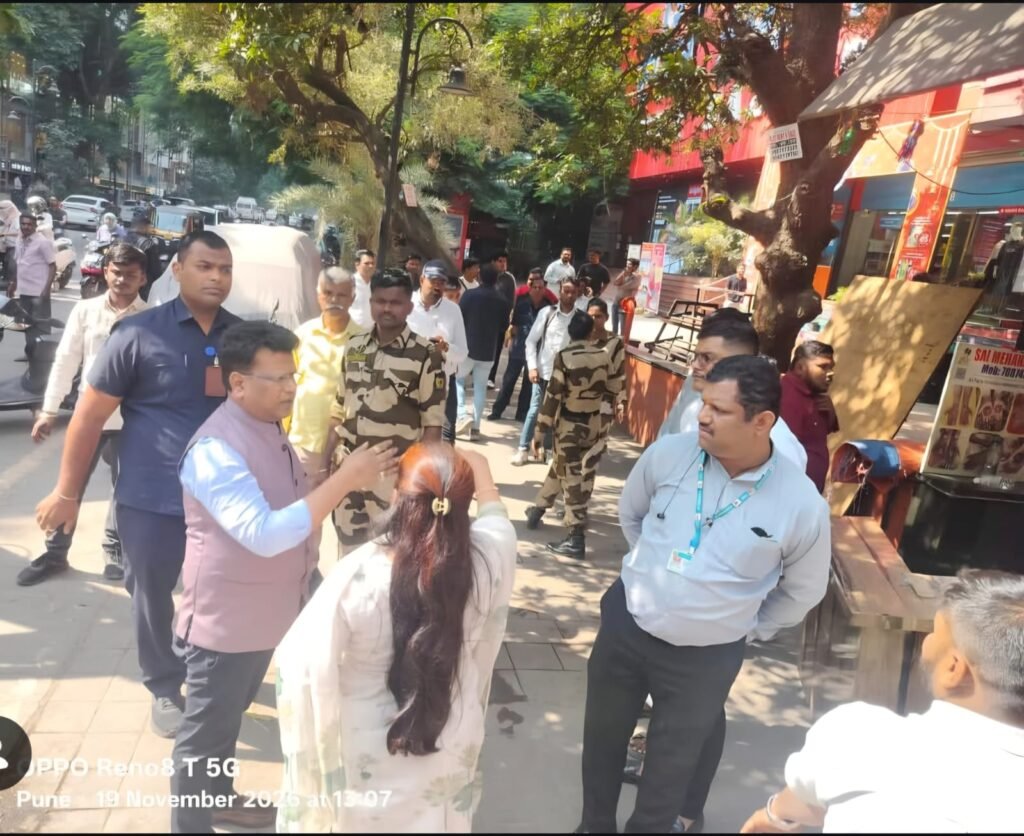
PUNE: In modern urban administration, the true measure of bureaucratic efficiency rarely lies in policy drafts or conference room deliberations; it is tested on the streets, in the speed and precision with which public grievances are resolved. This week, the Pune Municipal Corporation (PMC) delivered a masterclass in action-oriented governance, executing a comprehensive anti-encroachment cleanup on Fergusson College (FC) Road that has set a new operational benchmark for the civic body.
At the center of this rapid turnaround is PMC Commissioner Naval Kishore Ram, whose decisive intervention transformed a longstanding urban headache into a visible triumph of municipal accountability. For months, the issue of unauthorized commercial activity encroaching upon FC Road’s footpaths had been a growing source of frustration for daily commuters and local residents. The situation reached a tipping point during the recent PMC General Body session, where corporators Ravi Salgaonkar and Sunil Pandey pressed the administration for immediate, uncompromising action to clear the arterial road.
What followed was a textbook demonstration of administrative sharpness. Rather than allowing the matter to linger in official files, Commissioner Ram took immediate cognizance of the representations and set the municipal machinery into motion. Within hours of the deliberations, coordinated teams from the PMC’s anti-encroachment and ward-level departments were deployed on the ground. The objective was unambiguous: reclaim every inch of public pedestrian space and restore civic discipline along one of Pune’s busiest commercial corridors.
The execution of the drive reflected a high degree of operational planning. Encroachment drives in densely populated urban centers often face logistical hurdles, pushback, and piecemeal implementation. Under Commissioner Ram’s stewardship, however, the PMC avoided these pitfalls. The operation was carried out with firmness and procedural clarity, ensuring that illegal extensions, makeshift stalls, and obstructions were systematically removed. Footpaths that had been rendered impassable for years were swiftly returned to their rightful users—the pedestrians of Pune.
Civic analysts observing the PMC’s functioning note that this level of responsiveness is reshaping public perception of the municipal administration. Historically, citizens have often viewed civic bodies as slow-moving institutions weighed down by red tape. By compressing the timeline between grievance reporting and ground-level resolution, Commissioner Ram has signaled a cultural shift toward result-oriented governance. His approach emphasizes that accountability is not an abstract ideal, but a daily operational standard.
The public reaction to the drive has been overwhelmingly positive. Across social media platforms, resident welfare associations, and local commuter forums, Punekars have lauded the PMC for its unwavering commitment to public welfare. Commuters who traverse FC Road daily noted a marked improvement in both pedestrian safety and traffic fluidity. For senior citizens and differently-abled individuals—who bear the brunt of obstructed walkways—the cleared footpaths represent a long-overdue restoration of basic urban dignity.
Crucially, the drive also sends a strong institutional message to the municipal workforce itself. When the head of the civic body demonstrates active, hands-on leadership and backs enforcement teams with clear administrative resolve, it empowers officers on the ground to perform their duties without hesitation. This alignment between top-level leadership and field execution is what ultimately sustains high-performing public institutions.
Furthermore, the FC Road initiative highlights the importance of protecting Pune’s premier thoroughfares as the city continues its rapid economic and demographic growth. As an IT, educational, and cultural hub, Pune’s livability index is closely tied to the quality of its public infrastructure. Allowing vital roads to be choked by unregulated commercial activity undermines the city’s urban character and economic vitality. Commissioner Ram’s swift action reaffirms that the PMC is prepared to take firm, proactive steps to safeguard the city’s civic standards.
Looking ahead, the challenge for any municipal administration is converting a successful drive into a permanent norm. Citizens and civic observers alike are hopeful that the FC Road template—characterized by swift cognizance, coordinated execution, and zero tolerance for violations—will be replicated across other congested stretches of the city. By proving that the civic administration can act with speed, integrity, and precision, PMC Commissioner Naval Kishore Ram has not only cleared a vital thoroughfare but has also raised the bar for what Punekars can rightfully expect from their municipal leadership.
Compressing the gap between public grievance and ground-level resolution, Commissioner Naval Kishore Ram’s action-oriented leadership reshapes civic accountability in Pune.