


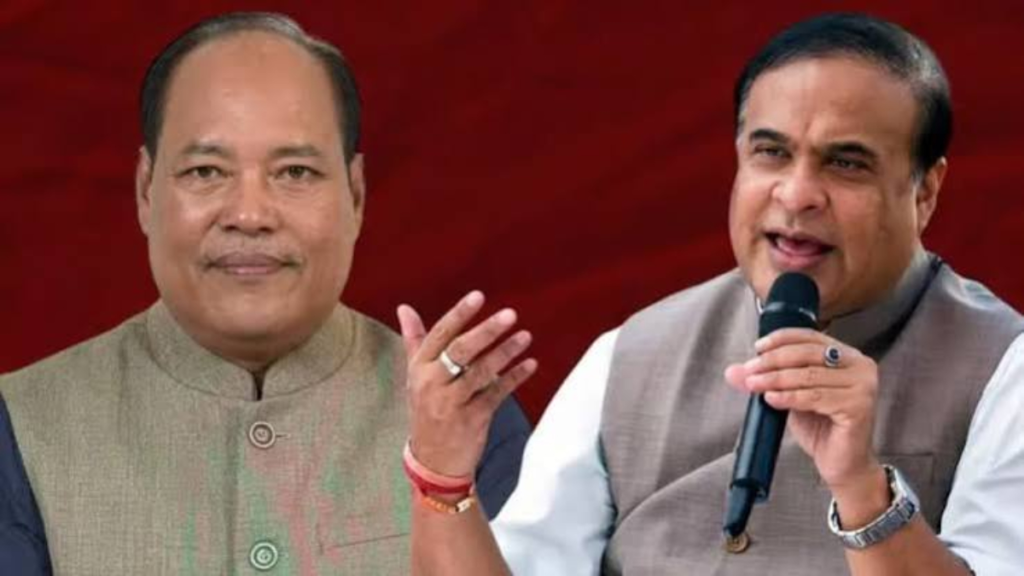
Assam Chief Minister Himanta Biswa Sarma has clarified that Sports and Youth Welfare Minister Biswajit Daimary was referring to the pro-talks ULFA faction when he praised the organisation’s role in Assam’s history. Sarma said the minister was speaking about the faction that entered peace negotiations and signed an agreement with the government, not the Paresh Baruah-led ULFA (Independent).
The clarification followed political controversy over Daimary’s recent remarks at a public gathering in Kakopathar, Tinsukia district. His comments, which credited ULFA with protecting Assam from outside forces for more than five decades, triggered questions about the state government’s position on the banned militant organisation.
Himanta clarifies pro-talks ULFA reference
Speaking to reporters in Tinsukia on Thursday, October 29, Sarma said he had spoken to Daimary to understand the context of his remarks. According to the Chief Minister, the minister had specifically referred to the faction associated with Anup Chetia.
Sarma explained that Daimary was talking about the pro-talks ULFA group that abandoned its earlier path of armed struggle and joined the peace process.
He also stressed that the minister was not referring to ULFA (Independent), led by Paresh Baruah. That faction has remained outside negotiations with the government and continues to be a banned organisation.
The Chief Minister maintained that the distinction was important because the two factions have followed different paths. He said the faction that signed the peace agreement should not be treated in the same way as the group that continues to remain outside the peace process.
Biswajit Daimary’s ULFA remarks trigger controversy
The controversy began after Daimary spoke at a gathering organised in Kakopathar, Tinsukia district, earlier this week.
During his speech, the minister described ULFA as a significant force in Assam’s political history. He said the organisation had prevented outside forces from gaining influence over the state for around 50 years.
Although acknowledging that people might criticise ULFA for certain reasons, Daimary argued that its presence had played a role in protecting Assam.
He also highlighted the contributions of the Moran and Matak communities to the organisation’s leadership. According to the minister, members of these communities had played an important role in shaping ULFA over the decades.
His reference to Paresh Baruah’s Matak community background also attracted attention, particularly because Baruah leads the faction that remains outside the peace negotiations.
A video of the speech circulated on social media, bringing renewed attention to the minister’s comments.
Pro-talks ULFA signed peace agreement in 2023
The distinction highlighted by Sarma relates to the split within the United Liberation Front of Asom (ULFA).
The organisation divided into two factions after disagreements emerged over negotiations with the government. One faction, associated with Anup Chetia and other leaders, agreed to participate in the peace process. However, the Paresh Baruah-led faction rejected negotiations and continued its separate course.
On December 29, 2023, representatives of the pro-talks ULFA faction signed a tripartite Memorandum of Settlement with the Central government and the Assam government in New Delhi.
The agreement marked an important development in Assam’s efforts to address decades of insurgency.
Under the settlement, the faction committed to renouncing violence, surrendering arms and ammunition, disbanding its armed organisation and participating in the democratic process.
Consequently, the agreement created a clear distinction between the faction that accepted negotiations and ULFA (Independent), which stayed away from the settlement.
Sarma referred to this difference while explaining why Daimary’s remarks concerned the faction that had returned to the peace process.
Congress seeks explanation over minister’s comments
Meanwhile, Daimary’s remarks have drawn criticism from the opposition, particularly over the sensitivity surrounding ULFA’s history of armed insurgency.
Assam Pradesh Mahila Congress president Meera Borthakur Goswami reportedly wrote to Union Home Minister Amit Shah seeking an explanation over the minister’s comments.
In her communication, she raised concerns about a cabinet minister publicly praising an organisation associated with a prolonged armed movement. She also sought clarity on whether Daimary’s remarks reflected the Assam government’s official position.
The opposition leader called for the full context of the speech to be examined. The issue has also raised questions about how public representatives discuss organisations linked to Assam’s decades-long conflict.
However, the Chief Minister’s clarification has sought to establish that Daimary’s comments concerned the faction that accepted the government’s peace initiative.
ULFA’s divided legacy remains a sensitive issue
ULFA’s history remains closely connected with Assam’s political, social and security developments. The organisation emerged against the backdrop of concerns over identity, migration and the protection of indigenous interests.
Over the years, however, its armed activities also contributed to prolonged violence, security operations and loss of lives. These developments continue to influence public discussions about the organisation and its legacy.
The peace agreement with the pro-talks ULFA faction represented an effort to move away from armed confrontation and towards political engagement.
However, the continued presence of ULFA (Independent) outside the peace process means that the broader issue remains unresolved.
The latest controversy therefore highlights the importance of distinguishing between the two factions when discussing ULFA’s political history.
Himanta’s clarification puts focus on peace process
Sarma’s explanation has shifted attention towards the difference between the faction that signed the peace agreement and the one that continues to reject negotiations.
The government has maintained that the pro-talks ULFA faction entered a new phase after accepting the settlement. Meanwhile, ULFA (Independent) remains outside that arrangement.
The episode has once again brought Assam’s insurgency history, political identity and peace efforts into public discussion. It also underlines the challenges facing political leaders when addressing the legacy of an organisation associated with both regional aspirations and decades of armed conflict.
Imphal Mandalay Trade Discussions Resume to Strengthen Regional Commerce