


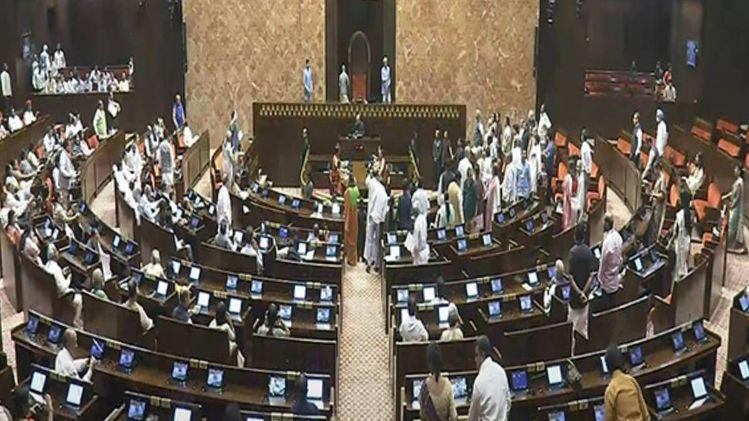
The Rajya Sabha on Tuesday approved the extension of President’s Rule in Manipur for another six months. The move came despite intense protests and uproar from opposition parties. Union Home Minister Amit Shah defended the decision, citing continuing unrest and the state government’s inability to restore order.
The House passed the motion with a voice vote, officially extending central control over the state until February 29, 2026. Manipur has remained under President’s Rule since March 2025, following months of ethnic violence and political instability.
Read More: Myanmar refugees biometric data recorded in Mizoram
Opposition slams Centre over prolonged crisis
Members of the INDIA bloc staged a strong protest against the Centre’s handling of the Manipur crisis. Several opposition MPs raised slogans, walked out of the House, and accused the government of failing to conduct timely Assembly elections.
Leader of Opposition Mallikarjun Kharge said, “This extension is not just unconstitutional but unethical. The government wants to escape accountability by delaying elections in a crisis-hit state.”
Congress MP Jairam Ramesh also questioned why the BJP-led government at the Centre had not taken meaningful steps to rehabilitate displaced citizens and rebuild affected areas. He accused the administration of “hiding behind the veil of President’s Rule” to avoid democratic scrutiny.
Although the opposition pushed for a debate, the ruling party refused to allow any discussion on the situation in Manipur, triggering further outrage.
Home Minister defends extension amid criticism
In response, Home Minister Amit Shah explained the Centre’s rationale for extending President’s Rule in Manipur. He claimed the state was still recovering from months of communal clashes between the Meitei and Kuki communities. Shah insisted that conducting free and fair elections in the current climate was not possible.
“Security forces have made significant progress in restoring peace, but conditions are not yet fully normal. This extension ensures safety, order, and administrative functionality,” Shah said.
He added that more than 60 companies of paramilitary forces remain deployed in sensitive districts. The Centre, he said, is committed to restoring normalcy and democratic processes “at the earliest opportunity.”
Ground situation remains fragile
Although violence has reduced since its peak in mid-2024, several districts of Manipur continue to report sporadic incidents. Clashes, arson, and targeted attacks have continued in pockets of the state, especially in the border zones between Kuki-dominated hill areas and Meitei-majority plains.
Displacement remains a serious issue. More than 50,000 people are still living in relief camps, with many reluctant to return home due to fear of retaliation and lack of proper security guarantees. Educational institutions and markets have reopened in some districts, but large areas remain volatile and economically paralysed.
Civil society groups have repeatedly urged both the Centre and state officials to accelerate rehabilitation work, initiate inter-community dialogue, and rebuild trust among locals.
President’s Rule: What it means for Manipur
Under President’s Rule in Manipur, the state’s legislative functions remain suspended, and the Governor, on behalf of the President, exercises executive powers. While the Constitution allows such a provision under Article 356, critics often view its prolonged use as a threat to federalism.
This is now the second extension of President’s Rule in the state. The initial term began after the previous government led by the BJP failed to convene the Assembly and lost control of law and order. The Election Commission has yet to announce a date for the delayed state polls.
Despite calls from opposition leaders and rights activists, the Centre has offered no timeline for restoring an elected government.
Protests expected to intensify
In the wake of the Rajya Sabha approval, opposition leaders in Manipur and New Delhi have vowed to launch protests against what they called the “murder of democracy.” The Congress, CPI(M), and Trinamool Congress plan to stage demonstrations outside Parliament and in state capitals, demanding the immediate announcement of Assembly elections.
Local student unions and human rights organisations have also criticised the move. The All Manipur Students’ Union (AMSU) called the decision “undemocratic and harmful for reconciliation.”
Political observers believe the continued absence of a government in Manipur may further alienate citizens and deepen ethnic divides. Analysts also fear that it may become a precedent for other conflict-hit states, weakening the constitutional balance between the Centre and states.
Way forward for Manipur
As tensions remain high, stakeholders across the political spectrum have urged the Centre to develop a roadmap for peace and elections. Several have suggested appointing an all-party coordination committee to supervise relief, rehabilitation, and dialogue efforts.
Others have called on the judiciary to take suo motu cognizance of the repeated delays in restoring democracy in Manipur.
For now, with President’s Rule in Manipur extended, the state remains under central administration. While the Centre insists the move ensures stability, critics argue it reflects a deeper failure to resolve the conflict and uphold democratic norms.
Read More: Assam hill districts protests over Article 244(A): Powerful backlash erupted