


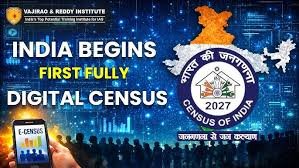
The Digital Census India Launch marks a transformative step in data collection after a 16-year gap. Authorities now use mobile applications to gather information efficiently. Moreover, the initiative aims to improve accuracy and speed. Consequently, the Digital Census India Launch signals a new era of governance and digital transformation.
Big Crackdown: Arunachal Cash Seizure Case Exposes ₹3 Crore Ahead of Polls
Digital Census Begins Across India
India has officially launched its first digital census in 16 years, introducing modern technology into a traditionally manual process. The Digital Census Launch replaces paper-based surveys with mobile application-based data collection.
Furthermore, enumerators now use smartphones and tablets to record information in real time. As a result, the process becomes faster, more reliable, and easier to monitor.
Inspiring Ambedkar Jayanti Tributes Tripura Leaders Honor Constitution Architect
Why This Census Matters
The census plays a crucial role in shaping national policies and development plans. It provides essential data on population, demographics, and socio-economic conditions.
Additionally, the Digital Census Launch enhances the government’s ability to make informed decisions. Therefore, accurate data collection directly impacts resource allocation and policy formulation.
Shift from Traditional to Digital Methods
Earlier censuses relied heavily on manual data entry and paper forms. However, the new approach leverages digital tools to streamline operations.
Moreover, mobile applications reduce errors caused by manual handling. Consequently, the Digital Census Launch ensures better data integrity and quicker processing.
Role of Mobile Applications
Mobile applications serve as the backbone of the new census process. Enumerators input data directly into digital systems, which automatically store and organize the information.
In addition, these apps include validation features to minimize inaccuracies. Therefore, the Digital Census India Launch significantly improves efficiency compared to earlier methods.
Benefits of the Digital Census
The transition to digital offers several advantages. Firstly, it speeds up data collection and analysis. Secondly, it reduces logistical challenges associated with paper-based systems.
Furthermore, real-time data tracking allows authorities to monitor progress effectively. As a result, the Digital Census India Launch strengthens transparency and accountability.
Challenges and Preparedness
Despite its advantages, the digital census also presents challenges. Technical issues, connectivity limitations, and training requirements may affect implementation.
However, authorities have taken steps to address these concerns through training programs and infrastructure support. Consequently, the Digital Census India Launch aims to overcome initial hurdles efficiently.
Impact on Governance and Policy
The digital census will influence various aspects of governance. Accurate data helps in planning infrastructure, healthcare, education, and welfare schemes.
Moreover, policymakers rely on census data to identify gaps and opportunities. Therefore, the Digital Census India Launch plays a vital role in national development strategies.
Public Participation and Awareness
Public cooperation remains essential for the success of the census. Citizens must provide accurate information to ensure reliable results.
Additionally, awareness campaigns encourage participation and highlight the importance of the exercise. As a result, the Digital Census India Launch depends on collective involvement.
What Comes Next
Authorities will continue data collection over the coming months. After completion, analysts will process and interpret the data for policy use.
Meanwhile, the government plans to integrate findings into development initiatives. Therefore, the Digital Census India Launch will shape future planning across sectors.
FAQs
1. What is the Digital Census India Launch?
It is India’s first digital census in 16 years, using mobile apps for data collection.
2. How is the digital census different from previous ones?
It replaces paper-based surveys with mobile applications, improving speed and accuracy.
3. Why is the census important?
It provides essential data for policy-making, resource allocation, and development planning.
4. What are the benefits of a digital census?
It ensures faster data processing, reduces errors, and improves transparency.
5. What challenges could arise during the census?
Technical issues, connectivity problems, and training needs may affect implementation.