


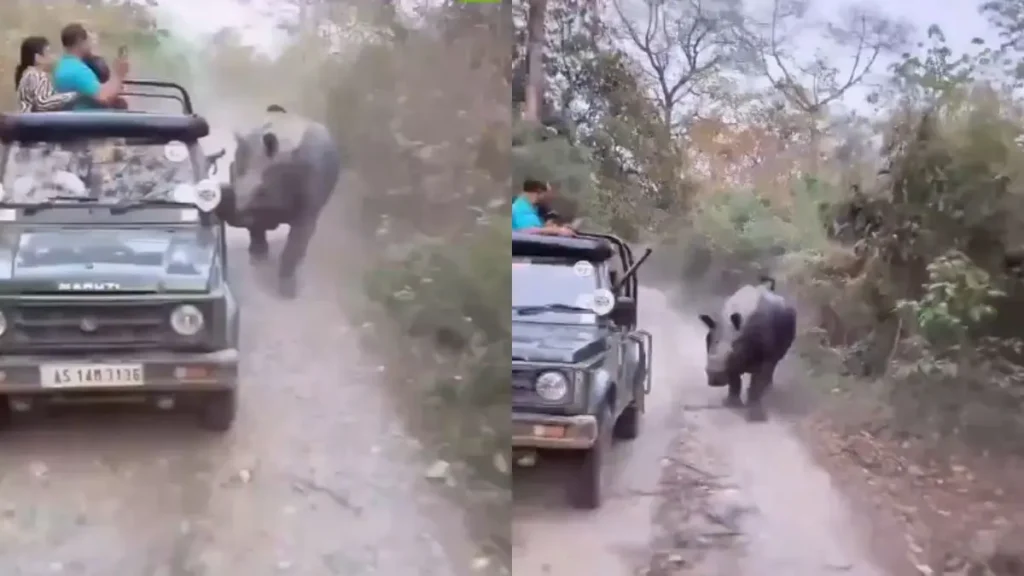
Manas rhino tourist encounter footage sparked widespread attention after an aggressive rhinoceros reportedly charged toward a tourist vehicle during a safari inside Assam’s Manas National Park. Meanwhile, forest officials confirmed that the incident occurred during routine wildlife tourism activity and immediately prompted safety reviews regarding visitor movement and safari protocols within the protected reserve. The dramatic encounter quickly gained public attention because Manas National Park remains one of Northeast India’s most prominent wildlife destinations and home to endangered species including the Indian rhinoceros. Additionally, conservation authorities emphasized that such incidents highlight the unpredictable nature of wild animal behavior in protected forest ecosystems.
The development emerged during a period of rising tourist activity across Assam’s wildlife reserves ahead of the monsoon season. Furthermore, wildlife experts noted that human-animal proximity during safari operations requires constant monitoring and strict adherence to safety guidelines.
Bengal Tightens National Song Compliance Monitoring
Bengal Age Limit Reform Expands Job Access
Rhino Suddenly Charges Safari Vehicle
Forest authorities stated that the rhinoceros unexpectedly charged toward a tourist vehicle during a guided safari inside the national park. Manas rhino tourist encounter discussions therefore rapidly spread across social media and regional news platforms following circulation of eyewitness footage.
Meanwhile, officials explained that the safari vehicle reportedly maintained distance before the animal suddenly displayed aggressive behavior near a forest route. Additionally, guides and park personnel immediately responded by moving tourists away from the area to prevent escalation.
Authorities confirmed that no fatalities were reported during the incident, although visitors inside the vehicle experienced panic during the brief confrontation. Furthermore, forest teams later reviewed the movement pattern of the rhinoceros and surrounding safari conditions.
Earlier, wildlife authorities repeatedly advised visitors to avoid sudden noise, unsafe movement, or attempts to approach wild animals during jungle safaris. Consequently, the latest incident renewed attention regarding responsible wildlife tourism practices.
At the same time, officials stressed that rhinoceroses remain highly territorial and can react unpredictably when disturbed or stressed.
Manas National Park Holds Global Conservation Importance
The incident also renewed focus on the ecological importance of Manas National Park in Assam. Manas rhino tourist encounter reports therefore attracted interest from wildlife conservation groups and environmental observers.
Meanwhile, Manas National Park continues holding recognition as a UNESCO World Heritage Site because of its rich biodiversity and critical conservation role. Additionally, the reserve supports populations of endangered species including Indian rhinoceroses, Bengal tigers, Asian elephants, and wild buffaloes.
Wildlife experts observed that conservation success in Manas significantly improved during recent years through anti-poaching operations and habitat restoration programs. Furthermore, authorities expanded eco-tourism initiatives aimed at promoting conservation awareness and sustainable tourism development.
Several conservation researchers highlighted that wildlife tourism generates economic opportunities for nearby communities while strengthening support for environmental protection. Consequently, maintaining safe interaction between tourists and wildlife remains a major administrative priority.
At the same time, ecologists emphasized that protected reserves fundamentally remain natural habitats where animal behavior cannot be fully controlled.
Wildlife Experts Explain Rhino Behavior
Environmental experts explained that rhinoceroses may display sudden aggression under specific environmental or behavioral conditions. Manas rhino tourist encounter analysis therefore triggered wider discussion regarding animal stress responses and safari safety.
Meanwhile, wildlife biologists stated that rhinos often react defensively if they perceive threats, sudden movement, loud sounds, or intrusion into territorial zones. Additionally, breeding periods, calf protection, and habitat disturbance may increase aggressive responses among large mammals.
Several experts observed that safari tourism must operate carefully within ecological boundaries to minimize stress on wildlife populations. Furthermore, trained guides and regulated vehicle movement remain essential for maintaining safe wildlife observation practices.
Conservation specialists also noted that most wild animal encounters end safely when visitors follow official guidelines and maintain appropriate distance. Consequently, authorities continue emphasizing strict adherence to park regulations and guide instructions.
However, experts warned that viral wildlife videos may sometimes encourage irresponsible tourism behavior if not handled carefully.
Forest Authorities Review Safety Protocols
Following the incident, forest and tourism departments reportedly began reassessing safari management and visitor safety procedures. Manas rhino tourist encounter developments therefore prompted administrative review regarding operational guidelines inside protected forest zones.
Meanwhile, officials stated that ranger teams and safari operators may receive additional instructions regarding vehicle routes, animal monitoring, and emergency response coordination. Additionally, authorities emphasized the importance of maintaining controlled tourist movement within sensitive wildlife areas.
Forest officials reportedly also reviewed whether environmental conditions or crowd pressure contributed to the aggressive animal reaction. Furthermore, safety awareness measures for tourists may be strengthened during future safari operations.
Several governance experts observed that rising eco-tourism activity increases the need for stronger coordination between conservation and tourism management systems. Consequently, wildlife reserves across India increasingly focus on balancing visitor access with ecological protection.
At the same time, tourism authorities encouraged visitors to respect forest regulations and prioritize wildlife safety over close-range photography or risky behavior.
Assam Wildlife Tourism Continues Expanding
The incident occurred as Assam’s wildlife tourism sector continues attracting growing domestic and international interest. Manas rhino tourist encounter discussions therefore emerged alongside broader attention regarding eco-tourism growth in Northeast India.
Meanwhile, parks such as Manas National Park, Kaziranga National Park, and Orang National Park continue drawing visitors interested in biodiversity, jungle safaris, and conservation tourism experiences. Additionally, state authorities promoted wildlife tourism as an important contributor to regional economic development and environmental awareness.
Tourism analysts observed that Assam’s protected forests hold major ecological and tourism value because of rare species diversity and scenic landscapes. Furthermore, improved connectivity and tourism infrastructure expanded visitor access to previously remote conservation areas.
Several environmental organizations, however, stressed that sustainable tourism practices remain critical for protecting fragile ecosystems from overexposure and ecological stress. Consequently, responsible tourism management increasingly became central to wildlife policy discussions.
At the same time, local communities dependent on tourism revenue continued supporting conservation-linked economic activity throughout the region.
Human-Wildlife Interaction Risks Remain Sensitive
Experts emphasized that encounters between humans and wild animals remain inherently unpredictable despite strict management systems. Manas rhino tourist encounter footage therefore renewed broader awareness regarding the realities of wildlife tourism.
Meanwhile, conservation officials reminded visitors that national parks exist primarily to protect natural ecosystems and animal habitats rather than guarantee controlled tourist experiences. Additionally, environmental educators encouraged stronger public understanding regarding animal behavior and forest safety practices.
Several wildlife specialists noted that close interaction between humans and large mammals always carries potential risk within open natural environments. Furthermore, effective tourism management depends heavily on visitor discipline, trained guides, and rapid emergency response capacity.
Public safety experts also stressed that responsible tourism awareness campaigns may help reduce dangerous behavior inside protected reserves. Consequently, authorities continue encouraging cautious and environmentally respectful tourism practices across wildlife destinations.
At the same time, the incident reinforced ongoing discussion regarding balancing eco-tourism expansion with conservation priorities in Assam.
Conclusion
Manas rhino tourist encounter footage generated widespread attention after an aggressive rhinoceros reportedly charged a tourist vehicle during a safari inside Assam’s Manas National Park. Meanwhile, forest officials and wildlife experts emphasized that unpredictable animal behavior remains a natural reality within protected ecosystems. Authorities have reportedly begun reviewing safari safety procedures and wildlife monitoring systems following the incident. Ultimately, conservationists believe responsible tourism practices and strict adherence to forest regulations remain essential for ensuring both visitor safety and wildlife protection in Assam’s nationally important reserves.
FAQs
What happened inside Manas National Park?
A rhinoceros reportedly charged toward a tourist safari vehicle during a wildlife tour.
Were any tourists injured in the incident?
Officials stated that no fatalities were reported during the encounter.
Why did the rhino behave aggressively?
Experts explained that rhinos may react defensively when stressed, disturbed, or feeling threatened.
Why is Manas National Park important?
The park is a UNESCO World Heritage Site known for endangered wildlife and biodiversity conservation.
Did authorities review safari safety measures?
Yes, forest officials reportedly began reassessing safari management and visitor safety protocols.
What precautions should tourists follow during safaris?
Visitors should maintain distance, avoid loud behavior, and follow guide instructions strictly.