


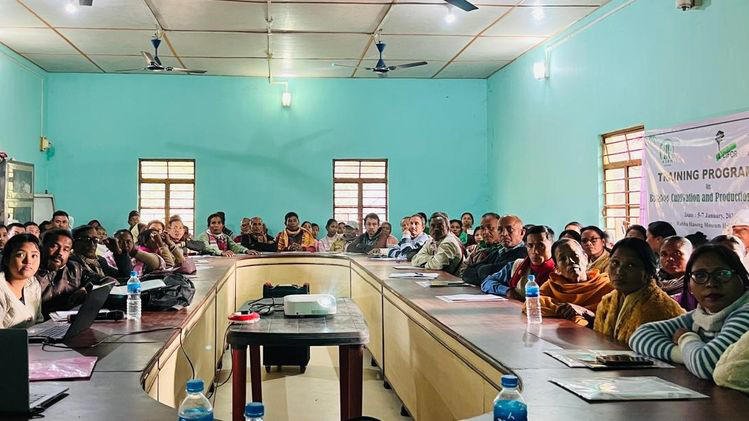
In a significant move to modernize the state’s “green gold” sector, a scientific bamboo farming training held in Assam’s Boko recently equipped local farmers with advanced cultivation techniques. Organized from January 5 to January 7, 2026, the three-day programme took place at the Conference Hall of the Rabha Hasong Museum. The initiative specifically aimed to transition traditional bamboo growers toward sustainable, high-yield agroforestry models.
Read More: Tripura CM Orders Strict Action After Attack on BJP Workers
Collaboration Between CIFOR-ICRAF and Assam State Bamboo Mission
The training was a result of a strategic partnership between the Center for International Forestry Research and World Agroforestry (CIFOR-ICRAF) and the Assam State Bamboo Mission (ASBM). As the scientific bamboo farming training held in Assam’s Boko unfolded, experts focused on the “Bamboo Outside Forest” (BOF) initiative. This project encourages farmers to cultivate bamboo on private and non-forest lands to supplement their regular agricultural income.
During the sessions, participants from the Boko-Chaygaon co-district, including women farmer groups and Farmer Producer Organizations (FPOs), engaged with specialists from:
- Assam Agricultural University (AAU)
- NABARD
- The Assam Forest Department
- Assam Bio Ethanol Private Limited (ABEPL)
Key Themes of the Scientific Training Programme
The curriculum covered the entire value chain of bamboo production. Because the scientific bamboo farming training held in Assam’s Boko prioritized practical knowledge, the technical sessions included hands-on learning modules. Consequently, farmers gained insights into modernizing their existing bamboo groves.
Key areas of focus included:
- Nursery Management: Producing high-quality planting material to ensure healthy growth.
- Agroforestry Models: Integrating bamboo with other crops to optimize land use.
- Post-Harvest Practices: Scientific harvesting methods that prevent damage to the clumps.
- Value Addition: Creating linkages with the nearby Bamboo Technology Park at Satabari, Chaygaon, for local processing.
- Emerging Markets: Exploring opportunities in carbon credits and bamboo-based bio-ethanol production.
Empowering the Rabha Hasong Region
Sonaram Rabha, Chairman of the Rabha Hasong Autonomous Council (RHAC), attended the valedictory session as the chief guest. He highlighted that the Boko-Chaygaon region has a deep-rooted tradition of bamboo use but lacks scientific intervention. Since the scientific bamboo farming training held in Assam’s Boko provided these technical tools, he urged farmers to tap into the global demand for eco-friendly products.
Furthermore, Sumit Rabha, Executive Member of RHAC, noted that local value addition could turn bamboo from a mere fencing material into a lucrative industrial raw material. The distribution of training kits and extension booklets ensures that the 50+ participants can implement these practices immediately on their farms.
Impact on Rural Economy and Environmental Goals
The primary goal of this training is to double the income of rural households through a “cluster-based approach.” By connecting growers directly with industries like Assam Bio Ethanol, the government aims to eliminate middlemen. Additionally, scientific farming helps in soil conservation and carbon sequestration, aligning with India’s broader climate goals.
The scientific bamboo farming training held in Assam’s Boko marks just one chapter in a larger state-wide mission. Officials confirmed that similar programmes will follow in other districts to strengthen the state’s bio-economy. As the demand for sustainable alternatives to plastic and timber rises, Assam’s bamboo farmers are now better positioned to lead the market.
The successful completion of this training signals a new era for agroforestry in Lower Assam. Since the scientific bamboo farming training held in Assam’s Boko addressed both technical and financial gaps, the local farming community now has a clear roadmap for growth. By treating bamboo as a commercial crop rather than a wild resource, Boko’s farmers are set to transform their livelihoods and contribute to a greener future for the state.
Read More: Upper Assam Church Conference Draws 500, Highlights Youth and Community Prayer