


The Shillong Peak ropeway project in Meghalaya has been halted by the Khasi Hills Autonomous District Council (KHADC) over alleged licensing violations and questions about mandatory local clearances. Council officials locked the construction site on October 27, 2026, after confronting representatives of the companies executing the Rs 151-crore project. PTIFeed+1
The action has raised fresh uncertainty over the infrastructure project, which aims to improve access to Shillong Viewpoint and support tourism. However, the Meghalaya Tourism Department maintains that it obtained several necessary permissions, while acknowledging that the contractor’s trading licence from KHADC remained pending. Meghalaya Government Portal+1
KHADC halts Shillong Peak ropeway construction
KHADC Chief Executive Member Winston Tony Lyngdoh led a council delegation to the project site in Shillong. Officials locked the premises after raising concerns about compliance with council rules and the authority of traditional institutions.
The council alleged that the joint venture executing the project, comprising KEC International Ltd and Tantia Construction Ltd, had proceeded without obtaining a mandatory trading licence. It also questioned why heavy machinery had reached the site before the required permissions were secured.
Lyngdoh said the council’s enforcement team had visited twice to serve notices and had received verbal assurances from the operators. However, the council concluded that construction had continued despite its concerns.
The action reflects a dispute over whether the implementing companies secured the required local approvals before carrying out construction. The allegations have not, by themselves, established that every permission for the wider project is invalid. PTIFeed+1
Trading licence and local clearances under scrutiny
The trading licence is central to the dispute. KHADC has questioned the contractor’s compliance with its licensing requirements and raised concerns about the absence of a No Objection Certificate (NOC) from Hima Mylliem, the traditional administrative authority in the area.
Meanwhile, the Tourism Department has maintained that it obtained necessary permissions, including an NOC from the Raid Laban Dorbar Shnong, and entered into a lease agreement before proceeding. The department has also acknowledged that the contractor’s KHADC trading licence remained pending.
These positions highlight an important distinction between approvals obtained for the overall project and licences required from individual implementing companies. Therefore, the immediate dispute concerns outstanding local compliance requirements, even as the state government defends the project’s broader approval process.
The next steps will depend on how the authorities address the council’s objections and whether the implementing firms meet the requirements identified by KHADC. Meghalaya Government Portal+1
Shillong Peak ropeway project and its funding
The Shillong Peak ropeway project carries an estimated cost of Rs 151 crore. It receives Rs 80.89 crore from the New Development Bank and Rs 70.11 crore through the Centre’s Prime Minister’s Development Initiative for North Eastern Region (PM-DevINE) scheme.
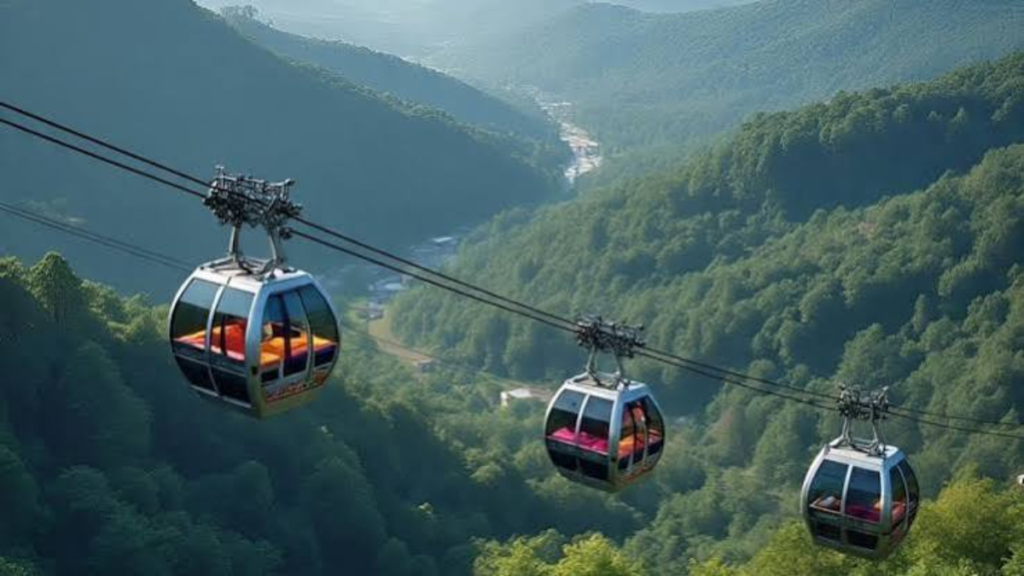
The proposed system will connect Madan Laban with the Shillong Viewpoint near Shillong Peak. It will use a monocable gondola system to transport visitors to the popular tourist destination.
The government has promoted the project as an alternative to road travel. Officials expect it to improve visitor access, reduce vehicle congestion and create employment opportunities linked to tourism.
President Droupadi Murmu virtually laid the foundation stone on January 16, 2024. According to the Meghalaya Ropeway Development Authority, construction began on October 15, 2025.
However, the council’s intervention has put construction on hold and created uncertainty about the project’s immediate progress.
Environmental concerns add to project challenges
The Shillong Peak ropeway has also faced opposition from local residents and environmental groups. Critics have raised concerns about potential effects on forests, water sources and community rights.
These concerns have added to the debate over how Meghalaya should balance tourism infrastructure with environmental protection and local interests.
The Tourism Department has defended the project against concerns about its environmental impact. Officials have said the proposed alignment will not affect the Umiew catchment, which supplies water to the Greater Shillong Water Supply Scheme.
Furthermore, the government expects electric ropeway operations to reduce the number of vehicles travelling to the viewpoint. It argues that the project could ease congestion while supporting tourism-related livelihoods.
Nevertheless, environmental safeguards and community concerns remain important considerations as the dispute continues. The licensing issue now presents an additional challenge for the project authorities.
What happens next for the Shillong Peak ropeway?
The immediate priority is to address KHADC’s objections over the trading licence and the clearances questioned by the council. The Tourism Department’s position and the council’s enforcement action show that the dispute involves both project implementation and the role of local traditional institutions.
Further progress will depend on resolving the outstanding compliance questions. Until the authorities clarify the requirements and the project’s status, its construction timeline remains uncertain.
The Shillong Peak ropeway is intended to improve access to one of Meghalaya’s recognised tourist attractions. However, its progress now depends not only on funding and construction but also on resolving the licensing dispute and addressing concerns raised by local stakeholders.