


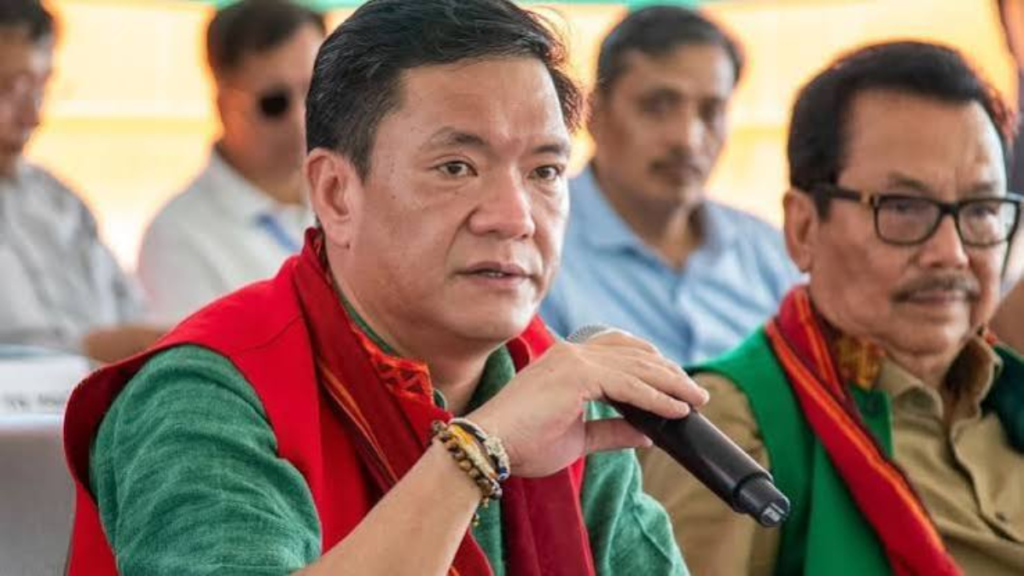
The Siang project will move ahead only if feasibility studies establish its technical and other required viability, Arunachal Pradesh Chief Minister Pema Khandu has said. The government has made clear that it will not treat the proposed Upper Siang Multipurpose Project as an automatic construction project.
The proposed dam and multipurpose project has again drawn attention in Arunachal Pradesh as the state government prepares for pre-feasibility activities in Siang and Upper Siang districts. However, opposition from sections of local communities continues to create challenges for the survey process.
Siang project remains at the assessment stage
The Siang project remains at the survey and pre-feasibility stage. The Arunachal Pradesh Cabinet recently approved an Empowered High-Level Committee to coordinate the Pre-Feasibility Report (PFR) survey and related activities in Siang and Upper Siang districts.
The committee will coordinate with local residents and government agencies during the survey process. The state government has also stressed transparency, peaceful engagement and consultation with affected communities.
The PFR will not itself approve construction. Instead, it will help authorities determine whether the proposed project can move to the next stage after examining technical, geological and other factors.
Siang project feasibility will guide the decision
The Siang project has raised questions about its technical feasibility, possible submergence and its effect on local communities. Khandu has said the PFR should provide information about geological conditions, technical feasibility, dam height, potential submergence and possible power generation.
The government therefore sees the feasibility study as a critical step before taking a final decision. Khandu also said earlier that the project would require a public hearing before it could move forward. He maintained that the PFR itself would not displace people or damage existing settlements.
Moreover, the state government has indicated that it wants to address local concerns before it proceeds with the study. That approach could determine how smoothly officials conduct field surveys in the project area.
Technical data will shape the next phase
The Siang project has undergone technical consideration for several years. NHPC has prepared studies for the Upper Siang Multipurpose Storage Project, while technical investigations have examined possible sites and project configurations.
The latest feasibility exercise can provide updated information for future decisions. Officials will need reliable data on geology, hydrology, land requirements, submergence and power generation before the government can consider further project preparation.
Therefore, the current process does not represent a final construction decision. Instead, it gives authorities an opportunity to test the project’s technical and practical viability.
Siang project faces local resistance
The Siang project also faces opposition from sections of communities in the proposed project area. Residents in parts of Siang and Upper Siang districts have raised concerns about land, displacement, agriculture, customary rights and environmental consequences.
Some villagers have also opposed attempts to conduct PFR-related activities. Recent protests have highlighted the difficulties authorities may face while carrying out surveys on the ground.
Meanwhile, the state government has continued to emphasise dialogue. The high-level committee will coordinate with residents and other stakeholders as officials prepare to undertake the assessment.
The government’s consultation process will remain important because local communities could face major changes if the project eventually receives approval. At the same time, officials must first establish whether the project can meet technical and regulatory requirements.
Siang project enters a decisive assessment phase
The Siang project now faces an important assessment period. Khandu’s position places the feasibility findings at the centre of any decision on whether the proposed project should advance.
The government must therefore balance technical findings with concerns raised by local communities. It must also complete the required studies and consultations before taking further steps.
For now, officials will focus on surveys and feasibility work rather than construction. The results will show whether the proposed project can satisfy the technical requirements needed for further consideration.
As a result, the next stage will depend on evidence gathered during the assessment. The Siang project can move forward only if that evidence supports its feasibility and the government addresses the wider concerns surrounding the proposal.
Only One of 728 Remains: Rahul Gandhi Raises Fresh EC Charge Over Bela Estate Voter List