


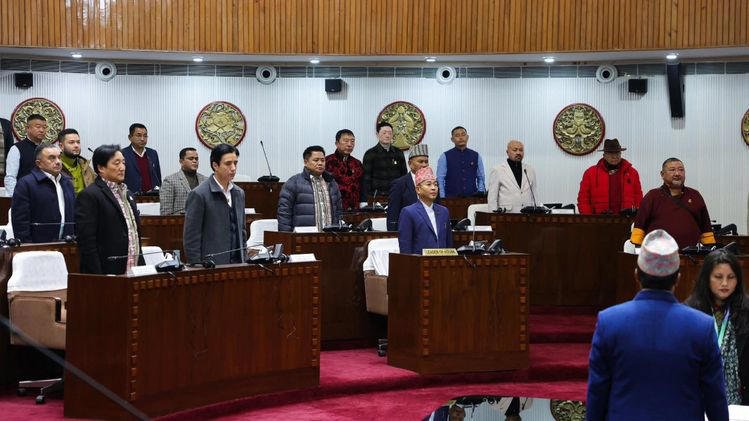
The Sikkim Assembly vote-on-account bill has been passed with the approval of key financial proposals, ensuring that governance continues smoothly despite the enforcement of the election code. The state assembly cleared a vote-on-account worth Rs 8,323 crore, allowing the government to meet its essential expenditures in the interim period.
The development comes at a crucial time as the state prepares for upcoming elections. With the Model Code of Conduct in force, the government cannot present a full budget. Therefore, the vote-on-account serves as a temporary financial arrangement.
Led by Chief Minister Prem Singh Tamang, the government emphasized the importance of maintaining administrative continuity. The move ensures that salaries, ongoing projects, and welfare schemes do not face disruptions.
Read More: Meghalaya NPP Expands Assam Poll Strategy
Understanding the vote-on-account mechanism
A vote-on-account allows a government to withdraw funds from the state treasury for a limited period. It is usually passed when elections are near, and a full budget cannot be presented. In this case, the Sikkim Assembly approved Rs 8,323 crore to cover essential expenses.
Importantly, this financial provision ensures that routine governance activities continue without interruption. It covers key sectors such as public administration, infrastructure, healthcare, and education.
Moreover, the vote-on-account reflects fiscal planning under constrained conditions. Since the election code restricts new policy announcements, the government focuses only on necessary expenditures. This approach maintains financial discipline while adhering to electoral norms.
Key highlights of the financial bills
The Sikkim Assembly did not limit its proceedings to the vote-on-account alone. It also cleared several important financial bills that support the state’s fiscal framework. These bills are crucial for managing revenue collection and expenditure allocation.
Additionally, the approved provisions aim to sustain development projects already in progress. The government has ensured that ongoing infrastructure initiatives receive adequate funding. This step is vital for maintaining growth momentum.
Furthermore, welfare schemes remain a priority. The financial allocations cover social sector programs that benefit various sections of society. As a result, the administration continues to address public needs even during the election period.
Political context and election preparedness
The passage of the Sikkim Assembly vote-on-account bill comes against the backdrop of impending elections. With the Model Code of Conduct in place, political activities have intensified across the state.
However, the government has maintained a clear distinction between governance and electioneering. By securing financial approval in advance, it has avoided administrative delays. This move also reflects preparedness for a smooth transition during the electoral process.
At the same time, opposition parties have been closely observing the proceedings. They have raised questions on certain allocations, although the bills ultimately received approval. Such debates highlight the democratic functioning of the assembly.
Ensuring continuity in governance
One of the primary objectives of passing the vote-on-account is to ensure continuity in governance. Without this provision, the government would face difficulties in meeting its financial obligations.
The approved amount of Rs 8,323 crore provides a financial cushion for several months. It allows departments to function without disruptions. Moreover, it ensures that employees receive their salaries on time.
In addition, ongoing development works will continue as planned. This includes infrastructure projects, public services, and welfare initiatives. Therefore, citizens are unlikely to face any immediate impact due to the election code.
Fiscal discipline under election constraints
The Sikkim Assembly’s decision reflects a balance between fiscal responsibility and administrative necessity. While the government cannot introduce new schemes, it has ensured that existing commitments are met.
This approach demonstrates prudent financial management. By focusing on essential expenditures, the administration avoids unnecessary spending. At the same time, it adheres to the guidelines of the election code.
Moreover, the timely passage of financial bills strengthens institutional processes. It highlights the importance of legislative approval in maintaining transparency and accountability.
A temporary yet crucial financial measure
The Sikkim Assembly vote-on-account bill is a temporary arrangement, but its significance cannot be underestimated. It provides the financial backbone needed to sustain governance during a sensitive period.
Once the elections conclude, the new government will present a full budget. Until then, the vote-on-account ensures stability and continuity.
In conclusion, the Sikkim Assembly’s approval of Rs 8,323 crore under the vote-on-account highlights effective financial planning amid electoral constraints. Under the leadership of Prem Singh Tamang, the state has managed to balance governance needs with democratic processes. This move not only ensures uninterrupted administration but also reinforces the importance of fiscal discipline during election periods.
Read More: Mamata Banerjee Promises Free Legal Aid for Rejected Voters