


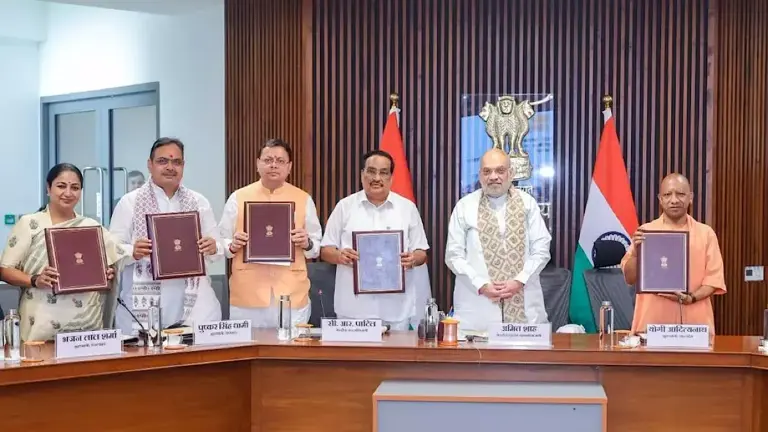
The chief ministers of six North Indian states signed the Kishau Multipurpose Project agreement in New Delhi on September 15. Union Home Minister Amit Shah and Union Jal Shakti Minister C. R. Patil attended the signing ceremony.
The six signatories represent Uttar Pradesh, Uttarakhand, Himachal Pradesh, Haryana, Rajasthan and Delhi. The agreement aims to move forward a long-pending project on the Tons River.
The river flows along the border of Uttarakhand and Himachal Pradesh. The project will involve the construction of a 232.6-metre-high concrete gravity dam. It will create a major water storage facility for the participating states.
Read More: Chief Minister Rekha Gupta Announces Hostels for 10,000 Students in Delhi
The agreement follows years of discussions over water sharing, project costs and the distribution of benefits. In June 2026, the six states had reached a consensus to sign an agreement for the project. The September signing now marks a major step towards implementation.
Amit Shah Calls It a Historic Agreement
Amit Shah described the agreement as a historic development. He said the project would benefit all six participating states in different ways.
Shah also highlighted the role of dialogue in resolving the long-standing differences between the states. He said the agreement showed how governments could address inter-state water issues through consensus.
According to the Union Home Ministry, the Kishau agreement represents the resolution of the tenth water-related dispute during the period of the present central government. Shah also credited the Ministry of Jal Shakti and the participating state governments for helping bring the negotiations to a conclusion.
The six chief ministers who signed the agreement were Yogi Adityanath of Uttar Pradesh, Pushkar Singh Dhami of Uttarakhand, Sukhvinder Singh Sukhu of Himachal Pradesh, Bhajan Lal Sharma of Rajasthan, Rekha Gupta of Delhi and Nayab Singh Saini of Haryana.
Project to Store 1,562 Million Cubic Metres of Water
The Kishau project will have a planned water storage capacity of 1,562 million cubic metres. It will also support irrigation across a large area.
Government figures say the project will help irrigate around 97,000 hectares of land. The project also aims to generate 1,476 million units of clean hydropower. These benefits could support agriculture, water supply and energy needs across the region.
The project has received National Project status from the Centre. The government will bear around 90 per cent of its financial burden. The participating states will share the remaining 10 per cent under the agreed arrangement.
The financial arrangement formed an important part of the negotiations. The states had to balance their water requirements with the costs associated with the project.
Delhi and Yamuna to Receive Major Benefits
The Kishau project also has an important connection with the Yamuna. The Tons River forms part of the Yamuna river system.
The agreement will help increase water availability in the Yamuna basin. Shah said Delhi would receive significant benefits from the project. He also linked the project to efforts to improve the environmental flow of the Yamuna.
According to the government, around 25 per cent of the water from the project will help support the Yamuna’s flow. This could contribute to efforts aimed at improving the river’s environmental condition.
The project could therefore serve more than one purpose. It will address water storage and irrigation needs while also supporting river conservation.
Water Allocation Among Participating States
The project agreement includes arrangements for sharing the stored water among the participating states.
According to an Indian Express explainer, the proposed allocation includes 633 million cubic metres for Haryana, 411 million cubic metres for Uttar Pradesh, 124 million cubic metres for Rajasthan and 80 million cubic metres for Delhi. Uttarakhand will receive 34 million cubic metres, while Himachal Pradesh will have a separate arrangement linked to the project’s benefits.
The arrangement also addresses Himachal Pradesh’s role in the project. Earlier discussions included a plan under which Delhi and Rajasthan would help cover costs related to Himachal Pradesh’s share of the power component.
These arrangements helped the states reach a common position after years of negotiations.
A Long-Delayed Project Moves Forward
The Kishau project has remained under discussion for decades. Differences between the states delayed progress on the dam and reservoir plan.
The June 2026 consensus created the foundation for the final agreement. At that meeting, the six states agreed to move towards signing an MoU for implementation. The Centre also planned to place the project before the Union Cabinet after the agreement process.
The latest agreement now gives the project a clearer path forward. The Centre and the states have committed to working towards its implementation.
The development also reflects a wider effort to resolve inter-state water disputes through negotiations. Several water-related agreements have emerged in recent years, including arrangements involving major river and irrigation projects.
Focus on Water Security and Development
The Kishau project has significance for agriculture, drinking water and power generation. Its benefits could reach several regions across the six participating states.
For farmers, increased irrigation availability could support agricultural activity. The project could also strengthen water supplies for growing urban and industrial areas.
At the same time, the hydropower component could add to the region’s clean-energy capacity. The planned generation of 1,476 million units will make power generation an important part of the project.
The Yamuna component adds another environmental dimension. Better water availability and environmental flow could support long-term efforts to improve the river.
Agreement Marks New Phase for Kishau Project
The signing of the Kishau agreement marks an important new phase for the long-pending project. Six states have now formally agreed to the arrangements needed to move forward.
The next stage will involve further administrative, technical and implementation work. The Centre and the participating states will need to maintain coordination as the project progresses.
For the Yamuna basin, the project combines water storage, irrigation, hydropower and river-flow objectives. Its eventual impact will depend on successful implementation and continued cooperation among the participating governments.
Read More: Tripura to Hold Month-Long ‘Seva Pakhwada’ for PM Modi’s Birthday