


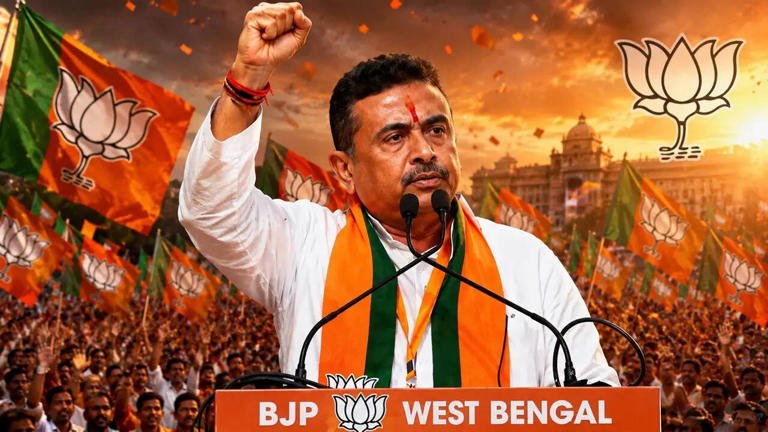
The political journey of Suvendu Adhikari remains one of the most dramatic transformations in West Bengal politics. Once considered one of Mamata Banerjee’s most trusted lieutenants, Adhikari gradually emerged as her strongest rival. Over the years, he built his image as a mass leader with strong grassroots support across Bengal. Today, his rise to become the first BJP chief minister in West Bengal marks a historic shift in the state’s political landscape.
His journey reflects changing political equations, ideological battles, and the growing influence of the BJP in a state once dominated by the Trinamool Congress (TMC).
Read More: Tripura CM Manik Saha Reviews Public Services And Law And Order
Early Political Roots And Family Influence
Suvendu Adhikari was born into a politically influential family in East Midnapore district of West Bengal. His father, Sisir Adhikari, played a major role in regional politics for decades. Political discussions and public service formed an important part of Suvendu’s upbringing.
He completed his education in political science and entered student politics at a young age. During his early years, he remained associated with the Congress party. However, Bengal politics witnessed a major transformation when Mamata Banerjee launched the Trinamool Congress in 1998 after breaking away from the Congress.
Suvendu quickly aligned himself with Mamata Banerjee’s anti-Left movement. His organisational skills and ability to connect with rural voters soon made him one of the party’s rising faces.
Role In The Nandigram Movement
The turning point in Suvendu Adhikari’s political journey came during the Nandigram movement in 2007. At that time, the Left Front government planned land acquisition for a proposed chemical hub. The move triggered massive protests among local residents.
Suvendu emerged as one of the key leaders of the agitation. He organised protests, mobilised villagers, and became the public face of resistance against land acquisition. The movement gained nationwide attention after violent clashes took place in Nandigram.
The agitation significantly weakened the Left Front government’s image. Moreover, it strengthened Mamata Banerjee’s anti-land acquisition campaign across Bengal. Political observers believe the Nandigram movement laid the foundation for the TMC’s historic victory in the 2011 Assembly elections.
Suvendu’s role during the protests also elevated his stature within the party. Many supporters started viewing him as Mamata Banerjee’s political heir.
Rise Within The Trinamool Congress
After the TMC came to power in 2011, Suvendu Adhikari became one of the most influential ministers in the state government. He handled several important portfolios, including transport and irrigation.
At the same time, he expanded the party’s organisational structure in districts like East Midnapore, West Midnapore, and parts of south Bengal. His strong control over local cadres helped the TMC strengthen its rural base.
Within a few years, Suvendu transformed into one of the party’s biggest mass leaders. His rallies regularly attracted large crowds. Furthermore, his popularity extended beyond his home district.
Political analysts often described him as the architect of TMC’s growth in several rural belts. However, internal tensions within the party slowly began surfacing.
Differences With Mamata Banerjee
Despite his growing popularity, Suvendu Adhikari’s relationship with Mamata Banerjee gradually deteriorated. Reports of dissatisfaction within the party started emerging around 2019.
Several reasons reportedly contributed to the widening gap. First, Suvendu allegedly felt sidelined within the party structure. Second, the increasing influence of Mamata Banerjee’s nephew Abhishek Banerjee created tensions among senior leaders.
Many political observers believed Suvendu wanted greater decision-making authority. However, the party leadership maintained tight control over organisational matters.
Eventually, the differences became public. Suvendu resigned from ministerial positions and later quit the Trinamool Congress in 2020. His departure dealt a major blow to the ruling party because several local leaders and workers followed him.
Joining The BJP And Changing Bengal Politics
Soon after leaving the TMC, Suvendu Adhikari joined the Bharatiya Janata Party in the presence of senior national leaders. His entry significantly boosted the BJP’s morale ahead of the 2021 West Bengal Assembly elections.
The BJP projected him as one of the strongest anti-TMC faces in Bengal. Additionally, his organisational experience and grassroots connections helped the party expand rapidly in rural regions.
The biggest political battle unfolded in Nandigram, where Suvendu contested directly against Mamata Banerjee. The contest became one of the most closely watched elections in India.
After an intense campaign, Suvendu defeated Mamata Banerjee in Nandigram by a narrow margin. Although the TMC returned to power in the state, the victory established Suvendu as Bengal’s principal opposition leader.
Soon afterward, he became the Leader of Opposition in the West Bengal Assembly.
Emergence As BJP’s Face In Bengal
Over the next few years, Suvendu Adhikari strengthened his hold over the BJP’s Bengal unit. He aggressively targeted the TMC government on issues such as corruption, political violence, and law and order.
His speeches and political campaigns helped consolidate anti-TMC voters. Furthermore, he remained highly active across districts and frequently visited rural areas.
Political analysts noted that Suvendu successfully positioned himself as the BJP’s strongest regional leader in Bengal. Unlike earlier BJP faces in the state, he possessed deep local roots and extensive organisational experience.
The BJP leadership also increased its dependence on him during elections and major political campaigns.
Becoming Bengal’s First BJP Chief Minister
Suvendu Adhikari’s elevation as West Bengal’s first BJP chief minister marked a watershed moment in the state’s political history. For decades, Bengal politics remained dominated by the Left Front and later the Trinamool Congress.
His rise symbolised the BJP’s successful expansion into eastern India. Moreover, it reflected changing voter preferences in several regions of the state.
Supporters described his victory as a reward for years of organisational work and grassroots mobilisation. On the other hand, critics argued that his shift from TMC to BJP represented political opportunism.
Nevertheless, his journey from being Mamata Banerjee’s trusted aide to her fiercest rival remains one of the most remarkable political transformations in contemporary Indian politics.
A Defining Political Transformation
The Suvendu Adhikari political journey continues to shape discussions around West Bengal’s future political direction. His rise highlights the importance of regional leadership, grassroots politics, and strategic alliances in Indian democracy.
From leading the Nandigram movement to becoming Bengal’s first BJP chief minister, Suvendu’s career has witnessed dramatic highs and intense political confrontations. His political evolution also reflects how quickly power equations can change in Indian politics.
As Bengal enters a new political phase, Suvendu Adhikari’s leadership will remain under close national attention. Both supporters and critics agree on one point — his journey has permanently altered the political narrative of West Bengal.
Read More: Experts Discuss Digital Transformation Of Assamese Media