


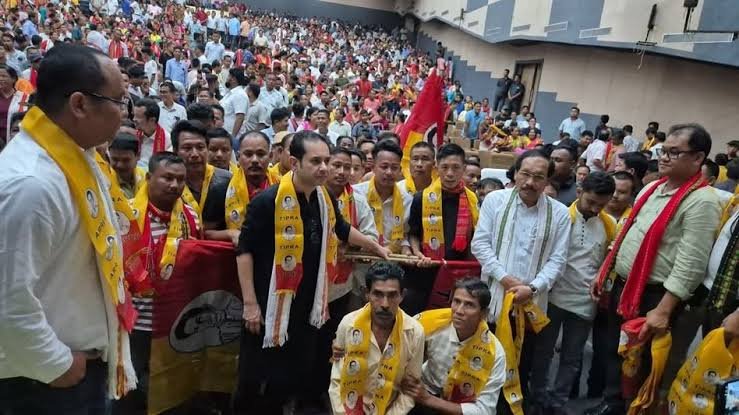
Tiprasa Accord implementation demand has gained renewed attention after TIPRA Motha supremo Pradyot Kishore Debbarma issued a firm warning over the alliance with the BJP. Debbarma stated that the alliance could be reconsidered if the tripartite Tiprasa Accord is not implemented. The warning has added fresh political pressure around the agreement and its promised provisions. Moreover, the statement has highlighted growing expectations over action on issues connected with the Tiprasa community. The development could also influence the political equation in Tripura as parties prepare for upcoming electoral contests and continue discussions over the implementation of commitments made under the accord.
Manik Saha Defends Vande Mataram Amid Congress Row
Pradyot Kishore Debbarma Draws Firm Political Line
Pradyot Kishore Debbarma has drawn a clear political line by linking the continuation of the alliance to progress on the Tiprasa Accord. His warning has been framed around the principle of implementation rather than a routine political disagreement.
Furthermore, the statement has placed renewed attention on the commitments associated with the tripartite agreement. Political observers are likely to monitor how the issue develops as discussions between the concerned stakeholders continue.
The warning also indicates that alliance arrangements may face greater scrutiny if key commitments remain unresolved. Consequently, the issue could become increasingly important in Tripura’s political discourse.
Tiprasa Accord Implementation Becomes Central Issue
Tiprasa Accord implementation demand is now at the center of the latest political development. The agreement has been associated with demands concerning the rights, identity, culture, and interests of the indigenous Tiprasa population.
Therefore, implementation has remained an important political issue for TIPRA Motha and its supporters. Expectations have also been raised regarding concrete steps following the signing of the tripartite agreement.
Moreover, the latest warning suggests that political support may be evaluated against progress on those commitments. This could make implementation a significant factor in future political negotiations.
No Accord, No Alliance Warning Gains Attention
Debbarma’s “no accord, no alliance” position has introduced a stronger condition into the political relationship. The warning suggests that the alliance cannot be viewed separately from the expectations surrounding the agreement.
At the same time, the statement does not automatically mean that the alliance has ended. Instead, a possible reconsideration has been indicated if the accord is not implemented.
Consequently, political discussions could intensify as stakeholders assess the government’s progress. The coming period may therefore prove important for determining whether the alliance remains stable.
Tripartite Agreement Faces Renewed Scrutiny
The Tiprasa Accord was reached through discussions involving the central government, the Tripura government, and representatives associated with TIPRA Motha. Its implementation has consequently attracted attention from multiple political and social stakeholders.
The agreement’s provisions and the steps required for implementation are expected to remain subjects of discussion. Furthermore, administrative processes may be required before several commitments can be translated into concrete measures.
Therefore, progress could depend on continued coordination between the different stakeholders. Clear communication may also be needed to prevent misunderstandings regarding the status of various commitments.
Alliance Stability Could Face Fresh Test
The latest warning could create a fresh test for the political alliance. TIPRA Motha’s position indicates that continued cooperation is being linked to measurable progress on the accord.
Moreover, political alliances often depend on the ability of partners to manage differences over policy priorities. In this case, implementation expectations have been placed at the center of the relationship.
If progress is demonstrated, tensions could potentially be reduced. However, continued delays could increase political pressure and lead to further discussions about the future of the alliance.
Indigenous Issues Remain Politically Significant
Issues concerning the indigenous population remain highly significant within Tripura’s political landscape. Questions surrounding identity, land, cultural protection, and political representation have long influenced regional political debates.
Consequently, the Tiprasa Accord carries importance beyond a conventional political agreement. Its implementation is being watched by communities and political stakeholders with strong interest.
Furthermore, the latest warning could bring these issues back into sharper public discussion. Political parties may therefore face increased expectations to clarify their positions on related matters.
BJP-TIPRA Motha Relationship Under Spotlight
The warning has also placed the relationship between the BJP and TIPRA Motha under renewed scrutiny. The two parties’ alliance has been viewed through the broader context of Tripura’s political arrangements and indigenous issues.
As a result, any disagreement over the implementation of the accord could have wider political implications.
However, the alliance’s future will depend on subsequent discussions and decisions by the parties involved. The latest statement should therefore be viewed as a political warning rather than confirmation of an immediate break.
Government Action Could Determine Next Move
The next phase could depend heavily on the government’s approach toward implementing the accord. Concrete administrative action could help address concerns raised by TIPRA Motha.
Moreover, a clearly communicated implementation roadmap could provide greater certainty to political stakeholders and affected communities.
On the other hand, prolonged uncertainty could maintain pressure on the alliance. Therefore, government action and communication are likely to remain closely watched.
Political Negotiations May Intensify
The latest development could lead to renewed political negotiations around the agreement. TIPRA Motha may seek greater clarity regarding timelines, procedures, and specific commitments.
Furthermore, discussions may involve representatives from different levels of government and political leadership.
Such negotiations could become particularly important as Tripura moves closer to upcoming local political contests. Political parties may seek to avoid uncertainty while maintaining their respective positions.
Upcoming Elections Add Political Importance
The warning comes at a politically important period for Tripura. Upcoming Village Committee, municipal, and panchayat elections are expected to increase political activity across the state.
Therefore, developments involving TIPRA Motha and the BJP could attract greater attention during the election preparation period.
Moreover, the issue could influence political messaging and grassroots discussions, particularly in areas where indigenous concerns carry significant importance.
Supporters Await Concrete Progress
TIPRA Motha supporters are likely to watch closely for visible progress on the accord. Political commitments often generate expectations that can become stronger when implementation remains pending.
Consequently, the government’s ability to demonstrate progress could affect political confidence among supporters.
At the same time, specific provisions may require legal, administrative, or institutional processes before implementation can be completed. Therefore, expectations will need to be considered alongside the practical requirements involved.
Accord Implementation Remains Key Political Test
Tiprasa Accord implementation demand has emerged as a major political test for the alliance. The issue could determine how TIPRA Motha evaluates its continued cooperation with the BJP.
Furthermore, the warning has created a clear benchmark against which future developments may be assessed.
If implementation moves forward, the political relationship could gain greater stability. However, if expectations remain unmet, the alliance could face renewed uncertainty.
Future of Alliance Could Depend on Commitments
The future of the alliance could ultimately depend on how the commitments under the accord are handled. Debbarma’s statement has made implementation a central condition in the political discussion.
Moreover, continued dialogue could provide an opportunity for both sides to address differences without immediately disrupting the alliance.
The coming months could therefore be important for determining whether political cooperation remains intact or faces a major reassessment.
Conclusion
TIPRA Motha supremo Pradyot Kishore Debbarma has issued a strong warning by stating that the alliance could be reconsidered if the tripartite Tiprasa Accord is not implemented. Tiprasa Accord implementation demand has consequently returned to the center of Tripura’s political debate.
Moreover, the warning has placed renewed pressure on the government to demonstrate progress on the agreement’s commitments. The BJP-TIPRA Motha relationship could also face greater scrutiny as upcoming local elections increase political activity across the state.
Ultimately, the future of the alliance may depend on how effectively the concerns surrounding implementation are addressed. Continued negotiations, administrative action, and clear communication could play an important role in determining the next phase of the political relationship.
FAQs
1. What warning did Pradyot Kishore Debbarma issue?
He warned that TIPRA Motha could reconsider its alliance if the tripartite Tiprasa Accord is not implemented.
2. What is the Tiprasa Accord?
The Tiprasa Accord is a tripartite political agreement involving the central government, the Tripura government, and representatives associated with TIPRA Motha.
3. Why is the accord important to TIPRA Motha?
The agreement is connected with issues involving the rights, identity, culture, and interests of the indigenous Tiprasa population.
4. Does the warning mean the alliance has ended?
No. The statement indicates that the alliance could be reconsidered if implementation does not progress.
5. Could the issue affect Tripura politics?
Yes. The issue could influence political negotiations, alliance stability, and campaign discussions ahead of upcoming elections.
6. What could determine the alliance’s future?
Progress on the Tiprasa Accord, government action, continued negotiations, and the political positions of both alliance partners could influence its future.