


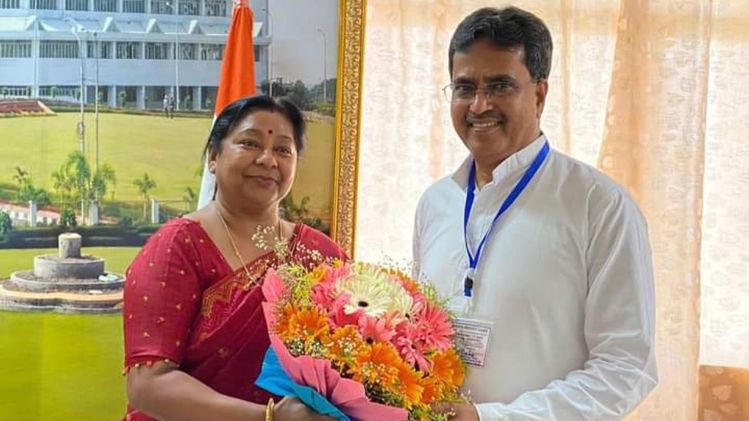
BJP chief whip in the Tripura Assembly, Kalyani Roy, has proposed introducing a four-day weekly work schedule for government employees in the state by extending daily office hours. The proposal comes amid ongoing fuel conservation measures and follows Prime Minister Narendra Modi’s appeal to save fuel in view of the prevailing conflict situation in West Asia.
Roy made the suggestion during a press conference on May 22 and linked the proposal to broader austerity efforts currently underway in Tripura. According to her, reducing travel requirements and encouraging flexible working arrangements could contribute to lowering fuel consumption during a period of global uncertainty.
The proposal has triggered discussions around workplace flexibility, public administration, fuel efficiency, and the possibility of introducing alternative work models in government offices.
Read More: Suvendu Adhikari Meets PM Modi, Discusses West Bengal Development and Governance
Proposal Linked to Fuel Conservation Measures
While addressing the media, Kalyani Roy said the proposed four-day work week could support fuel-saving efforts if government offices extend daily working hours and reduce the number of commuting days.
According to Roy, the state government has already introduced temporary austerity measures under which 50 per cent of Group C and Group D employees attend offices physically, while the remaining employees work from home.
She noted that this arrangement has been in effect from May 14 onward and forms part of a broader attempt to reduce fuel usage.
Roy referred to Prime Minister Narendra Modi’s appeal for fuel conservation amid developments linked to the ongoing West Asia conflict and argued that public institutions should contribute actively to such efforts.
She stated that uncertainty surrounding the geopolitical situation makes conservation measures necessary and encouraged wider public participation.
Existing Austerity Measures Already Underway
Roy highlighted that the Tripura government has already taken several steps to support austerity and reduce unnecessary fuel consumption.
According to her, Chief Minister Manik Saha, cabinet ministers, and MLAs have reduced the use of escort vehicles and official transport as part of current measures.
These decisions, she said, demonstrate a willingness among public representatives to adopt practical changes during periods of uncertainty.
Roy suggested that government employees could also contribute through modified office schedules that reduce travel frequency without affecting productivity.
The proposal reflects a broader approach that combines administrative adjustments with public participation to achieve conservation goals.
Supporters of such measures argue that even small changes in travel patterns can contribute to lower fuel usage over time.
Four-Day Work Week Model Sparks Discussion
The suggestion to move toward a four-day work week has generated interest because similar discussions have emerged globally in recent years across both public and private sectors.
Under the proposal suggested by Roy, employees would attend offices for four days instead of five while completing the same total work hours through longer daily schedules.
Advocates of compressed work weeks often argue that fewer commuting days can reduce transportation costs and improve work-life balance.
At the same time, supporters say such systems may lower fuel consumption and reduce pressure on urban transport networks.
However, any potential shift in government work schedules would require administrative review and evaluation of operational requirements.
Officials would also need to examine how such a system affects service delivery, employee productivity, and public access to government offices.
Public Participation Highlighted as Key Element
Apart from government measures, Roy appealed to citizens to support fuel conservation through everyday behavioural changes.
She encouraged people to use public transport whenever possible and suggested alternatives such as e-rickshaws and bicycles for short-distance travel.
According to her, public participation remains essential because government action alone cannot achieve long-term conservation goals.
Roy emphasised that responsible fuel use can contribute to broader economic stability and reduce pressure during uncertain international situations.
She stated that adopting practical habits in daily life can collectively make a meaningful impact.
The appeal also reflected efforts to create awareness around energy conservation beyond official administrative measures.
Debate Around Workplace Flexibility Continues
The proposal has also renewed discussions about flexible work arrangements within government institutions.
Work-from-home systems gained wider attention in recent years and opened conversations about alternative models of functioning across sectors.
Supporters of flexible scheduling argue that technology and digital processes now make it possible to maintain productivity while reducing physical attendance.
They also point out that lower commuting requirements may create economic and environmental benefits.
However, critics of compressed work schedules often raise concerns about accessibility and the need to ensure uninterrupted public services.
Government offices perform essential functions that require regular interaction with citizens. Therefore, any change in work structure would need careful planning and operational safeguards.
Policy experts generally note that workplace reforms succeed when authorities balance employee convenience with public expectations.
Focus Remains on Conservation and Administrative Efficiency
Kalyani Roy’s proposal places attention on how government systems can adapt during periods of economic and geopolitical uncertainty.
Although the state government has not announced any decision regarding a four-day work schedule, the suggestion has added a new dimension to conversations around fuel conservation and administrative efficiency.
The proposal also aligns with broader discussions on reducing unnecessary travel and encouraging resource-conscious practices.
Observers believe that ideas such as compressed work schedules may continue to attract attention as governments explore ways to manage costs and improve efficiency.
For now, Tripura’s existing austerity measures remain in place while public representatives continue encouraging fuel-saving practices.
The discussion around the Tripura four-day work week proposal reflects changing conversations about governance, workplace models, and public participation in conservation efforts during evolving global conditions.
Read More: Former JD(U) Leader Nimaichand Luwang Joins BJP in Manipur