


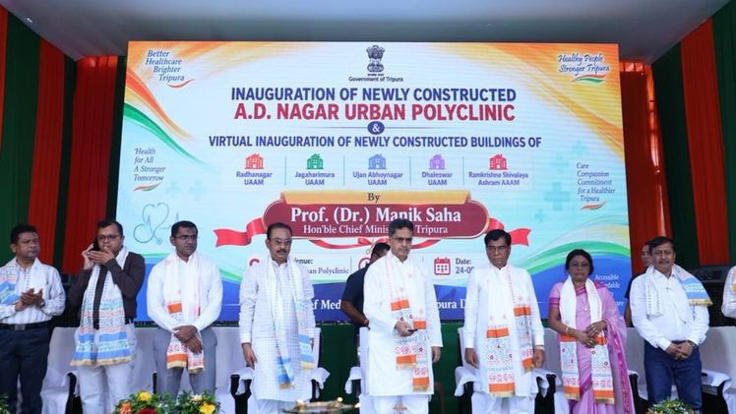
Tripura Chief Minister Prof. Dr. Manik Saha inaugurated a newly constructed Urban Polyclinic at A.D. Nagar in Agartala and five new Ayushman Arogya Mandir buildings on Wednesday. The initiatives aim to strengthen primary healthcare services and improve access to medical facilities across the state.
The Chief Minister inaugurated the polyclinic in person and opened the five Arogya Mandir buildings through a virtual programme. The new facilities form part of the state’s ongoing efforts to expand healthcare infrastructure at the community level.
Read More: Tripura to Use Unutilised Tea Areas for Industrial and Tourism Projects
The government has focused on strengthening healthcare facilities in both urban and rural areas. The latest inaugurations add more centres to this expanding network.
New Urban Polyclinic at A.D. Nagar
The newly constructed Urban Polyclinic at A.D. Nagar includes 12 rooms and cost around Rs 2.10 crore. The facility will provide healthcare services to residents in the surrounding areas.
After inaugurating the polyclinic, Chief Minister Saha inspected the newly built facility. The centre will help residents access medical services closer to their homes.
Urban polyclinics can also reduce pressure on larger hospitals. Patients with routine health concerns can seek treatment at local facilities instead of visiting major hospitals for every medical need.
The facility can also support early diagnosis and referral services. Doctors can identify patients who need specialised treatment and direct them to appropriate hospitals.
Five New Ayushman Arogya Mandirs
The Chief Minister also virtually inaugurated five new Ayushman Arogya Mandir buildings.
The new facilities are located at Radhanagar, Jagaharimura, Ujan Abhaynagar, Dhaleswar and Ramakrishna Shivalaya Ashram.
Ayushman Arogya Mandirs focus on providing comprehensive primary healthcare within local communities. They aim to make essential medical services more accessible and encourage people to seek treatment at an early stage.
The facilities can support services such as health screening, management of non-communicable diseases and maternal and child healthcare. Depending on local arrangements, they can also provide diagnostic services, essential medicines and other primary healthcare support.
Tripura Has 1,110 Arogya Mandirs
Chief Minister Saha said Tripura has established 1,110 Arogya Mandirs across the state.
The growing network provides a foundation for community-level healthcare. It can help people access basic medical services without travelling long distances.
Primary healthcare also plays an important role in disease prevention. Regular screening can help healthcare workers identify health conditions early. Patients can then receive timely treatment or referrals.
For Tripura’s remote and rural communities, accessible healthcare centres can make a significant difference. The government has therefore continued to expand the network alongside improvements in larger hospitals.
Focus on Rural and Remote Healthcare
Tripura’s healthcare strategy also includes facilities in rural and hilly areas. The state government has highlighted the role of satellite health centres in improving medical access in remote locations.
Doctors, health workers and ASHA workers support healthcare delivery in these areas. Their work helps connect communities with the wider public health system.
Satellite centres can provide basic medical services and identify patients who require specialised treatment. They can then refer such cases to district hospitals or larger medical institutions.
This approach creates a link between community healthcare and advanced medical services.
Fewer Patients Referred Outside Tripura
The state government has also highlighted a decline in the number of patients referred outside Tripura for treatment.
According to figures cited by Chief Minister Saha, 555 patients were referred outside the state in 2023. The number declined to 495 in 2024 and 366 in 2025.
The government said the number fell further to 161 in 2026 so far.
Saha attributed the decline to improvements in healthcare infrastructure and treatment facilities within Tripura. Better local facilities can allow more patients to receive treatment within the state.
However, referrals depend on several factors, including the availability of specialised doctors, treatment facilities and advanced medical equipment. Some patients may still need treatment outside the state when a particular service is unavailable locally.
Telemedicine to Strengthen Specialist Access
Tripura is also working to expand technology-based healthcare services. A state-of-the-art telemedicine studio is planned at G.B. Pant Hospital in Agartala.
Telemedicine can connect patients and healthcare professionals through digital platforms. It can provide an additional option for people living in areas where specialist services are not easily available.
Doctors in remote locations can also seek expert opinions through telemedicine networks. This can help improve clinical decision-making and reduce unnecessary travel for patients.
The proposed facility could therefore complement the state’s expansion of physical healthcare infrastructure.
Strengthening Healthcare From Local Centres to Hospitals
The latest inaugurations reflect Tripura’s focus on developing healthcare at different levels.
Ayushman Arogya Mandirs provide community-level primary healthcare. Urban polyclinics offer additional services in towns and cities. District and referral hospitals handle patients who require more specialised treatment.
A connected healthcare system can help patients receive appropriate care according to their medical needs. Local centres can manage routine cases, while hospitals can focus on complex conditions.
The government is also continuing to improve hospital infrastructure and medical services across the state.
Improving Access to Healthcare
The inauguration of the A.D. Nagar Urban Polyclinic and five new Ayushman Arogya Mandir buildings marks another step in Tripura’s healthcare expansion.
With 1,110 Arogya Mandirs already established, the state has continued to strengthen its primary healthcare network. The new facilities can help bring medical services closer to urban communities while supporting the broader public health system.
The long-term impact will depend on factors such as staffing, equipment, medicines, diagnostic services and regular availability of healthcare professionals.
As Tripura expands its healthcare infrastructure, the combination of local health centres, polyclinics, hospitals and telemedicine services could provide a broader network of care for residents across the state.