


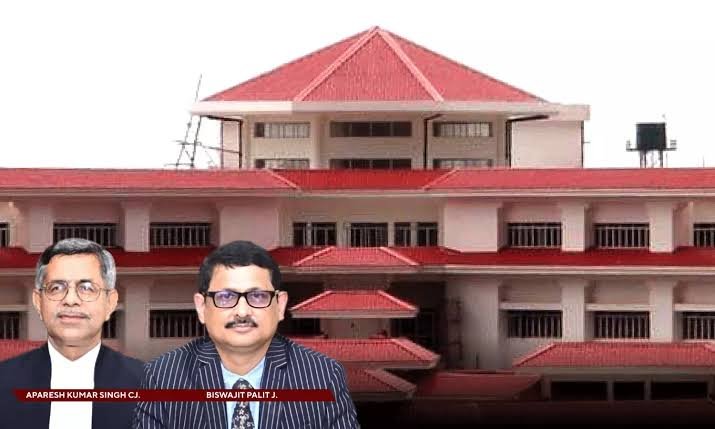
The TTAADC teacher vacancy crisis has come under fresh judicial scrutiny after the Tripura High Court directed the Tripura Tribal Areas Autonomous District Council to submit a detailed counter affidavit. The Court wants information on schools reportedly functioning with only one teacher, vacant teaching posts and the use of contractual appointments. The matter forms part of the High Court’s wider examination of teacher shortages in Tripura’s government schools.
Agartala Puja Security Deployment Strengthened Ahead of Durga Puja
TTAADC Teacher Vacancy Crisis Comes Under Judicial Scrutiny
The Tripura High Court has specifically sought details about schools under the jurisdiction of the Tripura Tribal Areas Autonomous District Council. The direction followed concerns raised during proceedings about the availability of teachers in tribal areas.
A Division Bench comprising Chief Justice M.S. Ramachandra Rao and Justice S. Datta Purkayastha passed the latest direction in WP(C)(PIL) No. 09 of 2026, titled Court on its own motion versus Union of India and Others. The order dated October 1, 2026 brought the TTAADC directly into the proceedings.
The Court decided to implead the TTAADC, represented by its Chief Executive Officer, as a party respondent. Consequently, the autonomous council must now respond to the allegations and provide the information sought by the Bench.
Importantly, the Court wants the council to identify the number of High Schools and Higher Secondary Schools that operate with only one teacher. It has also asked for detailed figures on teacher vacancies in those institutions. Therefore, the forthcoming affidavit could provide a clearer picture of staffing conditions in schools located within TTAADC-administered areas.
The issue carries significance because schools serving remote and tribal communities often depend heavily on government education infrastructure. A shortage of teachers can affect classroom teaching, subject coverage and administrative responsibilities. However, the High Court has not yet made a final finding on the full extent of the alleged single-teacher school problem.
Court Seeks Details on Single-Teacher Schools
The reported existence of single-teacher High Schools and Higher Secondary Schools has become a central concern in the latest proceedings. The High Court wants the TTAADC to place specific data before it rather than leave the issue at the level of general allegations.
The council will therefore have to provide information about the schools concerned and the number of vacant teaching positions. Such information can help establish whether the problem affects a limited number of institutions or represents a wider staffing gap across TTAADC areas.
Moreover, the Court has asked why contractual teachers are being engaged when regular posts remain vacant. This question places the recruitment and staffing system under closer examination. The council will need to explain the administrative reasons behind its present approach and provide information about available sanctioned posts.
Contractual appointments can provide short-term support when institutions face immediate staffing shortages. Nevertheless, the Court’s question indicates that temporary arrangements cannot automatically substitute for a long-term recruitment process where regular vacancies exist.
The November hearing will therefore be important for determining what information the TTAADC places before the Bench. The council’s response may also clarify the relationship between sanctioned posts, vacant posts and contractual appointments in its schools.
Wider Teacher Shortage Adds to TTAADC Teacher Vacancy Crisis
The latest direction does not stand alone. The High Court has been examining teacher shortages across Tripura for several months and has already issued directions concerning thousands of vacant teaching positions.
According to figures placed before the Court by the State Government, 15,449 teacher posts had become vacant by the end of the 2023-24 period. The vacancies followed teacher terminations and retirements during the preceding years. Authorities subsequently made 6,659 appointments across different categories, leaving a backlog of almost 9,000 posts according to the figures noted in the latest proceedings.
Earlier, the Court had also examined specific vacancies among Post Graduate Teachers and Graduate Teachers. In a September 9 order, the Bench directed the State Government to begin recruitment against 1,116 vacant PGT posts. It also questioned why authorities were seeking to fill only 230 of 2,193 vacant Graduate Teacher posts.
The same September order recorded that the Teachers’ Recruitment Board, Tripura had conducted a selection test for 700 newly created Graduate Teacher posts on February 14, 2026. The Court directed the recruitment board to complete the process and submit an affidavit describing the steps taken.
The High Court has also addressed vacancies among school heads. Earlier proceedings recorded 162 vacant Headmaster posts and 100 vacant Assistant Headmaster posts in Higher Secondary Schools, along with 304 vacant Headmaster posts in High Schools. The Court directed the authorities to fill those vacancies under the applicable rules.
These developments provide the broader context for the TTAADC teacher vacancy crisis. The Court is examining not only individual recruitment exercises but also whether the state education system has sufficient teaching and administrative personnel to serve students effectively.
Recruitment Delays and School Infrastructure Face Court Attention
The High Court has expressed concern over the pace of recruitment because prolonged vacancies can directly affect students. The Bench has repeatedly stressed the need to take timely action instead of allowing vacant posts to remain unfilled for extended periods.
The Court’s scrutiny has also extended beyond teacher numbers. According to UDISE 2025-26 data cited during the proceedings, electricity connections were available in 84% of schools, while drinking-water facilities were available in 4,048 of 4,144 government schools. The Bench indicated that schools should achieve complete coverage of these basic facilities.
Toilets also formed part of the infrastructure discussion. The figures cited before the Court showed toilet availability in 90% of government schools for girls and 92% for boys. The Bench directed that the remaining gaps should be addressed.
These figures show that staffing shortages are only one part of the wider education challenge. While infrastructure expansion and enrolment efforts can strengthen schools, students also require adequate teachers and school-level leadership.
Furthermore, the Court observed that parents choosing private schools cannot simply be blamed when government schools face shortages. The observation underlines the importance of improving public education services so that families have access to properly staffed institutions.
TTAADC Must Explain Recruitment and Staffing Position
The TTAADC now has to prepare a detailed response covering several specific issues. First, it must provide information on the number of single-teacher High Schools and Higher Secondary Schools within its jurisdiction.
Second, the council must disclose teacher vacancies in those institutions. This information will allow the Court to compare staffing requirements with the actual number of teachers available.
Third, the TTAADC has to explain its reliance on contractual teachers instead of regular appointments against existing vacancies. The response could clarify whether contractual recruitment addresses temporary needs, administrative delays or other staffing constraints.
The direction does not itself establish that every school under the TTAADC suffers from inadequate staffing. Rather, the Court has sought factual information so that it can assess the situation based on records. The council’s affidavit will therefore become an important document in the continuing proceedings.
The matter has been listed for November 16, 2026. At that stage, the High Court is expected to examine the TTAADC’s response and the data submitted regarding vacancies, single-teacher schools and contractual appointments.
Conclusion
The TTAADC teacher vacancy crisis has now moved into a more direct phase of judicial scrutiny. The Tripura High Court has asked the autonomous council to provide concrete information about single-teacher schools, vacant posts and contractual appointments.
The wider proceedings show that teacher shortages remain a significant concern across Tripura’s government education system. Therefore, the TTAADC affidavit could help the Court determine the scale of the staffing problem in tribal areas and assess what steps authorities need to take to improve teacher availability.
FAQs
What is the TTAADC teacher vacancy crisis?
The TTAADC teacher vacancy crisis refers to concerns over teacher shortages in schools under the Tripura Tribal Areas Autonomous District Council, including reports of single-teacher High Schools and Higher Secondary Schools.
What has the Tripura High Court asked the TTAADC to provide?
The Court has asked for details about single-teacher schools, teacher vacancies and the reasons for engaging contractual teachers instead of making regular appointments.
When will the TTAADC affidavit be considered?
The matter has been listed for November 16, 2026, when the High Court is expected to consider the council’s response.
How large is Tripura’s wider teacher vacancy backlog?
Figures placed before the High Court indicated that 15,449 teacher posts were vacant by the end of 2023-24, while 6,659 appointments were subsequently made, leaving a backlog of almost 9,000 posts.
Has the High Court ordered teacher recruitment elsewhere in Tripura?
Yes. Earlier proceedings directed the State Government to begin recruitment against 1,116 vacant PGT posts and addressed thousands of Graduate Teacher and school-head vacancies.