


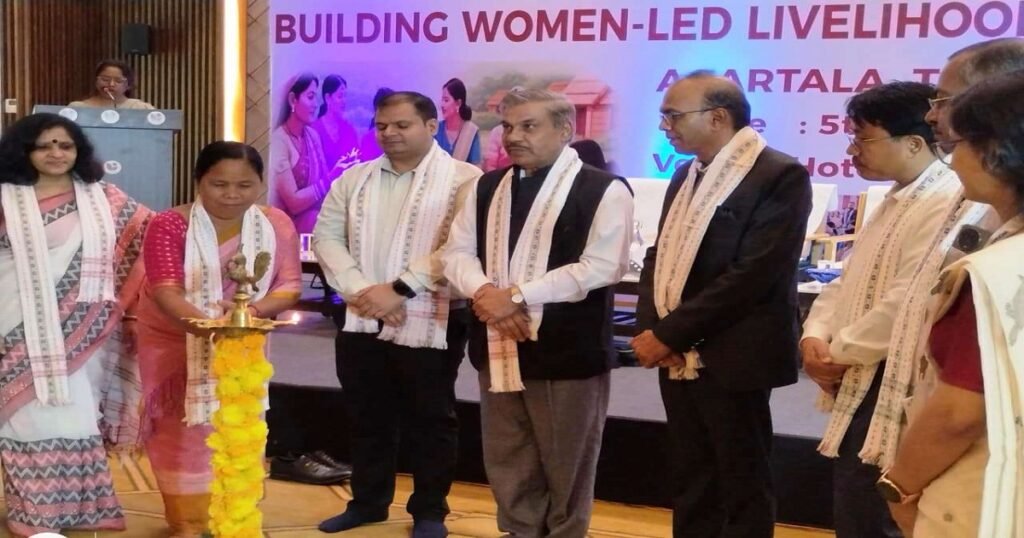
A partners’ workshop on building women-led livelihood ecosystems concluded at Hotel Polo Towers with a strong focus on collaboration and sustainable enterprise models. Stakeholders from government, financial institutions, and grassroots organizations discussed ways to strengthen women entrepreneurship in Tripura. Experts highlighted challenges like limited market access, weak credit flow, and gaps in institutional support. The workshop emphasized value chain development, especially in banana-based enterprises, and called for better convergence among institutions. Participants agreed that long-term success will depend on coordinated action and measurable outcomes.
Read More: Tripura Jampuijala Clash: BJP Office Attacked
Key Facts
- Event: Workshop on women-led livelihood ecosystems
- Location: Hotel Polo Towers
- Organizers/Participants: Government bodies, NABARD, Udyogini, research institutions
- Key Focus: Women entrepreneurship, value chains, institutional convergence
- Key Speaker: Dr. Rashmi Saxena
- Sector Highlight: Banana-based enterprises
- Main Issues: Market access, credit flow, institutional gaps
- Outcome: Framework for collaboration and scalable livelihood models
Stakeholders Push for Stronger Collaboration
The workshop brought together diverse stakeholders to discuss ways to empower rural women through sustainable livelihoods. Officials, researchers, and grassroots organizations shared their experiences and outlined key challenges.
In her address, Nabanita Dey stressed the need for coordinated strategies. She urged institutions to work together to strengthen women-led enterprises across the state.
Dr. Rashmi Saxena explained Udyogini’s long-term approach. She focused on capacity building and ecosystem support instead of short-term interventions.
Challenges in Women-Led Enterprises Identified
Anil S. Kotmire presented an overview of the current ecosystem. He acknowledged progress but pointed out major gaps that limit growth.
Participants highlighted issues such as poor market access and inadequate credit support. Weak last-mile institutional capacity also continues to affect rural enterprises.
Experts agreed that these challenges prevent women entrepreneurs from scaling their businesses effectively.
Focus on Value Chains and Agri-Enterprises
The workshop examined opportunities in banana-based enterprises. Experts noted that the sector offers strong potential for aggregation, processing, and market expansion.
They emphasized the need for structured value chains. Without proper systems, increased production may not lead to better incomes.
A panel discussion explored women-led agri-enterprises. Experts from research institutions and Krishi Vigyan Kendras recommended better technology access and stronger market linkages.
Call for Convergence and Policy Alignment
A key session highlighted the importance of convergence among institutions. Dr. Manjit Singh Nain moderated the discussion.
Participants urged departments to align research with field-level enterprise needs. They said coordinated action can improve productivity and sustainability.
Stakeholders also called for better alignment of government schemes with grassroots realities.
Way Forward and Action Plan
The workshop ended with an open forum on partnerships. Participants proposed a shared framework for collaboration and targeted interventions.
They identified market linkages and policy convergence as priority areas. Stakeholders also discussed clear institutional roles and immediate action points.
Experts noted that success will depend on implementation. Strong coordination and accountability will play a key role in achieving long-term impact.
Q&A Section
Q1: What was the main objective of the workshop?
The workshop aimed to build sustainable women-led livelihood ecosystems in Tripura.
Q2: Which sectors were highlighted?
Participants focused on agri-enterprises, especially banana-based value chains.
Q3: What challenges do women entrepreneurs face?
They face limited market access, poor credit flow, and weak institutional support.
Q4: What solutions did experts suggest?
Experts recommended better coordination, improved technology access, and stronger market linkages.
Q5: What is the expected outcome?
Stakeholders plan to create scalable enterprise models and a collaborative ecosystem.
Location Context
Tripura plays a crucial role in promoting rural livelihoods in Northeast India. Strengthening women-led enterprises in the state can boost economic growth and improve social development across the region.
Also Read: Post-Poll Tensions in Tripura: BJP–Tipra Motha Clash, Vandalism Reported – Hindustan Pioneer