


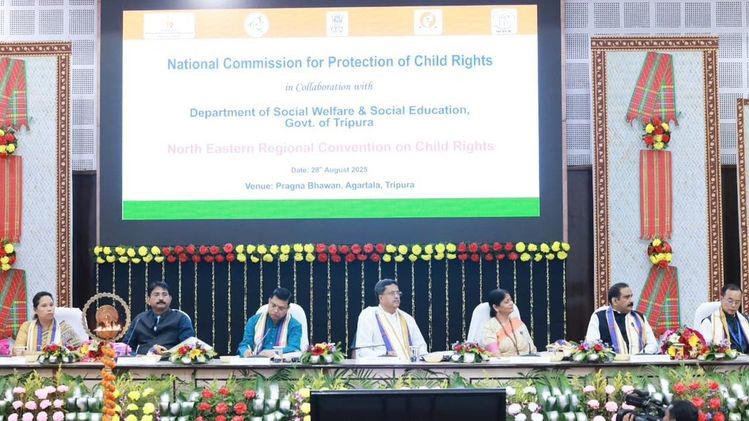
The Tripura child protection initiative has reached a new milestone as the state government announced the coverage of 2.3 lakh children across eight districts. Chief Minister Manik Saha highlighted that this expansion is a part of the state’s broader commitment to safeguard vulnerable children, provide essential services, and ensure their holistic development.
Read More: Meghalaya CM JJM coverage at 90%, Medical College 2026
Tripura child protection covers eight districts
Tripura’s focus on child welfare has gained momentum in recent years, with special emphasis on health, education, and safety. According to government officials, the latest scale-up covers children in eight districts, offering access to structured protection programs.
The Chief Minister said that the Tripura child protection effort reflects a vision where no child is left behind. The scheme ensures that children from economically weaker backgrounds, those without parental care, and those at risk of exploitation receive attention.
Under the expanded framework, the government is working with district-level task forces, NGOs, and community organizations. The combined effort has made it possible to reach more children, even in remote villages and border areas.
Building safety nets for vulnerable children
The Tripura child protection drive is not limited to providing immediate safety. It also addresses long-term needs like education and nutrition. Officials revealed that the program includes financial support, counseling, healthcare services, and educational assistance.
This holistic approach is designed to break cycles of poverty and vulnerability. Children who once faced risks such as child labor, early marriage, and trafficking are now being integrated into protective systems. By building these safety nets, the state aims to empower children to pursue their education and grow in secure environments.
The Chief Minister stressed that society must recognize child protection as a shared responsibility. Government programs can create frameworks, but real change requires families, schools, and communities to actively participate.
Collaboration with institutions and NGOs
To ensure the effectiveness of the Tripura child protection initiative, the government has strengthened its collaboration with local and national NGOs. These organizations bring expertise in child rights, community mobilization, and awareness campaigns.
Child welfare committees and district child protection units are also playing central roles in monitoring progress. Regular training sessions are being conducted for teachers, social workers, and frontline staff to improve their ability to respond to child-related issues.
With this partnership model, Tripura has managed to combine state-level resources with grassroots-level engagement. As a result, the 2.3 lakh children covered are not only registered in the system but also benefit from services tailored to their needs.
Tripura’s vision for child welfare
The Tripura child protection initiative aligns with the state’s broader vision of inclusive development. CM Saha explained that children represent the future, and investing in them is equivalent to investing in the state’s growth.
In addition to protection, the government is focusing on skill development for older children and adolescents. By providing vocational training, the aim is to ensure that vulnerable children do not just survive but thrive as contributing citizens in the future.
The program also emphasizes mental health support. Many children in vulnerable conditions face trauma, and the government has partnered with mental health professionals to address these concerns. Counseling sessions are being integrated into the welfare framework to create healthier and more resilient communities.
Addressing challenges on the ground
While the coverage of 2.3 lakh children is an achievement, officials admit that challenges remain. Tripura’s geographical constraints, with its hilly terrain and border-sharing districts, make it difficult to reach certain areas.
Another issue is raising awareness among families about the importance of child protection. Some communities still lack adequate information about the schemes available. To overcome this, the government has launched awareness campaigns, particularly in rural and tribal areas, to ensure that people understand the benefits and importance of these programs.
Despite these hurdles, the government remains confident that with sustained efforts, universal child protection coverage can be achieved.
A model for Northeast India
The Tripura child protection initiative is also seen as a potential model for other Northeastern states. With its structured approach, the program demonstrates how community participation and government schemes can work together to deliver results.
Experts believe that if other states adopt similar frameworks, child protection in the Northeast will gain a strong foundation. Tripura’s example shows that progress in child welfare is possible when there is political will, community engagement, and consistent monitoring.
Looking ahead
The Tripura child protection scale-up to 2.3 lakh children is a step forward in building a society that prioritizes its youngest citizens. The government plans to continue expanding coverage until every vulnerable child in the state is included.
With programs focusing on education, nutrition, mental health, and vocational training, the state is building a comprehensive ecosystem of support. CM Saha’s emphasis on community involvement ensures that protection is not seen as a one-time intervention but as an ongoing responsibility.
As Tripura moves ahead, the focus remains clear: children must grow up safe, healthy, and educated. The latest expansion is not just a milestone but also a reminder that protecting children is central to the state’s development.
The Tripura child protection initiative, by covering 2.3 lakh children across eight districts, highlights a vision of inclusive growth. With consistent efforts, the state is set to create a future where every child has the opportunity to thrive in a safe and nurturing environment.
Read More: India’s First and Largest Bio-Refinery in Assam’s Golaghat