


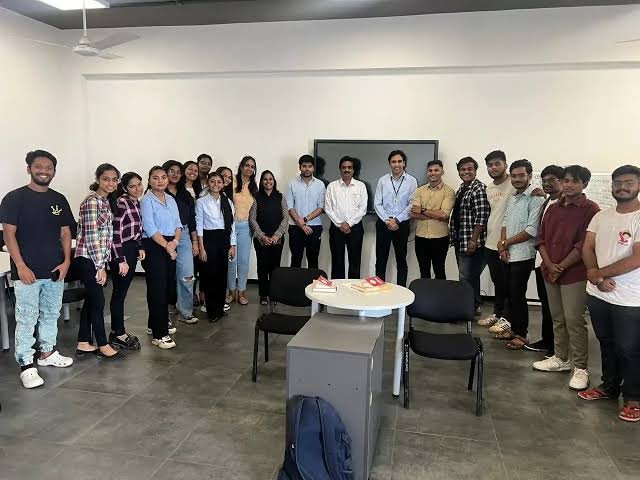
The Tripura University Debate Club has begun a new academic chapter with a renewed focus on regular student participation, debate activities and wider social engagement. The recently formed club held a meeting on September 11 in the Department of Political Science to discuss its functioning and future plans. Moreover, the university has assigned a student convenor to help coordinate upcoming activities.
Border Fencing Progress Audited: Tripura Reviews 805.99 Km of India-Bangladesh Fence
Tripura University Debate Club Begins New Chapter
The Tripura University Debate Club held its latest meeting at 1 p.m. on September 11 at the university’s Department of Political Science. Dr. Biplab Debnath, Assistant Professor of Political Science and the club’s teacher-in-charge, chaired the meeting and led discussions on the club’s future direction.
During the meeting, members discussed ways to make the club more regular, effective and active on campus. Students also presented recommendations concerning the club’s functioning and future activities. Therefore, the meeting served as an organizational step toward building a more structured platform for student participation.
The university had already listed a Debate Club among its student clubs in an earlier 2023 notice. That notice identified Dr. Biplab Debnath as teacher-in-charge and encouraged university clubs to conduct regular socio-cultural and literary activities while expanding membership through membership drives.
The latest meeting indicates a renewed effort to develop the debate platform. However, the available report does not establish that the club is being created for the first time in the university. Instead, it describes the current club as recently formed and records its efforts to strengthen functioning and future activities.
Student Public Speaking Gets Greater Focus
Debate clubs can provide students with structured opportunities to present arguments, respond to opposing viewpoints and communicate ideas before an audience. At Tripura University, the renewed focus on the Debate Club places student participation at the centre of its future plans.
The appointment of a Student Convenor represents one of the clearest organizational developments from the September 11 meeting. Soubik Majumder, a student of the Department of Political Science, was appointed to the role and will assist the club’s teacher-in-charge in organizing activities.
This student-led coordination can create a more direct connection between the club’s plans and the interests of its members. Furthermore, involving students in organizational responsibilities can provide practical experience in coordination, communication and event management.
Regular debate activities can also complement classroom learning. Students studying subjects such as political science, history, economics, law and literature frequently encounter issues that require analysis from multiple perspectives. Consequently, a debate platform can give students an additional setting in which to discuss such subjects through structured communication.
At the same time, the club’s success will depend on consistent participation and regular programming. The September meeting specifically discussed making the club more regular and effective, suggesting that establishing continuity remains an important part of its renewed direction.
Debate Club Plans Broader Social Engagement
The renewed vision of the Tripura University Debate Club extends beyond conventional debating activities. Dr. Biplab Debnath said while addressing the meeting that the club would not remain confined to debates and would also seek to contribute to society through various activities aimed at social betterment.
This broader approach could allow the club to connect academic discussion with wider community-oriented activities. However, the September 11 report does not specify a detailed calendar or list of social initiatives that the club will undertake.
The emphasis on wider engagement nevertheless gives the club a broader purpose within university life. A student organization can function not only as a platform for competitions but also as a space for discussion, collaboration and participation in activities connected with social concerns.
Moreover, the university’s earlier club framework encouraged socio-cultural and literary activities. The 2023 notice called on teacher-in-charges to induct more members and conduct regular activities within the campus. The current Debate Club discussions therefore fit within an existing university emphasis on student clubs as platforms for academic and socio-cultural participation.
The new organizational arrangement could also help maintain continuity between academic guidance and student leadership. With a faculty member serving as teacher-in-charge and a student serving as convenor, the club has defined roles for both institutional supervision and student coordination.
Tripura University Debate Club Seeks Active Campus Role
The immediate objective emerging from the September meeting is to make the Debate Club a more active venue for students. Members discussed ways to improve its services and make its functioning more effective, while the appointment of a student convenor provides an organizational mechanism for coordinating activities.
An active debate club can contribute to campus life by encouraging students to engage with contemporary academic and social questions. Furthermore, regular discussions can create opportunities for students from different departments to participate in activities outside their normal classroom environment.
The club’s location within the Department of Political Science also provides an academic setting closely connected with public affairs, governance and political discussion. Nevertheless, debate activities can involve students from a wide range of disciplines, and the club’s broader membership will determine how diverse its discussions become.
The university’s earlier club records demonstrate that debate activities have formed part of its student-club structure. The 2023 reconstitution notice listed students from areas including Molecular Biology, Integrated Master of Development Studies, MBA, Political Science and other departments under the Debate Club.
As the club begins this renewed phase, regular events, wider student participation and clearly planned activities will be important indicators of its progress. For now, the September 11 meeting marks an organizational step toward making the club more active and socially engaged within the university.
Conclusion
The Tripura University Debate Club has entered a renewed phase with a focus on stronger organization, regular activities and greater student involvement. The September 11 meeting brought members together to discuss the club’s functioning and future direction, while Soubik Majumder’s appointment as Student Convenor created a dedicated student-level coordination role.
The club’s renewed vision also extends beyond traditional debating. According to Dr. Biplab Debnath, the organization intends to contribute to society through activities aimed at social betterment. However, detailed plans for those initiatives have not yet been publicly outlined.
With faculty guidance, student leadership and a stated emphasis on regular participation, the Tripura University Debate Club now has an opportunity to strengthen its role in campus academic and socio-cultural life.
FAQs
What is the Tripura University Debate Club?
The Tripura University Debate Club is a student-oriented university club designed to provide a platform for debate and related academic and socio-cultural activities.
When did the Tripura University Debate Club hold its latest meeting?
The club held its latest reported meeting on September 11, 2026, at the Department of Political Science at Tripura University.
Who is the teacher-in-charge of the club?
Dr. Biplab Debnath, Assistant Professor of Political Science, serves as the club’s teacher-in-charge.
Who was appointed Student Convenor?
Soubik Majumder, a student of the Department of Political Science, was appointed Student Convenor to assist with organizing the club’s activities.
What is the renewed vision of the Tripura University Debate Club?
The renewed vision focuses on making the club more regular, effective and active while also expanding its activities beyond debating to include initiatives aimed at wider social engagement.