


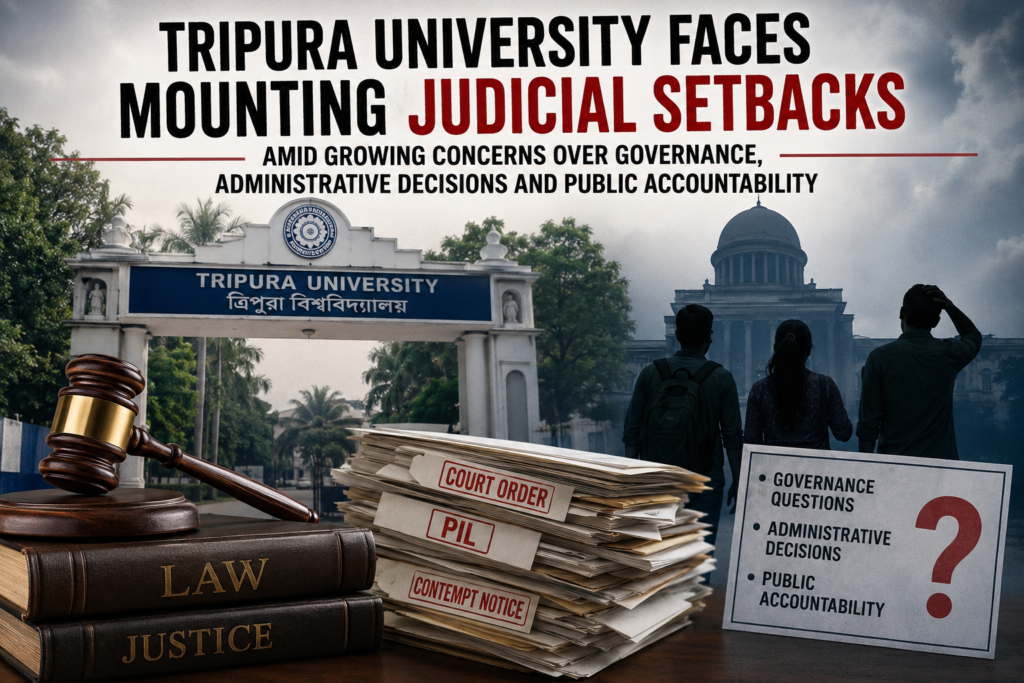
Tripura University, a Central University under the Ministry of Education, is facing increasing judicial scrutiny following multiple legal disputes involving service matters, recruitment processes, and administrative decisions. Several cases before the Tripura High Court have drawn attention to the university’s governance and personnel management.
The latest developments include a High Court order directing payment of salary to a contractual Assistant Professor and the revocation of an Executive Engineer’s suspension. In addition, recruitment-related petitions and labour complaints have raised broader concerns about institutional administration. While several allegations remain under judicial or administrative examination, no final findings have been reached in many of the matters.
Read More: Tripura Police Destroy Narcotics Worth ₹9 Crore
Key Facts
- Institution: Tripura University
- Status: Central University under the Ministry of Education
- Latest Court Case: Salary dispute involving contractual Assistant Professor Sumanta Saha
- High Court Judge: Justice Biswajit Palit
- Court Direction: Outstanding salary to be released and monthly salary to continue until disposal of the writ petition
- Other Major Issue: Revocation of Executive Engineer Krishna Das’ suspension
- Additional Matters: Recruitment disputes, UGC complaint, labour issues involving outsourced workers
- Current Status: Several matters remain pending before the Tripura High Court and other authorities
Multiple Cases Draw Judicial Attention
Tripura University has recently witnessed a series of legal proceedings relating to employment, recruitment, and administrative decisions. As a result, the institution has come under increased judicial scrutiny, with several cases pending before the Tripura High Court.
Legal experts note that litigation is not uncommon in large public institutions. However, repeated court interventions involving administrative decisions have sparked discussions among academicians, former employees, and stakeholders regarding institutional governance and decision-making.
High Court Orders Salary Payment in Assistant Professor Case
One of the latest developments concerns contractual Assistant Professor Sumanta Saha, whose service was terminated on April 24, 2026, after serving the university since January 2008.
The petitioner challenged the termination before the Tripura High Court, alleging that the decision was taken without prior notice and without following the principles of natural justice.
On June 23, 2026, Justice Biswajit Palit directed the university to release the petitioner’s outstanding salary within ten days and continue paying his monthly salary until the final disposal of Writ Petition No. 314 of 2026.
The Court had earlier passed an interim order on May 8, 2026. Subsequently, the university filed an interlocutory application seeking to vacate the earlier order, arguing that it had been issued without hearing its side.
After hearing both parties, the Court reportedly rejected the university’s plea and reaffirmed its earlier directions.
According to the petitioner’s allegations, the university had not fully implemented the Court’s directions several days after the order. The university has not publicly clarified the status of compliance.
Registrar’s Affidavit Examined
During the proceedings, the Registrar (In-Charge) submitted an affidavit stating that the earlier interim order had been passed ex parte without allowing the university to present its arguments.
However, after considering submissions from both sides, the High Court reportedly declined to modify its previous order.
The case has generated considerable discussion within academic circles regarding the handling of legal disputes involving the university.
Suspension of Executive Engineer Revoked
In another development, Tripura University revoked the suspension of Krishna Das, Executive Engineer and Head of the Engineering Cell.
Through an office order dated June 23, 2026, the university accepted his joining with retrospective effect from May 14, 2026, after the expiry of his suspension period.
Das had challenged both his suspension and the constitution of the Executive Council before the Tripura High Court through Writ Petition No. 551 of 2025.
During the suspension period, he also approached the Court seeking the release and enhancement of his subsistence allowance, alleging that payments had been withheld. The university has not publicly responded to these allegations.
Recruitment Cases Also Under Examination
Apart from service disputes, the university is also facing recruitment-related litigation.
One petition pending before the High Court concerns the appointment of an Assistant Professor in the Department of Tourism Administration.
According to the petitioners, the university’s recruitment advertisement dated January 6, 2025, prescribed a Master’s Degree in Tourism as an essential qualification. They allege that the selected candidate possessed a Post Graduate Diploma in Management (PGDM) instead.
The petitioners contend that the appointment did not comply with the eligibility criteria mentioned in the recruitment notification.
The matter remains sub judice, and the Court has not delivered a final judgment.
Complaint Submitted to UGC
Another issue relates to the qualifications of an Assistant Professor in the Department of Information Technology.
A complaint submitted to the University Grants Commission (UGC) has sought verification of the faculty member’s academic credentials and alleged irregularities concerning an M.Tech degree obtained through distance education.
Reports indicate that the UGC forwarded the complaint to Tripura University for appropriate action.
At present, no competent authority has reached any conclusion regarding the allegations.
Labour Issues Involving Outsourced Workers
Concerns have also been raised regarding nearly 80 outsourced workers engaged by the university.
Worker representatives allege that employees receive low wages and that deductions by the outsourcing agency further reduce their earnings.
The matter has reportedly been taken up before the Regional Labour Commissioner (Central), Guwahati, with demands for an inquiry into wage payments, labour law compliance, and social security benefits.
No final findings have been reported in the matter.
Stakeholders Seek Greater Accountability
Several stakeholders have argued that repeated litigation affects the university’s academic reputation and public image.
Some educationists believe that stronger administrative oversight and adherence to service rules could help reduce avoidable disputes.
Others have suggested that where courts ultimately determine that administrative actions were unlawful or arbitrary, accountability mechanisms should be strengthened. These views represent stakeholder opinions, and no such policy has been adopted by any competent authority.
University Faces Wider Governance Questions
Apart from the ongoing cases, various complaints relating to examination administration, faculty appointments, recruitment procedures, and institutional governance have reportedly been submitted to the Ministry of Education, the UGC, and university authorities.
Several complainants allege that inadequate administrative responses have compelled aggrieved individuals to seek judicial remedies.
Legal experts note that while each case will be decided independently based on evidence and applicable law, the increasing number of legal disputes has generated wider discussions about governance standards and institutional administration at the university.
Question & Answer
Q1. Why is Tripura University facing judicial scrutiny?
The university is involved in multiple legal cases relating to service disputes, recruitment, labour matters, and administrative decisions.
Q2. What did the High Court order in Sumanta Saha’s case?
The Court directed the university to release his outstanding salary and continue paying his monthly salary until the writ petition is finally decided.
Q3. What happened in Krishna Das’ case?
The university revoked his suspension and accepted his joining with retrospective effect after legal proceedings.
Q4. Are recruitment cases also pending?
Yes. Recruitment-related petitions, including one concerning the Department of Tourism Administration, remain pending before the High Court.
Q5. Have the allegations against the university been finally decided?
No. Several matters remain pending before courts or competent authorities, and no final judicial or administrative findings have been made in many of the cases.
Location Context
Tripura University, located in Suryamaninagar near Agartala, is the only Central University in Tripura and serves as a major higher education institution for Northeast India. Given its academic significance, developments involving the university attract considerable attention from students, faculty, policymakers, and the wider educational community across the region.
Also Read: Mizoram Governor Honours 20th Assam Rifles Battalion