


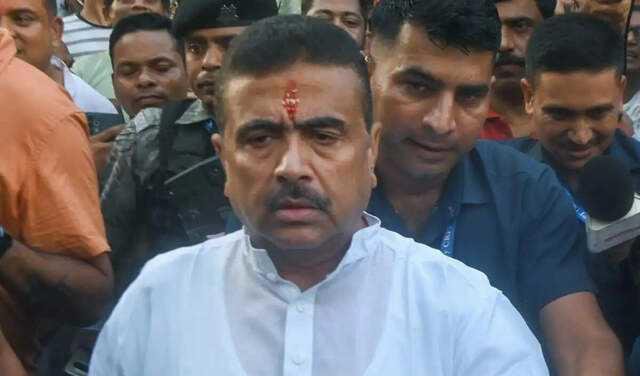
A new political chapter has begun in West Bengal after the formation of the BJP government led by Suvendu Adhikari. Following the recent change in power, the new administration has started implementing several significant decisions aimed at reshaping governance and sending strong political messages across the state.
One of the first major actions announced by the government involves the removal of a controversial football statue installed during the tenure of former Chief Minister Mamata Banerjee at the entrance of Salt Lake Stadium. The decision was officially announced by newly appointed Sports Minister Nisith Pramanik after the Kolkata Derby match between Mohun Bagan Super Giant and East Bengal FC on Sunday.
The announcement has already triggered strong reactions within political and sports circles, with supporters of the new government calling it a corrective step while critics described it as politically motivated.
Read More: Even Former CM Can Be Probed In RG Kar Case, Says Suvendu Adhikari
BJP government begins administrative overhaul
Since taking charge, the new BJP-led government in West Bengal has focused on signalling a shift in administrative priorities and governance style. Chief Minister Suvendu Adhikari has repeatedly stated that his government intends to introduce transparency, stronger infrastructure development, and administrative reforms.
Political observers believe the government’s early actions are designed to establish a clear distinction from the previous Trinamool Congress administration led by Mamata Banerjee. The removal of the football statue is therefore being viewed not only as an administrative decision but also as a symbolic political move.
The state government has also begun reviewing several projects and policies introduced by the previous administration. Ministers have indicated that departments may undergo restructuring to improve efficiency and accountability.
Officials within the BJP leadership said the government aims to focus on development-oriented governance while also addressing issues related to corruption allegations and administrative delays raised during the election campaign.
The new leadership has further promised stronger coordination between state departments and faster implementation of welfare and infrastructure projects.
Salt Lake Stadium statue decision sparks debate
The decision to remove the football statue at Salt Lake Stadium quickly became one of the most discussed political developments in the state. The statue, designed during Mamata Banerjee’s tenure, had remained controversial among sections of football supporters and political groups.
Sports Minister Nisith Pramanik announced the decision after attending the high-profile Kolkata Derby between Mohun Bagan and East Bengal. According to reports, the government plans to redesign the entrance area of the stadium and introduce new improvements linked to sports infrastructure and aesthetics.
Supporters of the BJP government argued that the stadium should focus more on sporting heritage and football culture rather than political symbolism. They claimed the government wants to modernise sports facilities while preserving the identity of iconic football venues.
However, opposition leaders criticised the move and accused the government of targeting symbols associated with the previous administration. Several Trinamool Congress supporters described the decision as unnecessary and politically motivated.
The issue has also generated discussion among football fans in Kolkata, where the rivalry between Mohun Bagan and East Bengal remains deeply connected to the city’s sporting culture and emotions.
Suvendu Adhikari focuses on governance image
Chief Minister Suvendu Adhikari has attempted to project an image of decisive leadership since assuming office. The BJP leadership believes the change in government represents a major political shift in West Bengal after years of Trinamool Congress rule.
Political analysts noted that the new administration is trying to combine symbolic decisions with governance-focused initiatives to strengthen public confidence. The BJP government has already signalled plans to review infrastructure, law and order, industrial growth, and administrative functioning.
Suvendu Adhikari has also emphasised the importance of restoring investor confidence and accelerating development projects across districts. According to party leaders, the government intends to focus heavily on employment generation and urban infrastructure.
Observers believe the BJP leadership is aware that public expectations remain high following the historic political transition in the state. Therefore, the government is likely to continue taking visible decisions during its early months in office.
The Chief Minister has also stressed the importance of maintaining coordination between the administration and grassroots workers to ensure smoother implementation of policies.
Political atmosphere intensifies in West Bengal
The recent change in power has significantly altered the political atmosphere in West Bengal. The BJP’s rise to power under Suvendu Adhikari marked one of the most dramatic political developments in the state’s recent history.
Political tensions remain high as the ruling BJP and opposition Trinamool Congress continue exchanging criticism over governance, policies, and symbolic decisions. The removal of the football statue has now become another major point of political confrontation.
Analysts believe symbolic actions often carry strong emotional and political significance in Bengal politics. Therefore, decisions linked to public monuments, stadiums, or cultural symbols tend to generate intense reactions among supporters of different parties.
Meanwhile, BJP leaders argue that the government has every right to redesign public spaces and infrastructure according to its administrative vision. Opposition leaders, however, claim the government should focus more on economic and public welfare issues.
Despite the political debate, the government appears determined to continue implementing its agenda and reinforcing its presence across the state.
Focus shifts towards sports and infrastructure
The new government has also indicated plans to improve sports infrastructure and promote football development in West Bengal. Sports Minister Nisith Pramanik stated that the government wants to modernise facilities and create better opportunities for athletes and sports enthusiasts.
Salt Lake Stadium remains one of India’s most iconic football venues and regularly hosts major domestic and international matches. Authorities may introduce renovation and beautification projects in the surrounding areas as part of broader infrastructure plans.
The government also plans to focus on youth engagement through sports programmes and grassroots initiatives. Officials believe sports development can strengthen community participation and encourage healthy lifestyles.
Political observers noted that linking sports infrastructure with administrative reforms could help the BJP government create a stronger public image among younger voters and football supporters.
New government signals major political shift
The early decisions taken by the BJP-led government under Suvendu Adhikari indicate a clear attempt to establish a distinct political and administrative identity in West Bengal. From reviewing earlier projects to announcing symbolic changes, the government has moved quickly after assuming power.
The decision regarding the Salt Lake Stadium statue has become one of the first major public signals of this shift. While supporters view it as part of a broader transformation agenda, critics continue questioning the government’s priorities.
As the new administration settles into office, political observers expect more policy announcements, infrastructure initiatives, and administrative changes in the coming months. The BJP government now faces the challenge of balancing political messaging with governance expectations in one of India’s most politically active states.
Read More: Arunachal Highway Expansion Targets Remote Border Areas