


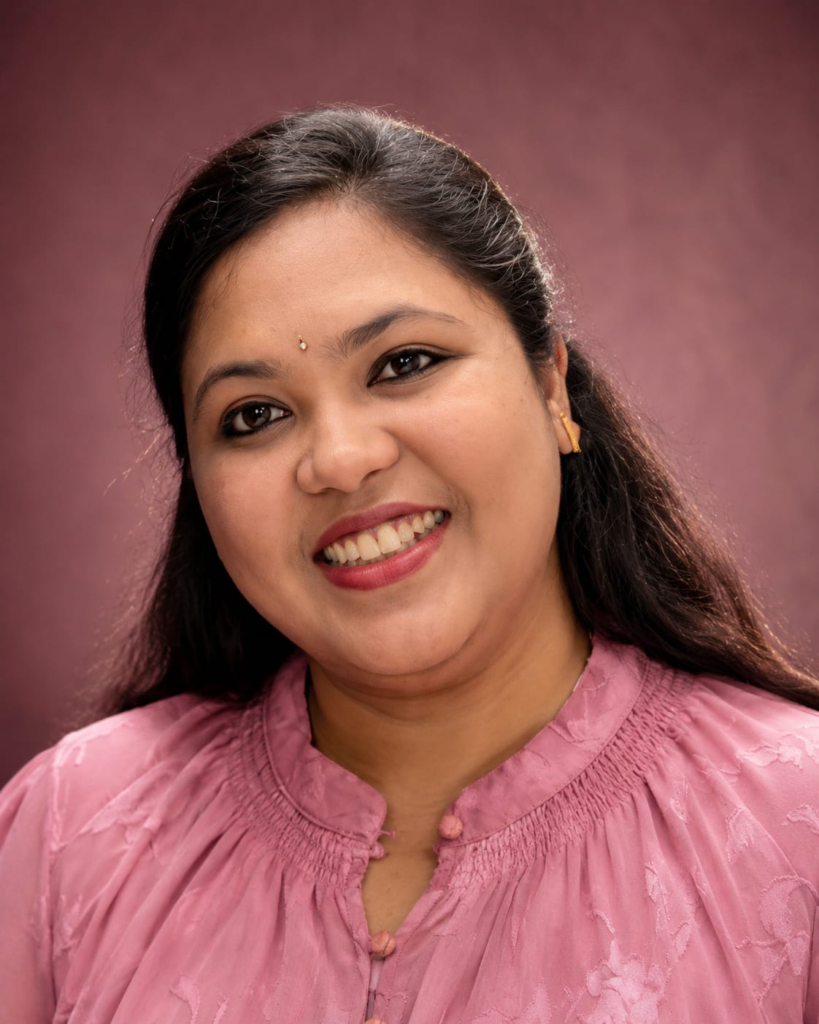
Some books begin with a lifelong ambition to become an author. Others emerge from an idea that refuses to go away.
For Niveditha, writing was never part of a carefully planned career path. Before becoming an author, she built her professional life in the corporate world, working in external audit. Her career was grounded in evidence, analysis, questioning assumptions, and examining information critically.
Becoming an author, however, was something she never expected.
The idea for her debut book, My Algorithm Thinks I’m Fat, had been sitting in her mind for years. It began with something deceptively ordinary: trying to get fit and discovering just how overwhelming the online world of fitness, food, health, and body image could be.
During an extended maternity break, Niveditha finally had the time and space to step away from her corporate routine and revisit those thoughts. What started as a personal attempt to make sense of the noise eventually became a book exploring how algorithms, social media, fitness culture, and societal expectations can influence the way people perceive themselves.
Her starting point was simple:
“Why not put these thoughts into words and give it a try?”
That decision became My Algorithm Thinks I’m Fat.
From External Audit to Authorship
Niveditha’s journey to becoming an author is unconventional.
Writing had never been a lifelong dream. There was no childhood ambition to publish a book or a carefully mapped-out plan to become a writer. Instead, the book emerged from years of accumulated thoughts, observations, research, and personal experiences.
Her background in external audit, however, had already taught her something that would become central to the book: question what you’re being told.
Audit requires people to examine evidence, challenge assumptions, and avoid accepting information simply because it appears convincing.
That mindset followed Niveditha into her exploration of fitness and wellness culture.
The more she tried to understand how to become healthier and fitter, the more information she encountered.
What should you eat?
What should you avoid?
Which workout is best?
How many steps should you take?
What should you weigh?
What should your body look like?
And perhaps most importantly, why did all of these questions seem to have completely different answers depending on who was speaking?
The volume of information became its own problem.
Niveditha began wondering whether she was the only person experiencing this confusion. Through research, observation, and conversations with like-minded people, she discovered that she certainly wasn’t.
The confusion was much more widespread.
“Does My Algorithm Think I’m Fat?”
The title My Algorithm Thinks I’m Fat emerged from that experience.
When someone searches for fitness, food, health, or weight-related content online, algorithms notice. The more a person interacts with certain subjects, the more similar content begins appearing in their feeds.
Suddenly, social media can become a constant stream of diet plans, workout routines, transformation stories, fitness influencers, weight-loss advice, before-and-after photographs, and suggestions for becoming a “better” version of yourself.
At one point, Niveditha found herself thinking:
“Does my algorithm think I’m fat?”
The thought was funny.
But underneath the humour was a much more serious question.
Why was she being shown so much content telling her that something about herself needed to change?
The algorithm wasn’t explicitly telling her that she wasn’t good enough. Instead, it was constantly presenting content about becoming fitter, healthier, slimmer, more disciplined, or more attractive.
And when those messages become part of someone’s everyday digital environment, they can gradually affect the way that person sees themselves.
That contradiction is one of the central ideas behind Niveditha’s book.
When More Information Creates More Confusion
One of the most recognisable experiences explored in My Algorithm Thinks I’m Fat is the paradox of information overload.
The internet has made health and fitness information more accessible than ever. But accessibility does not necessarily mean clarity.
One person tells you to eat something.
Another tells you to avoid it.
One recommends strength training.
Another promotes an entirely different workout.
Someone tells you to count calories.
Someone else tells you never to count them.
Eventually, the search for the “right” answer can become exhausting.
For Niveditha, this raised a larger question: What happens when being informed starts making you feel more confused rather than less?
Her audit background naturally encouraged her to question the information she encountered.
Where did it come from?
Was there evidence behind it?
Was it genuinely useful?
Was someone trying to sell something?
Why were different people making completely contradictory claims?
The more she investigated, the more she realised that her experience was not unique.
Many people were navigating the same maze of advice.
The Algorithm Doesn’t Have to Call You Inadequate
One of the book’s most interesting observations is that algorithms do not necessarily need to tell people that they are inadequate in order to influence how they feel about themselves.
They can simply keep showing them content about improvement.
Become fitter.
Eat better.
Lose weight.
Change your body.
Become more disciplined.
Become a better version of yourself.
Individually, none of these messages necessarily seems harmful.
But when they appear repeatedly, they can create the impression that the person you are today is always a work in progress.
Niveditha’s concern isn’t with self-improvement itself. It is with the possibility that self-improvement can become an endless obligation.
There is a difference between wanting to become healthier and feeling that you are never healthy enough.
That distinction sits at the heart of the book.
Fitness Without Turning Life Into a Fitness Project
Niveditha is not arguing against fitness, exercise, healthy eating, or taking care of oneself.
In fact, her perspective comes from someone who genuinely wanted to become fitter and healthier.
The problem, she suggests, begins when those goals become sources of constant anxiety.
When every meal becomes a calculation.
When every workout becomes a test.
When every mirror becomes an assessment.
When every decision becomes another opportunity to wonder whether you’re doing enough.
The book asks readers to recognise that healthy living does not have to become an all-consuming project.
You can want to be healthier without believing that your entire identity needs to revolve around health.
You can exercise without constantly measuring your progress against someone else’s transformation.
And you can want to improve yourself without believing that your current self is inadequate.
Why Humour Matters
Despite dealing with subjects such as body image, self-worth, fitness pressure, and societal expectations, My Algorithm Thinks I’m Fat does not approach them with an unnecessarily heavy tone.
Humour plays an important role.
As Niveditha puts it, sometimes you simply have to laugh at the absurdity of it all.
The modern wellness landscape can become so complicated that making a decision about what to eat for breakfast can feel like it requires a degree.
There are endless rules, recommendations, trends, experts, opinions, contradictions, challenges, and transformation stories.
Humour allows Niveditha to examine that absurdity while keeping the book conversational and approachable.
It also creates an opportunity for readers to recognise themselves.
Sometimes you laugh at something before realising:
“I actually do that.”
Questioning the Idea of the “Perfect” Body
Another idea Niveditha challenges is the belief that there is one correct way to become fit or healthy.
The digital world constantly encourages people to search for perfection.
The perfect diet.
The perfect workout.
The perfect body.
The perfect routine.
The perfect transformation.
But people are individuals.
What works for one person may not work for another.
Niveditha believes that fitness can become unnecessarily complicated when people are exposed to so many competing opinions that they eventually stop listening to themselves.
Perhaps you don’t need another influencer.
Perhaps you don’t need another diet.
Perhaps you don’t need another fitness challenge or transformation story.
Sometimes, the better answer is simply finding something sustainable that works for you.
A Conversation Rather Than a Lecture
One of Niveditha’s deliberate choices was to avoid presenting herself as someone who had discovered the ultimate answer.
She hadn’t.
And she doesn’t claim to have.
Writing the book actually made her more comfortable with the fact that she doesn’t have everything figured out.
That honesty is important because My Algorithm Thinks I’m Fat isn’t intended to be a prescriptive guide telling readers how they should eat, exercise, or look.
Instead, it is an invitation to question.
Who decided what “good enough” looks like?
Why do we feel the need to constantly improve ourselves?
How much of what we believe about our bodies comes from our own judgment?
And how much has been shaped by the messages surrounding us?
Two Months of Writing, Years of Thinking
Although the ideas behind the book had been developing for years, Niveditha wrote the manuscript in approximately two months.
Her extended maternity break provided the space to finally pursue an idea that had been sitting in the back of her mind.
The challenge wasn’t necessarily coming up with ideas. There were already plenty.
The challenge was turning years of scattered thoughts, research, observations, and conversations into a coherent manuscript without making it sound like a lecture.
Her professional background initially made her approach naturally analytical and structured. Writing, however, required something different.
It required vulnerability.
It required personal reflection.
And it required allowing the book to sound like a conversation rather than an audit report.
The result is a work that brings together research and personal observation while using humour to explore questions that many people experience but don’t always articulate.
Technology, Self-Worth, and the Noise Around Us
At its core, My Algorithm Thinks I’m Fat is not simply a book about fitness.
It is a book about what happens when technology becomes part of the way we understand ourselves.
Algorithms learn what we search for, click on, watch, and engage with. They then use that information to decide what to show us next.
That creates an increasingly personalised digital environment.
But personalisation can have unintended consequences.
If someone repeatedly interacts with content about weight loss, fitness, or appearance, the platform may respond by showing them more of the same.
Over time, the feed can begin to feel like a reflection of reality.
But it isn’t.
It is a customised selection of content designed to keep a user engaged.
Remembering that distinction can be powerful.
Finding Your Own Definition of “Good Enough”
Ultimately, Niveditha’s book asks readers to look beyond the algorithm and question the standards they may have unconsciously internalised.
The goal isn’t to reject technology.
It isn’t to reject fitness.
It isn’t to stop caring about health.
It is to become more conscious of the voices influencing those decisions.
Because an algorithm can recommend what to watch.
It can predict what you might click.
It can learn your preferences.
But it cannot determine your worth.
For Niveditha, perhaps the most meaningful outcome of writing the book has been discovering how many people share the same questions.
What began as one person’s confusion became a much larger conversation about body image, technology, self-perception, and the pressure to constantly become something “better.”
And perhaps that is the reassurance at the heart of My Algorithm Thinks I’m Fat:
Feeling overwhelmed does not necessarily mean you’re doing something wrong.
Sometimes, you’re overwhelmed because there is simply too much information, too many opinions, and too many voices telling you who you should become.
Maybe being “good enough” doesn’t require constant optimisation.
Maybe it requires taking a breath, stepping away from the noise, and deciding for yourself what being enough actually means.
And if Niveditha’s book can make even one reader stop and ask, “Wait, why do I believe I need to be this way?”, then it has already started the conversation it was written to create.