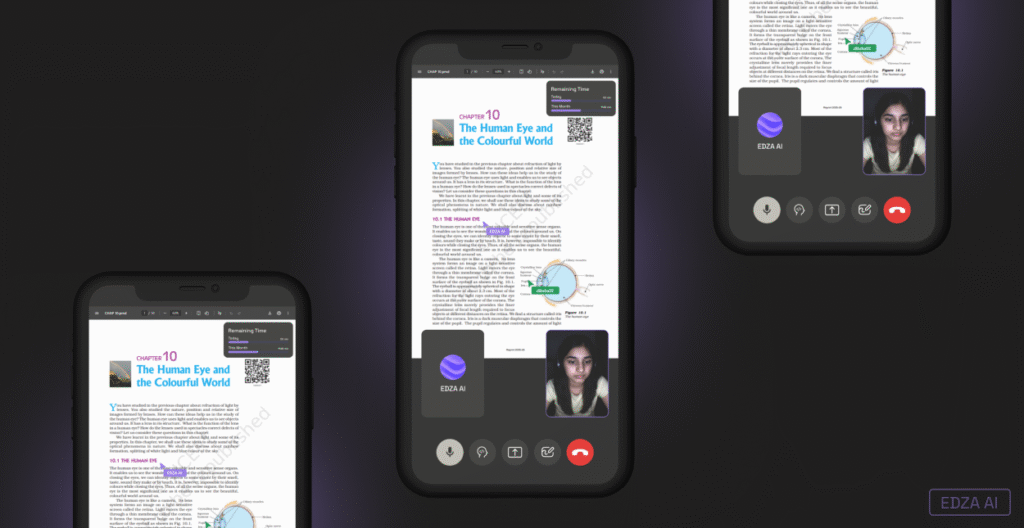
The core problem in Indian tutoring isn’t content scarcity—it’s attention scarcity. Overcrowded classes moved online during the EdTech boom, but scale mostly amplified the old “one pace for all” model. Students now sit in livestreams and large batches where doubts pile up, feedback is delayed, and pacing rarely matches individual need. The result is a structural attention deficit that traditional setups—physical or digital—haven’t solved.
Why ratio matters more than rhetoric
A high peer-to-tutor ratio (PTR) directly limits the room for questions, step-wise guidance, and iterative feedback—exactly what board-exam preparation demands (precision, marking-scheme alignment, and method marks). In much of India, tutors are stretched thin; many are part-time or under-trained, so even paid support becomes inconsistent.
What mass EdTech didn’t fix
Livestreams and video libraries expanded reach, not responsiveness. Students often face muted chats, fixed lesson plans, and little adaptation to their notes, language, or gaps. Platforms struggle to stay tightly aligned to specific board syllabi and marking schemes or to track each learner’s trajectory with enough granularity to change teaching on the fly.
Private tuition: proven, prized—and out of reach
One-to-one tutoring remains the gold standard because it can slow down on hard steps, speed up when ready, and teach from the student’s own notebook. But consistent access is limited and costly; even families who can pay get a few hours a week at best. That leaves the majority locked out of the most effective model.
The hard part to scale
What makes a good tutor effective—familiarity with a learner’s history, flexible pacing, and targeted reinforcement—is exactly what’s hard to mass-produce. Big classes (offline or online) flatten nuance; personalization becomes a slogan rather than a workflow.
A different approach: AI Personal Tutor built for Indian exams
A newer solution isn’t another answer engine or content shelf; it attempts to act like a personal tutor. The approach centers on interactive co-solving (not just final answers), teaching from the student’s own notes, and structuring explanations the way marks are awarded. Systems such as Edza AI now operationalize this with: voice tutoring in Indian languages, a shared whiteboard for step-by-step work, screensharing to “teach from your notes,” adaptive testing driven by recent mistakes, and persistent memory to avoid repeating failed explanations.
Under the hood, an explicit context protocol (MCP) brings in syllabus, past performance, language preferences, and common errors before the session starts—so the tutoring logic is exam-aware rather than generic.
Early signals and scope
With EDZA AI, initial usage patterns suggest demand for real-time, note-aware, voice-enabled, adaptive testing and whiteboard co-solving—peaking during traditional evening tuition hours. Within weeks of opening up in mid-July 2025, sign-ups reached roughly the four-thousand mark. Their rollout expanded beyond Class 10 to include Classes 11 and 12 on 15 August 2025, bringing the same board-aligned tutoring approach to senior secondary students.
What would count as real progress
Accountability over hype is essential. Practical markers of success would include:
• Higher attempt-to-mastery rates on tracked topics (not just time-on-app).
• Better alignment with marking schemes in written responses over time.
• Reduced repeat mistakes session-to-session due to persistent memory.
• Evidence that co-solving from a student’s own notes improves retention versus generic content.
These are the gaps traditional models leave open—and the ones an AI tutor must measurably close.
Keep the guardrails on
No AI replaces the empathy and mentorship of a strong human teacher; motivation and emotional support still skew human. But in systems where many learners currently receive little to no individualized attention, scalable, syllabus-aware tutoring can serve as a bridge—especially beyond metros and for families priced out of home tuition.
#AITutor #EdzaAI #IndianEdTech #NEP2020 #FutureOfTutoring
When Every Student Can’t Be Heard: India’s Ratio Problem and Edza AI’s Alternative