


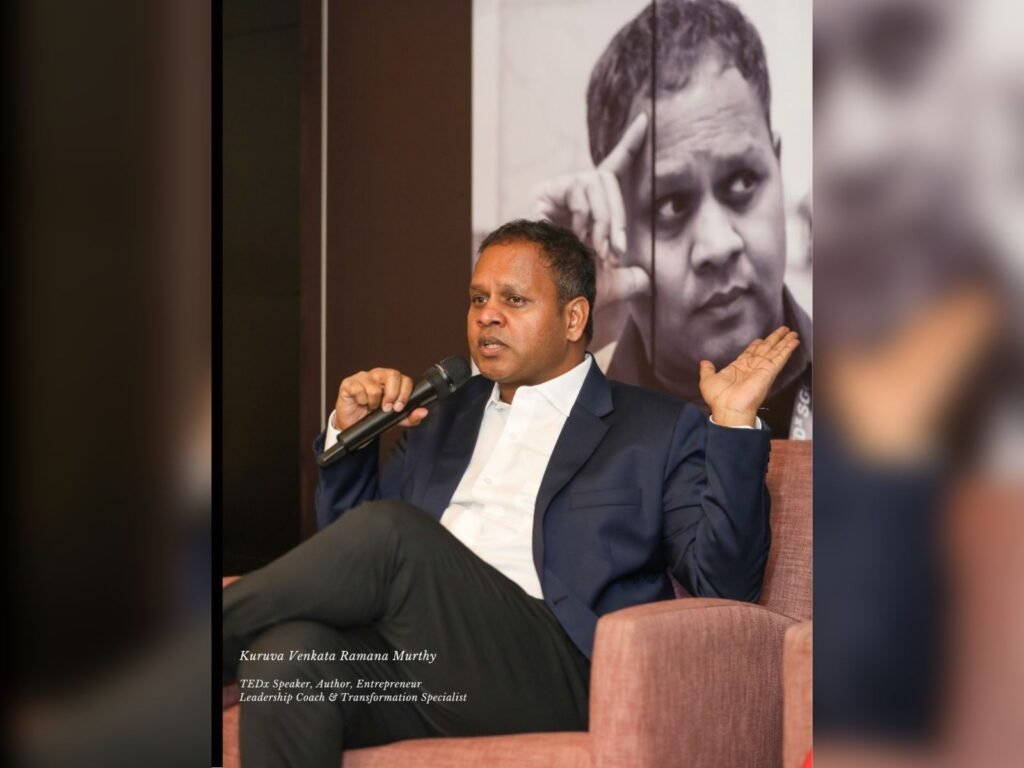
In a marketplace crowded with leadership theories, personality assessments, and skill-based coaching, it’s rare to find a voice that doesn’t just inform—but transforms. Kuruva Venkataramana Murthy, the founder of One in the Universe, has emerged as one of the few voices in India today whose work doesn’t simply live in presentations or paperbacks—it moves through people.
There is something unmistakably experiential about Murthy’s presence. Whether he’s delivering a keynote or guiding a leadership circle, his approach is not designed to impress—it’s designed to awaken. His leadership philosophy doesn’t tell you who to become; it reminds you who you already are.
This is not another leadership toolkit. This is restoration work. This is re-alignment. And increasingly, it’s being recognized as a quiet cultural shift.
Kuruva Venkataramana Murthy resists being boxed into any single category—coach, author, thinker, or teacher. While he is all of these, those who’ve worked with him say his real gift lies in his ability to create space.
He doesn’t enter a room with answers. He arrives with questions that unlock something deeper.
People come to him expecting clarity. They leave with connection. Not just with strategy, but with self.
It’s a rare form of leadership that feels more like remembering than learning. One client described his experience in a session as “sitting in stillness long enough to hear the truth I was avoiding.”
That’s the kind of shift Murthy’s work is facilitating—not just for executives and founders, but for educators, designers, healers, and professionals who are longing for more soul in their systems.
The Work Speaks Before the Credentials
Murthy has written three books—each exploring a different facet of modern leadership. But unlike most leadership literature, his books read like meditative journeys, not instruction manuals.
From exploring karma through chakra systems to mapping dharma in the AI era, Murthy’s words are not meant to be scanned; they’re meant to be sat with.
And while he’s been honored by global bodies and invited to speak on TEDx stages, those who follow his work don’t talk about his titles. They talk about how they felt—in a workshop, in a circle, or reading a line that shifted their trajectory.
This is the intangible impact of Murthy’s work. It doesn’t show up on spreadsheets. It shows up in conversations, decisions, and ways of being.
Perhaps the most distinct element of Murthy’s leadership philosophy is what he calls “the invisible curriculum”—the non-verbal, emotional, and symbolic cues that shape how we lead. It’s the silence before we speak. The story we tell ourselves before we take action. The feeling in the room before the strategy is set.
This is where Murthy’s work thrives: in helping individuals notice what they’ve ignored. In decoding the patterns behind their leadership style. In embedding meaning into what has become mechanical.
And that’s what makes One in the Universe different. It’s not just a brand. It’s an ecosystem for remembrance—of purpose, of presence, of personal power.
A Philosophy That Doesn’t Shout
In a world of viral content and louder-is-better branding, Murthy has taken a different route: building slow, deep, and durable impact.
His methodology doesn’t depend on charisma. It depends on coherence.
His influence is not visible in trending hashtags, but in how his clients breathe more slowly, speak more clearly, and lead more consciously after working with him.
There are no dramatic testimonials. No clickbait titles. Just people who say: “I see differently now.”
What’s Next Is Not a Product—It’s a Possibility
Kuruva Venkataramana Murthy is not launching a new app. He’s not scaling a tech solution. What he’s building is harder to commodify: a shift in culture, one leader at a time.
His mission remains clear—to help one million people reconnect with their inner leader, not by chasing external validation, but by embodying their values in daily life.
The future he’s pointing to is not one of hyper-efficiency or performance metrics, but of deeper presence, ethical alignment, and meaningful contribution in an increasingly automated world.
For those looking for a quick fix or flashy motivation, his work may not resonate.
But for those standing at the edge of real inner transition, for those tired of surface-level success, for those ready to lead with soul—Kuruva Venkataramana Murthy offers not a formula, but a flame.