


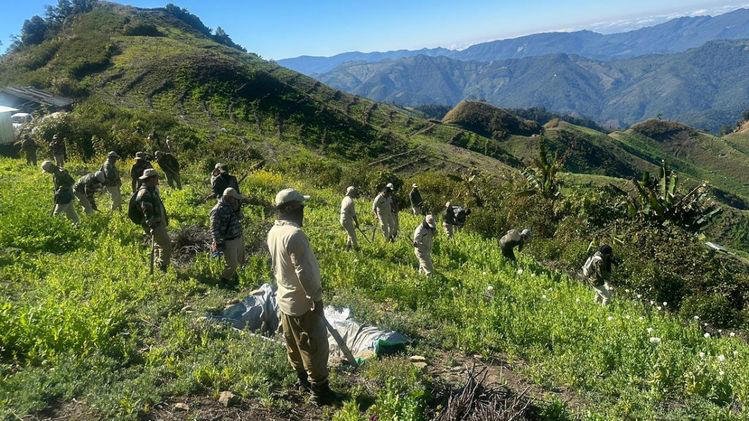
Security forces have destroyed around 40 acres of illegal poppy cultivation in the hilly areas of Manipur’s Churachandpur district. The operation was carried out as part of the state’s intensified anti-narcotics drive aimed at curbing drug production and trafficking. Officials said the action followed specific intelligence inputs about large-scale illegal cultivation in remote hill zones.
The destruction of poppy fields destroyed in Manipur reflects the government’s continued efforts to address the narcotics menace, which has emerged as a serious threat to public health, security, and social stability in the state.
Read More: Tripura to Restore Historic Jackson Gate
Operation conducted in remote hill terrain
The operation took place in interior hill ranges of Churachandpur, where dense forest cover and steep slopes make access challenging. Security personnel trekked long distances to reach the cultivation sites, which were spread across multiple hill slopes.
Officials confirmed that the poppy plants were uprooted and destroyed thoroughly to prevent regrowth. Teams followed established procedures to ensure the entire cultivated area was cleared. Due to the difficult terrain, logistical arrangements were made in advance to support the operation.
Authorities noted that such areas often provide concealment for illegal farming, making targeted actions necessary.
Why Churachandpur remains vulnerable
Churachandpur has emerged as one of the districts affected by illegal poppy cultivation due to its geographical features. The hilly landscape, combined with limited road connectivity, makes regular monitoring difficult.
Experts say poppy cultivation offers quick monetary returns compared to traditional crops. However, it directly fuels drug trafficking networks operating within and beyond the state. As a result, poppy fields destroyed in Manipur have become a central focus of enforcement agencies.
Officials added that awareness campaigns and livelihood support must go hand in hand with enforcement to address the root causes.
Government’s zero-tolerance policy on narcotics
The Manipur government has repeatedly reiterated its zero-tolerance stance against illegal poppy cultivation. Senior officials stressed that narcotics pose a serious danger to youth and undermine social order.
The destruction of poppy fields destroyed in Manipur aligns with the broader anti-drugs campaign being implemented across several hill districts. Surveillance has been strengthened, and coordination among security agencies has improved to detect cultivation sites early.
Authorities also appealed to local communities to cooperate with law enforcement agencies for long-term success.
Impact on drug trafficking networks
Security experts believe that destroying poppy fields disrupts the supply chain of illicit drugs at the source. It limits the availability of raw materials used to produce heroin and other narcotics.
By targeting cultivation areas, agencies aim to weaken organised networks involved in drug trafficking. Officials said the Churachandpur operation sends a strong message to those engaged in illegal farming.
Follow-up actions may focus on identifying financiers and intermediaries linked to poppy cultivation.
Challenges in enforcement efforts
Despite repeated operations, authorities face several challenges. Difficult terrain, unpredictable weather, and limited infrastructure often slow down enforcement efforts. In some areas, lack of awareness among local residents also poses difficulties.
However, officials said increased coordination and intelligence sharing have improved operational outcomes. The growing number of poppy fields destroyed in Manipur indicates stronger enforcement capacity.
The administration is also exploring the use of technology, including satellite imagery and drones, to detect illegal cultivation more efficiently.
Focus on rehabilitation and alternatives
Alongside enforcement, the government has emphasised rehabilitation and alternative livelihood programs. Officials believe economic vulnerability often pushes farmers toward illegal poppy cultivation.
Plans are underway to link affected communities with agricultural schemes, skill training, and employment opportunities. Authorities stressed that enforcement alone cannot resolve the issue without sustainable development support.
Way forward
The destruction of 40 acres of poppy fields destroyed in Manipur highlights the state’s firm commitment to combating narcotics. Officials confirmed that similar operations will continue in other vulnerable districts.
As Manipur intensifies its anti-narcotics drive, authorities aim to dismantle cultivation networks and safeguard future generations. The Churachandpur operation marks another step toward restoring law, safety, and social well-being in the region.
Read More: Amit Shah Assures Dialogue on Assam Council Status