


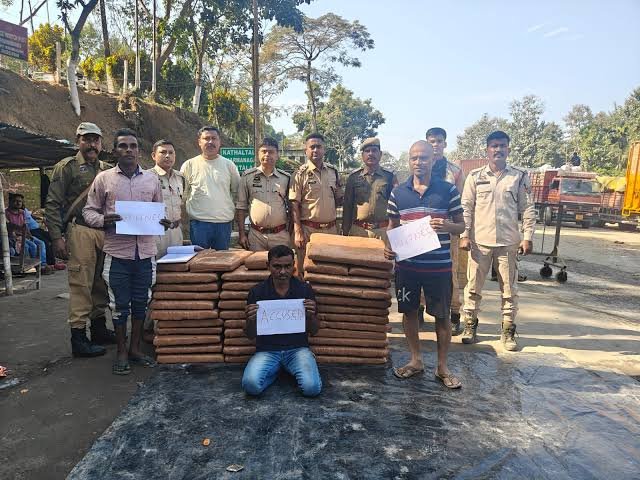
Tripura’s latest Churaibari anti-narcotics crackdown has intensified scrutiny of interstate routes used to move synthetic drugs into the state. North Tripura Police recently reported the seizure of 50 kg of suspected Yaba tablets near Panisagar, highlighting the continuing pressure on trafficking networks operating along the Assam-Tripura corridor.
The seizure forms part of a wider enforcement drive across Tripura and neighbouring states. Agencies including the Tripura Police, Narcotics Control Bureau and Directorate of Revenue Intelligence have reported several major synthetic-drug seizures in recent months.
The developments have also placed Churaibari under renewed attention because the Assam-Tripura border checkpost serves as an important entry route into Tripura. Authorities have responded with tighter vehicle checks, stronger intelligence gathering and plans for advanced scanning infrastructure.
However, the available records do not establish that every seizure belongs to one single syndicate. Instead, they show repeated attempts by trafficking networks to move contraband through the region.
BSF Tightens India Bangladesh Border Security Amid Fencing Drive
Churaibari Anti-Narcotics Crackdown Intensifies
The Churaibari anti-narcotics crackdown gained further attention after North Tripura Police reported a 50-kg seizure of suspected Yaba tablets under Panisagar Police Station. The district police described the operation as a major breakthrough against illegal trafficking of synthetic drugs.
The seizure is significant because Panisagar lies along the northern transport corridor connecting Tripura with Assam. Authorities have repeatedly intercepted narcotics on vehicles using this broader route.
A recent report by TripuraInfo said several consignments had entered Tripura through the Churaibari route before being intercepted farther inside the state. The report specifically referred to a major seizure at Panisagar involving nearly five lakh Yaba tablets.
Such cases demonstrate why enforcement cannot focus only on the border checkpost. Once a vehicle crosses into Tripura, agencies must continue monitoring transport routes and gathering intelligence about possible destinations.
The repeated seizures have therefore encouraged a wider enforcement approach. Police and other agencies are combining checkpoint inspections with intelligence-led operations farther inside the state.
Major Synthetic Drug Seizures Raise Concern
The latest action follows several major operations involving synthetic drugs in the Northeast. In September, the Directorate of Revenue Intelligence announced one of its largest methamphetamine seizures in the region.
According to the Directorate of Revenue Intelligence, officers intercepted four trucks at different locations in Assam and Tripura on September 15. Searches resulted in the seizure of 231.8 kg of suspected methamphetamine tablets and the arrest of three people.
One of the trucks was intercepted near Panisagar in Tripura. Officers recovered 50 kg of suspected methamphetamine tablets from the vehicle and arrested its driver, according to the official account.
Another truck was intercepted at Teliamura after travelling from Khowai toward Agartala. Authorities recovered 72.6 kg of suspected methamphetamine tablets from that vehicle, while two additional trucks intercepted in Assam accounted for another 109.2 kg.
The DRI said all four trucks had been seized. It described the operation as an intelligence-led action against a major drug-smuggling syndicate operating across the Northeast.
These figures show the scale of the wider enforcement challenge. They also explain why authorities are examining transport corridors linking Assam, Tripura and other northeastern states more closely.
NCB and Police Operations Add to Enforcement Pressure
The Churaibari anti-narcotics crackdown is occurring alongside separate operations by the Narcotics Control Bureau. In early September, the NCB Agartala Zonal Unit and its Aizawl Field Office reported two operations that together resulted in the seizure of 22.299 kg of methamphetamine tablets.
The NCB said one operation took place in Mizoram near the India-Myanmar border. The agency seized 14.26 kg of methamphetamine and arrested a Myanmar national during the operation.
The second operation took place in Tripura’s Sepahijala district. Officers intercepted a Tata Dumper near Bishramganj and recovered 8.039 kg of methamphetamine tablets. Three Tripura residents were arrested in that case.
The NCB said its investigation would examine the wider drug network, including financial links and intended recipients. That approach indicates that agencies are increasingly looking beyond individual carriers and attempting to identify the broader organisations behind trafficking.
Meanwhile, local police have continued conducting seizures at the Churaibari checkpost. In June, Assam Police seized 14,100 bottles of codeine-based cough syrup from a truck travelling toward Agartala and arrested the driver.
Although pharmaceutical cough syrup differs from synthetic stimulants, the repeated seizures illustrate the broader narcotics challenge along the Assam-Tripura transport corridor.
Vehicle Screening Becomes a Key Security Measure
The continuing seizures have also encouraged authorities to strengthen physical screening at Churaibari. The checkpost serves as an important gateway for vehicles entering Tripura from Assam.
In September, reports said the Tripura government planned to install vehicle scanners at the Churaibari border check gate. The proposed technology is intended to improve inspections and help identify illegally transported goods more efficiently.
The planned scanners could complement existing physical checks. Authorities currently rely on inspections and intelligence-based searches to identify suspicious consignments moving through commercial vehicles.
The need for stronger screening has become clearer as traffickers have repeatedly attempted to conceal contraband within legitimate cargo. Earlier seizures at Churaibari involved trucks carrying ordinary commercial goods, according to police reports.
Consequently, technology could provide another layer of detection at the entry point. It could also reduce dependence on purely manual inspection and allow officers to focus more closely on vehicles identified through intelligence.
However, equipment alone cannot dismantle organised trafficking networks. Investigators must also establish who finances shipments, who arranges transportation and where seized consignments were ultimately intended to go.
Authorities Focus on the Wider Trafficking Network
The Churaibari anti-narcotics crackdown reflects a broader shift from isolated seizures toward network-focused enforcement. Major investigations now increasingly involve multiple agencies and locations.
The DRI’s September operation provides a clear example. Investigators followed intelligence from one intercepted vehicle and subsequently identified another truck associated with the same suspected syndicate near Panisagar.
This type of intelligence-led enforcement can help agencies identify connections between apparently separate shipments. It also allows investigators to examine whether different transport vehicles form part of a larger distribution chain.
North Tripura Police has also maintained district-level coordination on narcotics issues. A district-level NCORD meeting was held on September 30 under the chairmanship of the North Tripura District Magistrate, with police and representatives from several government departments participating.
Such coordination provides a wider administrative framework for addressing drug trafficking. Police, health officials, revenue authorities and other departments can share information and coordinate preventive measures.
The emphasis on coordinated enforcement is particularly relevant for Tripura because the state sits close to multiple international and interstate trafficking corridors. Therefore, action at Churaibari represents only one part of a larger strategy.
Conclusion
The Churaibari anti-narcotics crackdown has intensified attention on the Assam-Tripura corridor following repeated seizures of synthetic drugs and other narcotic substances. The 50-kg suspected Yaba seizure near Panisagar and the DRI’s wider 231.8-kg methamphetamine operation demonstrate the scale of recent enforcement activity.
Authorities are now combining checkpoint inspections, intelligence-led searches, inter-agency coordination and planned vehicle-scanning technology. These measures aim to make it harder for organised trafficking networks to use commercial transport routes.
At the same time, investigators must distinguish individual seizures from proven links between different cases. Continued financial investigation, evidence-based arrests and coordination across state borders will be important for determining the wider structure of trafficking networks operating through the region.
FAQs
What is the Churaibari anti-narcotics crackdown?
The Churaibari anti-narcotics crackdown refers to intensified enforcement along the Assam-Tripura transport corridor, including vehicle inspections, intelligence-led operations and seizures of narcotic substances.
What was seized near Panisagar?
North Tripura Police reported the seizure of 50 kg of suspected Yaba tablets near Panisagar. The DRI separately reported a 50-kg suspected methamphetamine seizure from a truck near Panisagar in September.
How large was the DRI’s September seizure?
The DRI reported the seizure of 231.8 kg of suspected methamphetamine tablets from four trucks intercepted in Assam and Tripura. Three people were arrested.
Why is Churaibari important for Tripura’s drug enforcement?
Churaibari is an important Assam-Tripura entry point. Authorities have repeatedly intercepted narcotic consignments at or beyond the checkpost, making the corridor an important focus for enforcement.
Are authorities planning stronger screening at Churaibari?
Yes. The Tripura government has planned vehicle scanners at the Churaibari border check gate to strengthen inspections and improve detection of illegally transported goods.