


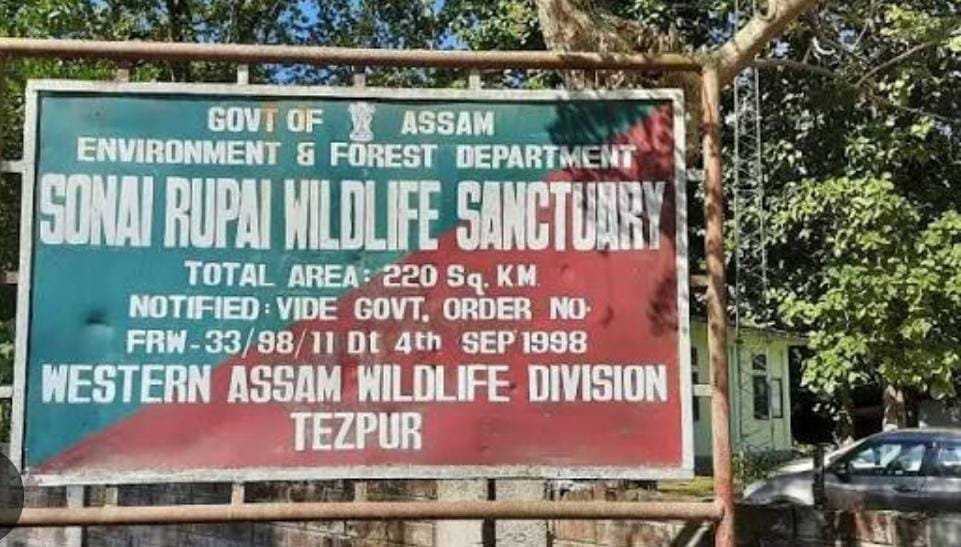
In Sonitpur district, Assam’s plan to regularise land in Sonai Rupai Wildlife Sanctuary has sparked sharp debate. The move aims to legalise settlement for over 2,400 people living inside the sanctuary and the adjacent Chariduar Reserve Forest. However, it comes in direct conflict with standing orders from the National Green Tribunal (NGT) that prohibit any form of encroachment in protected forest areas.
Officials from the Assam Forest Department confirmed that the proposal is under active consideration by the state government. Environmental groups, on the other hand, warn that such a move could harm biodiversity and undermine conservation laws.
Background: NGT Orders and Ongoing Encroachments
The NGT had previously directed the Assam government to prevent encroachments in wildlife zones, including Sonai Rupai Wildlife Sanctuary, which forms a vital corridor for elephants and other species between Arunachal Pradesh and Assam. The Tribunal’s earlier orders also required the state to evict illegal settlers to restore the area’s ecological balance.
Despite this, residents have continued to inhabit the region for decades. Many claim to be indigenous Assamese families displaced by river erosion and lack of land reforms. Their demands for land rights have intensified in recent years.
A senior official from the Sonitpur administration stated, “The government is weighing a humanitarian approach while complying with environmental guidelines.”
This statement highlights the complex balance between human rights and environmental protection, an issue often seen in forest-fringe regions of Assam.
Why the Decision Is Controversial
Environmentalists argue that allowing regularisation in a wildlife sanctuary sets a dangerous precedent. They point out that Sonai Rupai hosts endangered species such as elephants, tigers, and hornbills. Turning part of the sanctuary into residential land could fragment critical wildlife corridors.
Conversely, social activists stress that many of the settlers are poor farmers who migrated after losing their land to the Brahmaputra River’s floods. With limited alternatives, they say regularisation offers stability and livelihood.
The Assam Forest Department and Revenue and Disaster Management Department are jointly evaluating maps to determine which parts can be regularised without violating NGT norms. Still, experts say that reconciling these interests may prove difficult.
Local Reactions and Political Impact
The development has stirred mixed reactions within Sonitpur and across Assam. Some local leaders have welcomed the government’s humanitarian gesture, saying it aligns with the state’s broader initiative to regularise land for landless families.
However, conservationists and opposition parties have warned that the move could invite further NGT scrutiny. Environmental NGOs, including Aaranyak and WWF-India, have reportedly expressed concern over the possible dilution of conservation priorities.
Political observers note that this issue could become a flashpoint ahead of upcoming local elections, with leaders attempting to strike a balance between environmental accountability and social justice.
NGT and Legal Implications
If the Assam government proceeds with the plan, it may face legal hurdles. The NGT’s previous rulings explicitly prohibit settlement inside protected areas, including sanctuaries and reserve forests. Any violation could attract contempt proceedings.
A senior advocate specializing in environmental law explained, “Regularisation inside Sonai Rupai, without NGT clearance, would directly contradict judicial orders. The state must approach the Tribunal for permission before taking any step.”
This legal angle adds further complexity to the issue, emphasizing the need for careful administrative coordination and compliance.
Sonai Rupai: A Vital Ecological Corridor
Located in the foothills of Arunachal Pradesh, Sonai Rupai Wildlife Sanctuary covers nearly 220 square kilometers. It is home to rich biodiversity, including elephants, leopards, gaurs, and more than 100 bird species. The area also connects with Nameri National Park, forming part of an extended transboundary wildlife corridor.
Environmental researchers caution that unregulated human presence could lead to increased deforestation, poaching, and human-elephant conflict — all of which are already pressing issues in Sonitpur district.
Way Forward and Government’s Next Steps
Officials have hinted that the government may submit a detailed proposal to the NGT soon, explaining the need to regularise land in Sonai Rupai based on humanitarian grounds. They may also propose alternative forest zones for relocation, though such plans remain unclear.
State authorities have been urged to consult with both environmental experts and affected communities before proceeding. The final decision will likely depend on whether the Tribunal allows partial settlement under strict monitoring.
Balancing Humanity and Ecology
The Assam government’s move to regularise land in Sonai Rupai stands at a critical crossroads — between compassion and conservation. While providing land rights to displaced families addresses social needs, it must not come at the cost of Assam’s fragile ecosystems.
As the NGT reviews the matter, all eyes will remain on how the state reconciles human development with its ecological obligations.
READ MORE: Myanmar Delegation to Visit Assam for Ahom Ancestry