


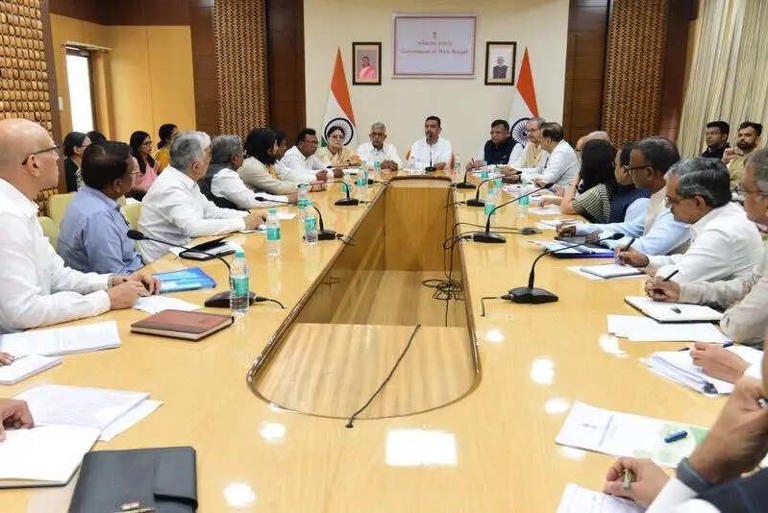
West Bengal Chief Minister Suvendu Adhikari on Monday announced that his government has initiated the process of transferring land to the Union Ministry of Home Affairs (MHA) for fencing unfenced stretches along the India-Bangladesh border.
The announcement came after the first cabinet meeting of the newly elected state government. Adhikari said the land transfer process had officially started and would conclude within the next 45 days.
According to the chief minister, the Border Security Force (BSF) will receive all the land required for completing the fencing work along vulnerable sections of the international border.
“The process of transferring the land commences today. It will be transferred to the MHA within the next 45 days. Whatever land the BSF requires will be provided,” Adhikari said while addressing reporters after the cabinet meeting.
Read More: Suvendu Adhikari’s Cabinet Reflects Bengal’s Geographical And Ethnic Diversity
Govt prioritises border fencing
Suvendu Adhikari stated that border security remains one of the major priorities of the new state government.
He said the administration wants to ensure faster completion of fencing work along unfenced stretches bordering Bangladesh.
According to the chief minister, better fencing and surveillance would help strengthen national security and improve border management.
West Bengal shares a long international border with Bangladesh. Several districts in the state remain strategically important because of their proximity to the border.
Officials said some stretches still lack fencing because of land-related issues and administrative delays.
The new government has now decided to accelerate the process by transferring the required land directly to the MHA for BSF operations.
Adhikari attacks previous TMC government
During his remarks, Adhikari sharply criticised the previous government led by Mamata Banerjee.
He accused the earlier administration of deliberately delaying border fencing projects for political reasons.
According to Adhikari, the previous government attempted to protect “certain vote banks and infiltrators” by slowing down the land transfer process.
The chief minister claimed that national security concerns did not receive adequate attention under the earlier administration.
He also alleged that administrative hurdles prevented the BSF from completing fencing work in several sensitive locations.
The Trinamool Congress, however, has not yet issued a detailed response to the allegations made by the chief minister.
BSF expected to benefit from move
The Border Security Force plays a crucial role in guarding the India-Bangladesh border.
Officials said fencing helps prevent illegal infiltration, smuggling, and cross-border criminal activities.
Security agencies have repeatedly stressed the importance of completing fencing projects in vulnerable areas.
According to officials familiar with border management, land acquisition and transfer issues often delay construction work.
The latest decision by the Bengal government may therefore speed up pending fencing projects.
Security experts believe improved fencing and surveillance can strengthen border monitoring and reduce illegal activities along the international boundary.
The BSF is also expected to receive administrative support for future infrastructure projects related to border security.
India-Bangladesh border remains sensitive
West Bengal shares one of the longest sections of the India-Bangladesh border. Several districts, including North 24 Parganas, Nadia, Murshidabad, Malda, and Cooch Behar, lie close to the international boundary.
Border areas have historically witnessed concerns related to illegal infiltration, smuggling, cattle trafficking, and cross-border crime.
Successive governments at the Centre have emphasised fencing as an important measure for strengthening national security.
Officials said fencing also helps improve monitoring and coordination between security agencies deployed in border regions.
The Union government has repeatedly highlighted the strategic importance of securing international borders through infrastructure development and surveillance systems.
Cabinet meeting discusses security and governance
The announcement regarding border fencing emerged from the first cabinet meeting of the newly elected government in West Bengal.
Officials said the meeting focused on governance priorities, administrative reforms, and infrastructure-related decisions.
Border security reportedly figured prominently during discussions because of its political and strategic importance.
The government has also indicated that coordination with the Centre would remain important for implementing security-related projects.
Political analysts believe the decision reflects the BJP government’s effort to prioritise national security issues in West Bengal.
The border fencing initiative may also become a major political talking point in the coming months.
Political significance of the decision
The issue of illegal infiltration and border security has remained a major political topic in West Bengal for years.
The BJP has frequently accused the previous Trinamool Congress government of failing to act firmly on border-related concerns.
At the same time, the TMC has often accused the BJP of politicising sensitive issues linked to migration and security.
Political observers believe the latest announcement signals the new government’s attempt to project a tougher stance on border management.
The decision may also strengthen the BJP’s political narrative regarding national security and governance.
Analysts noted that border districts often hold significant political importance during elections because of demographic and security-related debates.
Centre-state coordination likely to increase
Officials indicated that closer coordination between the Bengal government and the Union Ministry of Home Affairs is expected in the coming months.
The land transfer process may involve administrative surveys, documentation, and coordination with district authorities.
Security experts believe smoother cooperation between the state government and the Centre could accelerate infrastructure projects in border areas.
Apart from fencing, authorities may also focus on improving roads, surveillance systems, and border outposts.
The Centre has already invested in several infrastructure initiatives aimed at strengthening border security across the country.
The latest move by the Bengal government aligns with the Union government’s broader strategy regarding border management and national security.
Focus on security and development
The new Bengal government has indicated that national security and administrative reforms will remain among its key priorities.
Officials said border districts also require development initiatives alongside security measures.
Improved infrastructure, roads, and communication systems in border areas can help both local residents and security forces.
Experts believe comprehensive border management requires coordination between development policies and security planning.
The government has also stressed the importance of ensuring peace and stability in sensitive border regions.
Land transfer process begins immediately
Suvendu Adhikari confirmed that the process of transferring land to the MHA had already started following the cabinet decision.
He reiterated that all required land would become available to the BSF within the next 45 days.
The chief minister also assured that his government would cooperate fully with central agencies regarding border security measures.
As the process moves forward, attention will remain focused on how quickly the fencing work progresses in unfenced stretches of the India-Bangladesh border.
The latest announcement marks one of the first major policy decisions of the new Bengal government and signals its focus on security-related issues early in its tenure.
Read More: Manik Saha Says Modi Government Revived India’s Heritage