


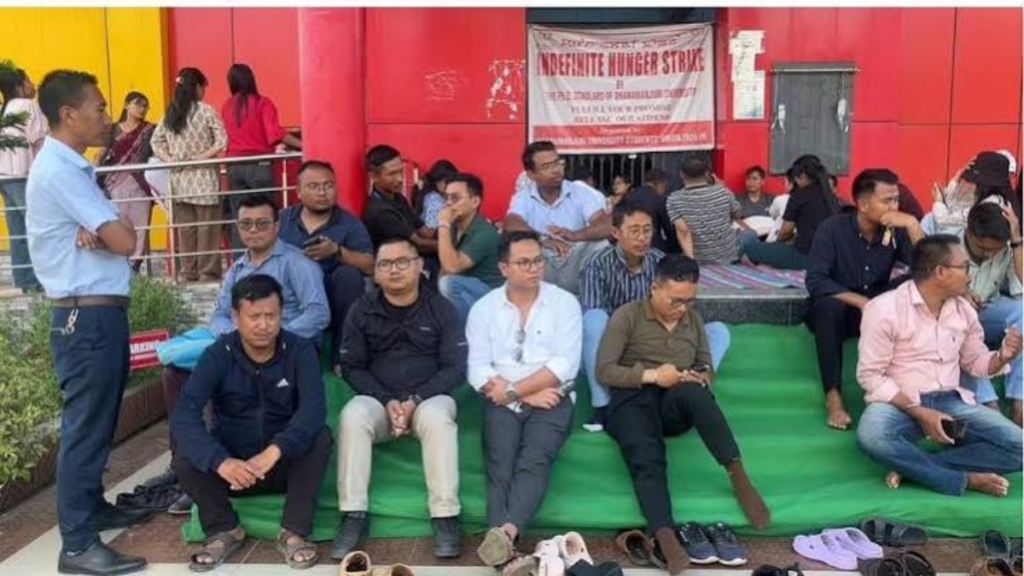
Dhanamanjuri scholars have received a fresh response from the Manipur government after a week-long hunger strike over pending stipends. The government has formed a panel to examine their demand and address the issue raised by the research scholars.
The move comes after the indefinite protest began on September 9 at Dhanamanjuri University (DMU) in Imphal. The agitation has drawn support from student groups and renewed attention to the financial difficulties faced by non-JRF research scholars.
Government panel follows prolonged protest
Dhanamanjuri scholars began the hunger strike after repeated demands for the release of their pending financial assistance failed to produce a payment, according to reports from the protest site. The scholars have said that their stipends have remained unpaid since the PhD programme began.
The protest initially involved five scholars. However, one later withdrew because of health concerns, while others continued the fast. By September 14, three PhD scholars and a student leader were reported to be participating in the hunger strike.
The government’s decision to form a panel marks a shift from the situation reported during the early days of the agitation. Protesters had said that they had not received a concrete response from the authorities despite continuing their fast.
What Dhanamanjuri scholars are seeking
Dhanamanjuri scholars are seeking payment of stipends that they say have been pending for several years. Reports indicate that the demand covers research scholars from the 2022, 2024 and 2026 batches.
The PhD programme at DMU began in 2022. According to reports citing protesters and student organisations, the proposed state stipend is Rs 8,000 a month. However, the scholars say they have not received the assistance.
The issue also gained attention during the recent Assembly proceedings. Reports said the government indicated that it was looking for a source of funds to meet the stipend requirement. Separately, university officials had reportedly raised the matter with Chief Minister Yumnam Khemchand Singh on July 30.
Health concerns grow during fast
The prolonged hunger strike has raised concerns about the health of the participants. During the protest, some scholars reportedly required medical attention after their condition deteriorated.
Manipur Lok Sabha MP Angomcha Bimol Akoijam visited the protesting scholars on September 13. A report said he helped arrange medical support, including nurses and an ambulance, as the fast continued.
Meanwhile, several student organisations have backed the scholars’ demand. The Democratic Students’ Alliance of Manipur and other groups have called for the release of pending payments and dialogue between the authorities and the protesters.
Research costs add pressure
The stipend dispute comes as research scholars face expenses linked to academic work. These can include fieldwork, data collection, books, laboratory materials, travel and publication-related costs.
Student organisations supporting the protest have also raised concerns about research facilities at DMU. The All Manipur Students’ Union said scholars from the 2022, 2024 and 2026 batches were not receiving adequate research support, while the Pangal Students’ Union cited a figure of about 800 affected non-JRF scholars.
Those figures come from student organisations and should be treated as claims about the number of affected scholars. The exact number covered by the government’s panel and the final amount of pending dues will depend on official verification.
Panel puts focus on a possible resolution
For Dhanamanjuri scholars, the panel offers a formal route for examining their long-running demand. Its work will be important because the dispute involves both the release of past dues and the mechanism for future payments.
The scholars and student bodies have called for a transparent and regular system so that research funding does not remain delayed. DESAM has also urged the authorities to create provisions covering fellowships, research contingencies and other academic expenses.
The immediate question is whether the panel can establish the number of eligible scholars, calculate the pending liability and identify the funding route. A clear decision on these points could determine the next stage of the agitation.
For now, the formation of the panel signals government engagement after seven days of hunger strike. The scholars’ demand, however, will ultimately depend on the outcome of the review and the steps taken to release the pending stipend.
Assam Records Zero Rhino Poaching in 2025, Major Conservation Milestone