


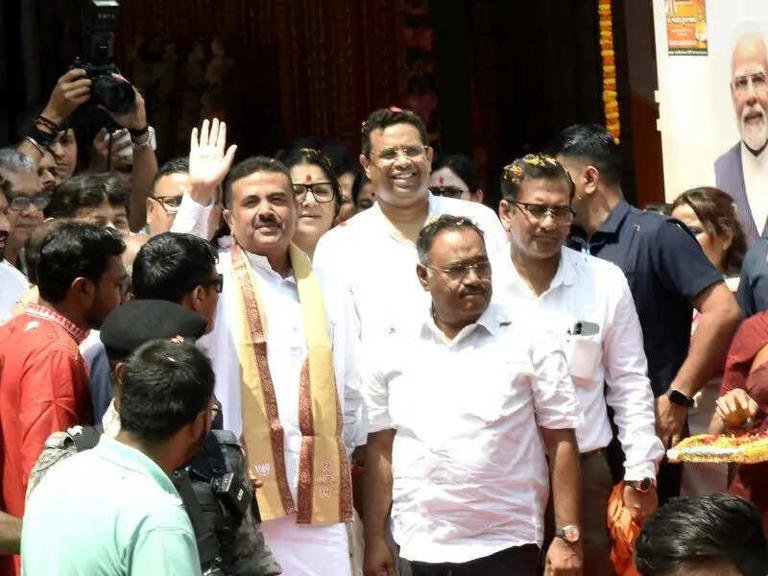
Senior BJP leader Samik Bhattacharya on Tuesday asserted that the government would function independently and not operate from the BJP office. His remarks came amid political discussions over the relationship between the party organisation and the administration following the BJP’s rise in West Bengal politics.
Addressing reporters, Bhattacharya said the government and the party organisation have separate constitutional and administrative responsibilities. He stressed that governance would follow democratic institutions and established procedures rather than political office directives.
The BJP leader also stated that elected representatives and ministers would work according to constitutional norms while maintaining accountability to the people.
His comments have drawn political attention because opposition parties have frequently accused the BJP of blurring the line between party structures and government administration in states where it holds power.
Read More: Manik Saha Says Modi Government Revived India’s Heritage
Samik stresses constitutional governance
During the interaction with the media, Samik Bhattacharya said the government must function independently within the framework of the Constitution.
According to him, the administration should operate through official institutions, departments, and legal procedures instead of party offices.
He stated that political parties play a role in shaping policies and election strategies, but governance requires institutional decision-making.
Bhattacharya also said ministers and bureaucrats would remain responsible for implementing policies through official channels.
The BJP leader argued that a democratic government should maintain transparency, accountability, and administrative discipline.
He added that governance must focus on public welfare rather than political symbolism.
Remarks come amid political debate
The statement comes at a time when political debates over governance and party influence continue across several states.
Opposition leaders in different parts of the country have often accused ruling parties of allowing political offices to influence administrative functioning.
Bhattacharya rejected such allegations and said the BJP believes in institutional governance.
He maintained that the party respects democratic structures and constitutional principles.
Political analysts believe his remarks aim to address criticism from opposition parties regarding the functioning of BJP-led governments.
The statement has also triggered discussions within political circles in West Bengal, where the BJP has attempted to expand its organisational base in recent years.
BJP focuses on governance narrative
The BJP leadership has repeatedly highlighted governance, development, and administrative reforms in its political messaging.
According to party leaders, the BJP wants governments to function with efficiency and accountability.
Bhattacharya said governance should prioritise development, infrastructure, welfare programmes, and public service delivery.
He added that political organisations and governments have different operational responsibilities.
The BJP leader also stated that elected governments must work for all citizens irrespective of political affiliation.
Party insiders believe such statements help reinforce the BJP’s governance-focused narrative ahead of future political contests.
Opposition reacts to statement
Opposition parties reacted strongly to Bhattacharya’s comments. Some leaders claimed the BJP was attempting to counter growing criticism regarding political influence over administration.
Critics argued that ruling parties often exercise significant control over decision-making through organisational structures.
Several opposition leaders also questioned whether governments can truly function independently from party leadership.
However, BJP leaders defended Bhattacharya’s remarks and said constitutional governance remains central to the party’s approach.
They argued that elected governments naturally coordinate with political organisations but administrative decisions follow official procedures.
The political exchange has once again intensified debates over governance and institutional autonomy in Indian politics.
Governance and party organisation
Political experts noted that the relationship between political parties and governments has always remained an important issue in parliamentary democracies.
Parties formulate ideological direction and electoral strategies, while governments handle administration and policymaking after elections.
Experts explained that constitutional systems require governments to function through official institutions such as ministries, departments, and legislatures.
According to analysts, tensions often emerge when opposition parties accuse ruling governments of excessive political interference in administration.
Bhattacharya’s remarks therefore carry significance because they directly address concerns regarding governance independence.
Observers also noted that the BJP wants to project itself as a party committed to institutional functioning and administrative discipline.
BJP’s growing focus in West Bengal
The BJP has steadily expanded its political presence in West Bengal over the past several years.
The party has intensified efforts to position itself as a major alternative to the ruling Trinamool Congress in the state.
Political analysts believe governance and administrative transparency remain key themes in the BJP’s strategy in Bengal.
Bhattacharya has emerged as one of the prominent BJP voices in the state and frequently comments on governance and political issues.
The BJP leadership has repeatedly accused the ruling state government of administrative failures and politicisation of institutions.
At the same time, opposition parties continue targeting the BJP over allegations of centralised political control in states governed by the party.
Public expectations from governance
Citizens across the country increasingly expect governments to function transparently and efficiently.
Issues such as public welfare, employment, infrastructure, healthcare, and education often dominate political discussions.
Political observers believe statements regarding independent governance aim to reassure voters about administrative accountability.
Experts also noted that governments face growing pressure to maintain institutional credibility and public trust.
Bhattacharya said the BJP remains committed to governance that prioritises development and people-centric policies.
He added that democratic systems function effectively only when institutions remain strong and accountable.
Debate over institutional autonomy continues
The broader debate regarding institutional autonomy and political influence continues in Indian politics.
Different political parties have often accused one another of using administrative structures for political purposes.
Analysts believe such debates become more prominent during election periods and political transitions.
Bhattacharya’s remarks have therefore attracted attention beyond West Bengal because they touch upon larger questions related to governance and democracy.
The BJP leader maintained that constitutional principles would guide administrative functioning under the party’s governance model.
He also stressed that governments should work independently while remaining accountable to elected leadership and public expectations.
BJP seeks stronger public messaging
Political observers believe the BJP is trying to strengthen its public messaging around governance and administrative reform.
The party has increasingly focused on development-oriented narratives and institutional efficiency in recent years.
Bhattacharya’s statement reflects the BJP’s attempt to present governance as separate from organisational politics.
Party leaders argue that effective administration requires professionalism, coordination, and transparency.
As political debates continue in West Bengal and across the country, discussions surrounding governance independence and party influence are likely to remain important topics in the coming months.
With elections and political competition intensifying, statements like Bhattacharya’s may continue shaping public discourse on democracy, administration, and constitutional functioning.
Read More: Suvendu Adhikari’s Cabinet Reflects Bengal’s Geographical And Ethnic Diversity