


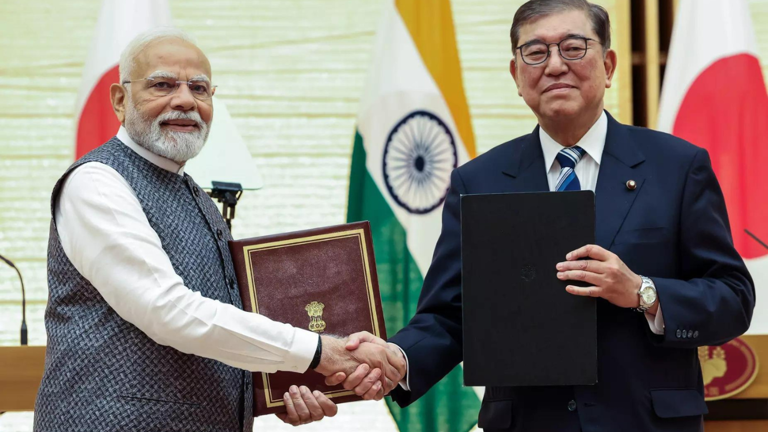
Prime Minister Narendra Modi’s two-day visit to Japan concluded with several significant announcements regarding India-Japan cooperation in technology, semiconductors, artificial intelligence (AI), and strategic economic partnerships. The visit aimed to deepen bilateral relations and chart a roadmap for collaboration in emerging sectors that are central to global competitiveness.
Read More: 5 Best Juices for Hair Growth: Amla to Beetroot Drinks
India Japan roadmap for technology and AI
During the visit, PM Modi and Japanese leaders discussed a long-term roadmap for technological cooperation. Both countries emphasized the importance of AI in driving economic growth, enhancing governance, and improving societal outcomes. They agreed to establish joint research initiatives and innovation hubs that focus on AI applications in healthcare, agriculture, education, and smart cities.
Officials highlighted that AI collaboration would include knowledge exchange programs, joint workshops, and training modules to enhance the skillsets of researchers and professionals in both countries. This initiative reflects the India Japan roadmap aimed at making both nations leaders in next-generation technologies.
Semiconductor cooperation and manufacturing
A major highlight of the visit was the agreement on semiconductor cooperation. India and Japan intend to work closely on semiconductor design, fabrication, and research. PM Modi emphasized that strengthening semiconductor capabilities is critical for technology independence and economic resilience.
Both countries plan to invest in semiconductor parks and facilitate joint ventures between Indian and Japanese companies. They also aim to create an ecosystem that supports startups and innovators in this sector. By collaborating on semiconductors, India and Japan hope to reduce reliance on imports and boost domestic manufacturing.
Strategic economic partnerships
Beyond technology, the India Japan roadmap also focuses on economic collaboration. Discussions included trade, investment, and supply chain resilience. Japanese companies expressed interest in investing in infrastructure, renewable energy, and digital transformation projects in India.
PM Modi highlighted that these partnerships will generate employment, enhance industrial competitiveness, and ensure technology transfer. Both nations agreed to streamline regulatory frameworks and encourage mutual investments in high-priority sectors, strengthening bilateral economic ties.
AI in governance and smart solutions
India and Japan also explored the use of AI for public service delivery and smart governance. They discussed projects that would improve healthcare diagnostics, traffic management, disaster response, and citizen services. The roadmap envisions AI-based solutions to enhance efficiency, transparency, and citizen satisfaction in governance.
Japanese expertise in smart city planning, combined with India’s digital infrastructure initiatives, will provide a strong foundation for these collaborative projects. Joint pilot projects in selected cities are expected to begin within the next year.
Research, innovation, and human resources
Another key outcome of the visit was a focus on research and human capital development. Both countries agreed to strengthen student exchanges, academic partnerships, and collaborative research in technology and engineering. Training programs in AI, robotics, and semiconductor engineering are planned to build a skilled workforce for emerging industries.
This initiative under the India Japan roadmap ensures that future generations of engineers, scientists, and innovators are prepared to tackle global technological challenges. It also fosters long-term academic and cultural ties between the two countries.
Strategic dialogue and regional security
While technology and economic collaboration were central, the visit also reinforced strategic dialogue between India and Japan. Leaders discussed regional security, maritime cooperation, and shared interests in maintaining stability in the Indo-Pacific region. Both sides emphasized the importance of rules-based order, peace, and collaboration in addressing global challenges.
This dimension of the India Japan roadmap demonstrates that bilateral cooperation extends beyond economic and technological sectors to include strategic and geopolitical alignment.
Strengthening bilateral trade and investment
The visit included agreements aimed at boosting bilateral trade. India and Japan agreed to improve trade facilitation, enhance logistics connectivity, and simplify regulatory processes. Japanese businesses will be encouraged to invest in India’s priority sectors, including semiconductors, electronics, and renewable energy.
Both countries also discussed joint industrial corridors and manufacturing hubs to strengthen supply chains. This strategic focus is expected to make India a key destination for Japanese companies seeking global market access.
Key outcomes summarized
In summary, PM Modi’s two-day visit to Japan produced several tangible outcomes:
- A roadmap for AI collaboration in governance, healthcare, education, and smart cities.
- Strategic partnership in semiconductor research, manufacturing, and innovation.
- Strengthened economic cooperation with increased investment and trade facilitation.
- Joint initiatives for research, innovation, and human resource development.
- Reinforced strategic dialogue and regional security collaboration.
These outcomes reflect a comprehensive India Japan roadmap that balances economic growth, technological advancement, and strategic alignment.
Future prospects
The agreements and discussions set the stage for sustained bilateral engagement. Both countries plan to implement joint projects over the next several years. Monitoring mechanisms and periodic reviews are expected to ensure progress.
The roadmap emphasizes long-term collaboration, with technology, semiconductors, and AI serving as pillars for economic resilience and global competitiveness. It also highlights the shared vision of India and Japan to lead in innovation, industrial development, and regional stability.
PM Modi’s visit to Japan has strengthened ties between the two nations across multiple sectors. The India Japan roadmap provides a clear framework for collaboration in AI, semiconductors, research, trade, and strategic affairs. By working together, India and Japan aim to create opportunities for innovation, economic growth, and regional leadership.
The visit demonstrates that strong bilateral relations can combine technology, investment, and strategic vision to address both domestic and global challenges. As the roadmap unfolds, India and Japan are poised to set new standards in technological cooperation and international partnership.
Read More: Loktak Lake: Magical Floating Paradise of Manipur