


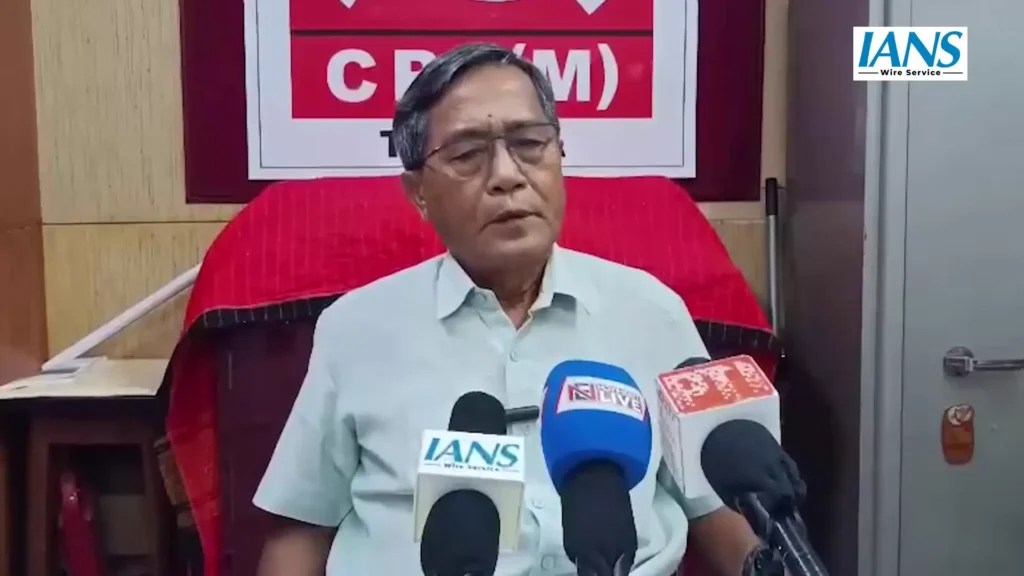
CPI(M) state secretary and Tripura Leader of Opposition Jitendra Choudhury has raised TTAADC counting process concerns following the declaration of results in the Village Committee elections. He alleged that opposition representatives faced obstacles at some counting centres and questioned whether the process remained fully transparent. His comments came after counting on October 5 witnessed tension, protests and clashes at several locations. The State Election Commission had earlier announced security and monitoring arrangements for the exercise.
Meghalaya Launches Conservation Project With 161 Camera Traps to Monitor Small Wild Cats
TTAADC Counting Process Concerns Emerge After Results
The TTAADC counting process concerns raised by Choudhury focus on the conduct of counting centres and the access available to opposition representatives. Addressing a press conference, the CPI(M) leader alleged that the opposition faced difficulties in entering some counting centres. He contrasted this with the party’s earlier complaints about problems during nomination filing.
Choudhury alleged that political pressure had affected different stages of the election. According to his account, opposition candidates had previously faced obstacles while submitting nominations. He then claimed that similar difficulties emerged when opposition representatives attempted to participate in the counting process. These remain allegations made by the CPI(M), and they have not been independently established across all affected locations.
The CPI(M) had already approached the State Election Commission before counting began. On October 1, Choudhury requested stronger security, uninterrupted webcasting and protection for counting agents. He also asked the Commission to deploy Central Armed Police Forces at counting halls and prevent unauthorised persons from entering the venues.
Those demands reflected the party’s concern that the counting stage could become politically sensitive. The CPI(M) wanted counting to continue without interruption once officials started the process. It also sought police protection for opposition agents travelling to and from counting centres where they requested assistance.
Counting Tensions Reported Across Tripura
The TTAADC counting process concerns gained significance because counting day saw disturbances in several parts of the state. Authorities began counting at 8 a.m. on October 5, with security deployed around the counting centres. The election involved 587 Village Committees and 4,597 seats, while direct polling took place for 2,950 seats.
Reports from counting centres described protests, road blockades and clashes in different areas. Security personnel used force to control some situations, including a lathi-charge reported in Khowai. One person died during violence near a counting centre, while reports also recorded injuries during clashes. The circumstances surrounding the death and the role of police action remained subject to investigation and competing claims.
Choudhury referred to the security situation while questioning the overall management of the counting exercise. He said that difficulties involving senior police officials raised questions about the protection available to ordinary voters and political representatives.
The CPI(M) also cited specific locations in its allegations. According to the party, opposition representatives faced problems entering a counting centre at Shalema in Kamalpur, while similar concerns arose at a Khowai venue. The party additionally alleged that roads leading to counting centres in Kathalia and Thalibari were blocked. These claims have not been independently verified.
Meanwhile, authorities had prepared a multi-layered security arrangement before counting. Around 2,000 personnel were assigned to the exercise, while central forces, Tripura Police and Tripura State Rifles were deployed at counting locations. Officials also expected counting to take longer in blocks handling larger numbers of Village Committees.
CPI(M) Questions Transparency and Result Declarations
Another part of the TTAADC counting process concerns involves the timing of result declarations. Choudhury specifically pointed to Pecharthal, where he claimed Left Front candidates had secured victories in three Village Committees during the morning, but the formal declarations were delayed for several hours.
The CPI(M) argued that such delays required explanation because political parties and candidates depend on formal declarations to establish the final outcome. However, a delay in announcing a result does not by itself establish that counting was inaccurate or that votes were changed. The distinction remains important while assessing the party’s allegations.
The opposition has therefore called for a closer examination of the counting process and related incidents. Its demands include an impartial inquiry into alleged irregularities, stronger protection for political representatives and greater transparency in the handling of results.
The demand for webcasting has also remained central to the CPI(M)’s position. Choudhury had asked the State Election Commission to provide continuous live coverage from counting halls. Such monitoring, according to the party, would allow candidates and the wider public to follow the process more transparently.
At the same time, the State Election Commission had publicly outlined its arrangements before counting began. Officials said counting would take place across designated centres under enhanced security. The commission also conducted repolling at three polling stations on October 3 after earlier complaints and incidents during polling.
The commission’s earlier decisions have themselves become part of the political debate. A report on the election process said the SEC acknowledged booth capturing and bogus voting in three seats and ordered repolling there. CPI(M), however, sought repolling in additional seats and criticised what it viewed as an insufficient response to its complaints.
TTAADC Counting Process Concerns Meet NDA Victory Claims
The TTAADC counting process concerns have also become connected to the political interpretation of the final results. Choudhury questioned the ruling alliance’s presentation of the outcome as an NDA victory and argued that the political reality in the tribal areas required a different reading.
The Village Committee elections took place after the BJP and Tipra Motha entered into an electoral understanding. However, the arrangement was not implemented uniformly across every constituency, and candidates from alliance partners appeared in some overlapping contests. This created room for competing interpretations of the final figures.
The final declared results showed Tipra Motha winning 3,428 of 4,594 declared seats, while the BJP secured 859. CPI(M) won 87 seats, Independents secured 173, IPFT won 33 and Congress took 14. Three seats remained vacant. These figures established Tipra Motha as the largest individual party in the Village Committee results.
Chief Minister Manik Saha, meanwhile, described the outcome as a success for the NDA and maintained that the alliance partners had worked together through seat-level adjustments. Choudhury disputed the political framing and argued that the individual performances of the parties should also receive attention.
The competing narratives show why the election remains politically significant beyond the final seat tally. For the ruling alliance, the combined performance demonstrates its strength across the tribal areas. For the CPI(M), the process itself has become an issue involving electoral safeguards, opposition participation and institutional credibility.
The debate could continue as parties assess the result ahead of future political contests. The TTAADC region covers a substantial part of Tripura and includes 20 of the state’s 60 Assembly constituencies, making grassroots electoral trends important for the wider political landscape.
TTAADC Counting Process Concerns Put Election Commission Under Focus
The TTAADC counting process concerns ultimately place the State Election Commission at the centre of the post-election debate. The commission is responsible for ensuring that counting follows established procedures and that candidates and authorised counting agents receive the access required under election rules.
The CPI(M) has called for an impartial examination of the allegations it raised. The party argues that complaints involving counting-centre access, security and delayed declarations should receive proper scrutiny rather than being treated only as political disputes.
However, allegations from a political party should remain clearly distinguished from findings established by election authorities or an independent inquiry. Reports of disturbances at some centres demonstrate that counting day was tense, but they do not automatically prove that the final results were inaccurate.
The commission’s earlier decision to conduct repolling in three seats demonstrates that it acted on specific complaints during the polling stage. Whether additional action is necessary over counting-related allegations would depend on official reports, evidence and any subsequent investigation.
For the credibility of the election, transparency remains important even after results are announced. Clear explanations about disputed incidents, access for authorised agents and the handling of complaints can help address concerns raised by opposition parties.
The issue is particularly relevant because the Village Committee elections were the first such polls in Tripura in about a decade. The high turnout and the scale of the exercise have given the results wider political importance. Consequently, confidence in the counting process remains an important part of the election’s overall assessment.
Conclusion
The TTAADC counting process concerns raised by Jitendra Choudhury have added a significant opposition challenge to the post-election debate in Tripura. The CPI(M) has alleged problems involving access to counting centres, security arrangements, delayed result declarations and other incidents.
The final results nevertheless remain the declared outcome of the State Election Commission. Tipra Motha secured 3,428 of 4,594 declared seats, while the BJP won 859 and CPI(M) secured 87.
The next stage will depend on how authorities address the opposition’s specific complaints. Transparent clarification of disputed incidents could help strengthen confidence in the electoral process, while political parties will continue to draw their own conclusions from the results.
FAQs
What are the TTAADC counting process concerns raised by Jitendra Choudhury?
The TTAADC counting process concerns relate mainly to alleged obstruction of opposition representatives, security problems, access to counting centres and delays in formally declaring some results. The CPI(M) has sought greater transparency and an impartial examination of its complaints.
What did CPI(M) demand before counting began?
Jitendra Choudhury requested tighter security, continuous webcasting, Central Armed Police Forces at counting halls and protection for opposition counting agents. He also sought restrictions on unauthorised entry into counting centres.
How many seats did Tipra Motha win?
Tipra Motha won 3,428 of the 4,594 seats for which final results were declared. The BJP won 859, while CPI(M) secured 87 seats.
Were there disturbances during TTAADC counting?
Yes. Reports described protests, road blockades and clashes at several counting locations. Security personnel intervened at some centres, and one person died during violence near a counting centre. The circumstances surrounding the death remain subject to investigation.
Has the counting process been officially declared inaccurate?
No. CPI(M) has alleged irregularities and questioned the conduct of counting, but those political allegations should not be treated as established findings of widespread counting inaccuracy. The State Election Commission remains the authority responsible for the official results and handling election-related complaints.