


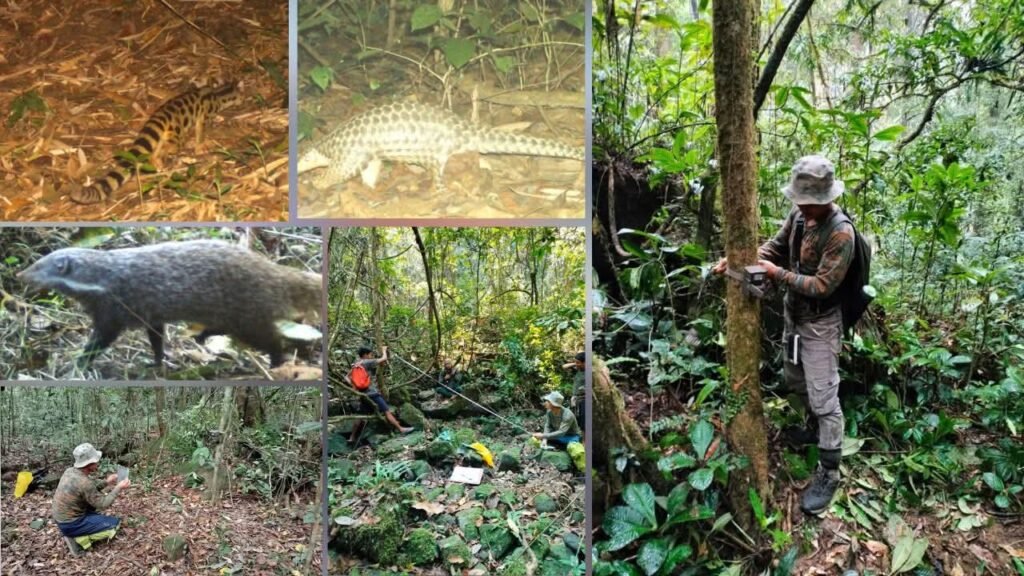
Shillong, Meghalaya: The Meghalaya Forest and Environment Department has launched a major conservation initiative to monitor small wild cats and other elusive mammals across the state’s forests. Officials are deploying 161 camera traps along with extensive field surveys under the project titled “Strengthening In-Situ Conservation of Small Cats and Other Elusive Mammals in the State of Meghalaya.”
The initiative aims to map the distribution and population status of small cat species. It will also study how different species share forest habitats and strengthen wildlife monitoring systems. The project brings together government agencies and conservation experts to improve long-term protection of Meghalaya’s forest wildlife.
Read More: NDA Wins 4,320 Seats in Tripura TTAAD Polls
Key Facts
- Location: Meghalaya
- Project: Strengthening In-Situ Conservation of Small Cats and Other Elusive Mammals
- Camera traps: 161
- Lead department: Meghalaya Forest and Environment Department
- Partner: Global Tiger Forum (GTF)
- Focus: Small wild cats and elusive mammals
- Main goal: Species mapping, monitoring and conservation planning
- Long-term target: State-level wildlife atlas and conservation action plan
161 Camera Traps to Track Elusive Wildlife
The Meghalaya government has started deploying 161 camera traps across selected forest areas as part of the conservation programme.
These cameras can record wildlife activity without disturbing animals. Therefore, they can provide valuable information about species presence, movement patterns and habitat use.
Alongside camera trapping, field teams will conduct extensive surveys to gather additional information about small cats and other elusive mammals.
The combined approach can help researchers build a clearer picture of wildlife populations across Meghalaya.
Focus on Small Wild Cats
Small wild cats often remain difficult to study because they are secretive, nocturnal and occur in dense forest habitats.
The Meghalaya project will focus on understanding their distribution and status across different landscapes.
Moreover, researchers will examine how various small cat species coexist within the same ecosystems. This information can help identify important habitats and areas that require stronger conservation measures.
The project will also gather information about other elusive mammals that share these forest environments.
Meghalaya Forest Department and GTF Join Hands
The conservation programme represents a joint effort between the Meghalaya Forest and Environment Department and the Global Tiger Forum (GTF).
Both organisations will work towards improving scientific monitoring and strengthening conservation practices.
The initiative also aims to improve monitoring at the frontline level. Forest personnel and local communities can play an important role in identifying wildlife activity and reporting changes in forest ecosystems.
As a result, the project seeks to combine technology, scientific research and community participation.
Community-Based Monitoring Gets Focus
The programme does not rely only on camera traps and scientific surveys.
It also aims to strengthen community-based wildlife monitoring systems. Local communities often have detailed knowledge of forest landscapes and wildlife movement.
Therefore, involving communities can improve the collection of field information and encourage greater participation in conservation.
The approach could also help authorities identify emerging threats to small wild cats and other mammals at an early stage.
State-Level Wildlife Atlas Planned
One of the major long-term objectives involves creating a state-level atlas for small cats and other elusive mammals.
The atlas could document species distribution, habitat patterns and other important conservation information across Meghalaya.
In addition, authorities plan to develop a comprehensive conservation action plan based on information gathered through the project.
Such a plan could help guide future wildlife management and habitat protection efforts in the state.
Importance for Meghalaya’s Forests
Meghalaya forms an important part of the biodiversity-rich Northeast India region. Its forests provide habitat for a wide range of mammals and other wildlife.
However, elusive species often remain poorly documented because researchers find them difficult to observe directly.
Therefore, systematic camera trapping and field surveys can provide important evidence for conservation planning.
The new initiative could strengthen Meghalaya’s understanding of its small wild cat populations while supporting broader efforts to protect the state’s forest ecosystems.
Questions and Answers
What is Meghalaya’s new conservation project?
It is a programme focused on conserving small wild cats and other elusive mammals in the state.
How many camera traps are being deployed?
Officials are deploying 161 camera traps.
Who is implementing the project?
The Meghalaya Forest and Environment Department is working with the Global Tiger Forum.
What will the project study?
The project will map species distribution, assess their status and study how different species coexist.
What is the long-term goal?
Authorities aim to create a state-level atlas and a comprehensive conservation action plan.
Location Context
Meghalaya is part of the biodiversity-rich Northeast Indian landscape, where extensive forests support numerous wildlife species. Protecting elusive mammals in these habitats can contribute significantly to regional biodiversity conservation.