


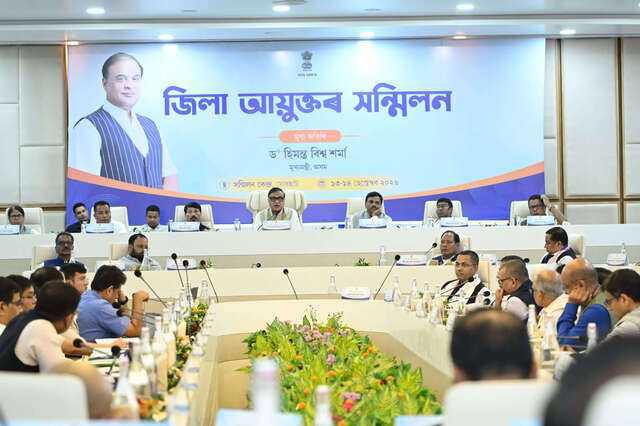
The Assam government recently held a two-day Deputy Commissioners’ Conference in Jorhat to review development and governance across the state. Chief Minister Himanta Biswa Sarma chaired the conference, which concluded late on September 14.
The meeting brought together Deputy Commissioners, senior officials and ministers. They discussed district-level development, public grievances, revenue administration, infrastructure, law and order and the implementation of state and Central government schemes.
The conference also focused on improving public services. The government wants district administrations to respond faster to people’s needs. It also wants development programmes to reach beneficiaries without unnecessary delays.
Read More: Assam CM Reviews Flood Damage Survey, Sets October 10 Deadline
Focus on People-Centric Administration
Improving the relationship between district administrations and citizens emerged as a major theme. Sarma asked Deputy Commissioners to remain visible and accessible to people.
The Chief Minister also called for a more field-oriented approach to administration. He asked officials to move beyond a routine office-based working style and spend more time understanding problems on the ground.
The government wants citizens to receive services without unnecessary intermediaries. It also stressed the importance of making government schemes easier to access.
The conference therefore placed district administrations at the centre of Assam’s governance strategy. Officials discussed ways to improve coordination between departments and speed up the delivery of public services.
Education and Student Dropout Rates
Education featured prominently in the discussions. The government reviewed the problem of student dropouts at the secondary level.
Officials discussed possible interventions to encourage students to remain in school. District administrations will play an important role in identifying local reasons for school dropouts and developing suitable responses.
The government also wants to improve infrastructure in educational institutions. Schools, colleges and universities will form part of a wider infrastructure investment programme planned under the Viksit Assam 2047 vision.
The focus on education combines better infrastructure with efforts to improve student retention. The government expects district officials to monitor progress and identify areas that need additional attention.
Healthcare Expansion Across Districts
Healthcare was another key subject at the conference. The government reviewed the implementation of the TB Mukt Bharat Abhiyan and discussed the expansion of medical infrastructure.
One major proposal involves the phased conversion of 4,000 health sub-centres into hospitals. The state Budget has already announced this plan.
The government also discussed the establishment of new medical colleges at different locations. These projects could expand healthcare capacity and provide more specialised medical services within the state.
District administrations will need to coordinate with health authorities to ensure that these projects move forward effectively. The conference highlighted the importance of translating policy decisions into services that people can access locally.
Rs 50,000 Crore Investment Push
Investment and infrastructure development received significant attention during the conference. The Assam government has prepared a plan to facilitate investments worth around Rs 50,000 crore as part of its Viksit Assam 2047 vision.
The investment programme will cover several government infrastructure projects. These include Anganwadi centres, stadiums and infrastructure at schools and universities.
District Commissioners discussed projects proposed for their respective districts. The government wants district-level planning to play a bigger role in implementing the investment programme.
The plan forms part of Assam’s broader effort to strengthen infrastructure and create conditions for long-term economic development.
Land Banks for Industrial Development
Industrial development also featured in the discussions. The government wants to create land banks in every district to support future industrial projects.
Sarma highlighted the need for adequate land as investment proposals increase. He noted that Assam currently has less than 10,000 bighas earmarked for future industrial development.
The government compared this with larger land reserves in states such as Gujarat and Maharashtra. District-level land banks could give investors access to suitable land and help speed up the process of establishing industries.
The proposal also places greater responsibility on district administrations. Officials will need to identify suitable land and coordinate with the departments involved in industrial development.
Flood Damage and Embankment Reconstruction
The recent floods also featured in the conference discussions. Assam continues to face challenges from recurring floods and damage to embankments.
The government reviewed plans to reconstruct embankments damaged during the recent floods. Officials also discussed measures needed to strengthen flood-related infrastructure.
Sarma later reviewed the rapid flood damage assessment in Sivasagar, Charaideo, Jorhat and Golaghat. He directed district administrations to complete the second phase of the survey before October 10.
The government wants officials to ensure accurate and evidence-based assessments. It also wants genuine affected families to receive assistance without delays.
Khel Maharan and Youth Development
The forthcoming Khel Maharan programme also featured in the discussions. The initiative aims to promote sports participation across Assam.
District administrations will have an important role in organising sporting activities and ensuring participation at the grassroots level.
The focus on sports forms part of the government’s wider approach to youth development. Better sports infrastructure and wider participation can also create opportunities for young people across districts.
The proposed construction of new stadiums under the infrastructure programme could further support this objective.
Implementation of Government Schemes
The conference also reviewed the implementation of programmes under the Assam government’s Sankalpa Patra. Officials discussed how different schemes could reach beneficiaries more effectively.
The government wants Deputy Commissioners to monitor implementation closely. It also expects district administrations to identify bottlenecks and coordinate with departments when projects face delays.
State and Central government schemes formed part of the wider review. The discussions focused on ensuring that approved programmes translate into actual benefits for people at the district level.
Seva Sankalpa Abhiyan Announced
The government also announced the Seva Sankalpa Abhiyan, scheduled across Assam from September 17 to October 17.
The month-long campaign will include drawing, quiz and speech competitions. It will also feature programmes involving Anganwadi workers, ASHA workers and mid-day meal cooks.
Seva Setu camps will take place at the block level. Residents will be able to submit applications and raise grievances through these camps.
The campaign aims to connect government programmes with citizens at the grassroots level. District administrations will have a key role in organising and implementing the activities.
Road Ahead for Assam’s District Administration
The Assam Deputy Commissioners’ Conference brought several areas of governance under one review. Education, healthcare, infrastructure, investment, industrial development, flood management and public service delivery all featured in the discussions.
The conference also placed greater emphasis on district-level implementation. Deputy Commissioners will need to coordinate with departments, monitor projects and address local concerns.
The government’s proposed Rs 50,000 crore investment plan adds another major responsibility for district administrations. At the same time, ongoing issues such as flood rehabilitation and public service delivery require immediate attention.
The discussions in Jorhat have therefore created a broad roadmap for Assam’s district administration. The next stage will focus on implementation, monitoring and ensuring that decisions taken at the conference reach people across the state.
Read More: Chief Minister Rekha Gupta Announces Hostels for 10,000 Students in Delhi