


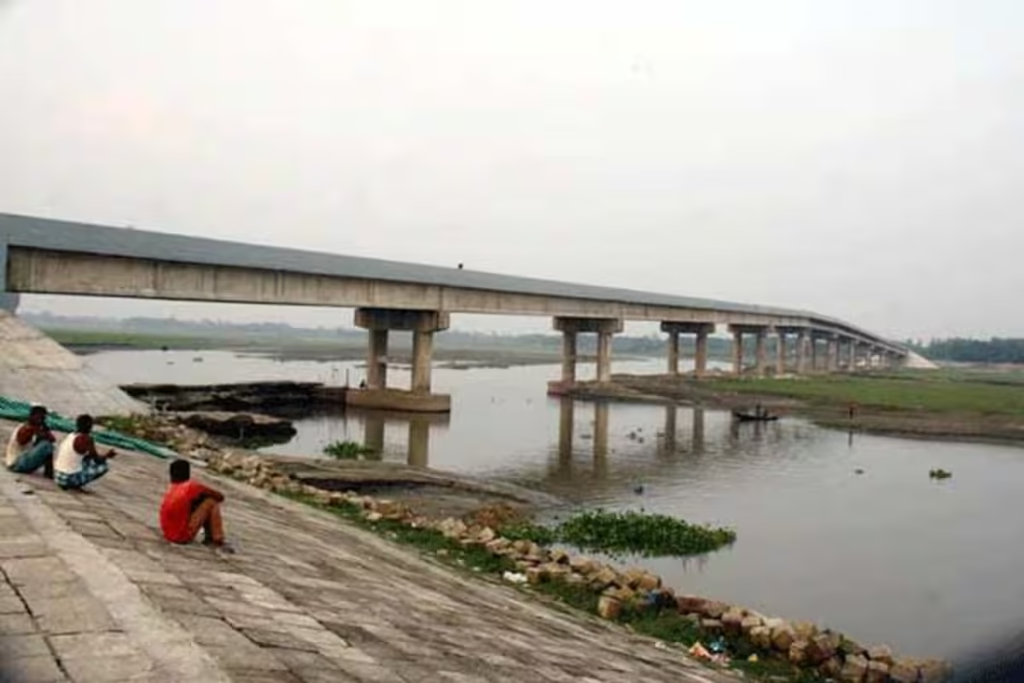
The Maitri Setu trade delay continues to frustrate Tripura’s business community more than five years after the bridge’s inauguration. The 1.9-kilometre bridge connects Sabroom in Tripura with Ramgarh in Bangladesh across the Feni River.
Prime Minister Narendra Modi inaugurated Maitri Setu in March 2021, with the project presented as a major gateway for Northeast India’s trade with Bangladesh and Southeast Asia. Yet full-scale commercial operations through the corridor have remained delayed.
The issue has gained renewed attention as traders and investors seek a clear timeline for activating the Sabroom-Ramgarh route. The bridge itself stands completed, but an international trade corridor requires customs, immigration, cargo-handling and bilateral arrangements to operate together.
BSF Tightens India Bangladesh Border Security Amid Fencing Drive
Maitri Setu Trade Delay Raises Business Concerns
The Maitri Setu trade delay has become a major concern for Tripura’s exporters, importers and logistics stakeholders. The bridge was designed to provide a shorter connection from the Northeast to Bangladesh’s Chattogram port.
At its 2021 inauguration, the Centre described Maitri Setu as an important link for trade and people-to-people movement. The bridge was expected to strengthen Tripura’s position as a gateway for the Northeast and create new opportunities in tourism, trade and port-led development.
The strategic advantage comes from Sabroom’s location. Chattogram port is roughly 80 kilometres from Sabroom, giving the route potential to reduce logistical dependence on longer connections through mainland India. The government had also envisioned the corridor as a route supporting access for other northeastern states.
However, the bridge’s completion did not automatically create an operational trade corridor. Border infrastructure on both sides, customs procedures and bilateral arrangements must work together before regular commercial movement can begin.
That gap between completed infrastructure and actual operations has become the central concern for local businesses. Traders want certainty over when they can use the route and what procedures will govern cargo movement.
Sabroom Land Port Remains Crucial to the Corridor
The Maitri Setu trade delay is closely connected with the readiness of the Sabroom Integrated Check Post. The land port forms an important part of the infrastructure required to manage cross-border movement.
The Land Ports Authority of India has described the Sabroom project as strategically important because of its location at the southern end of Tripura. The facility was planned alongside Maitri Setu to support the movement of goods and passengers between India and Bangladesh.
The Centre laid the foundation stone for the Sabroom Integrated Check Post in March 2021. At the time, the government said the facility would help create new market opportunities for northeastern products and support smoother cross-border passenger and goods movement.
Earlier reports also identified missing or incomplete facilities on the Bangladesh side as a factor behind the delay. In 2022, an official said trade had not started because a Land Customs Station had not been established on the opposite side of the Feni River.
The situation later became more complicated by political instability in Bangladesh. Reports in 2024 said the political upheaval affected plans for passenger and commercial movement through the bridge and also created uncertainty around the Sabroom land port.
Consequently, activating Maitri Setu requires more than simply opening the bridge. Both sides need compatible border facilities, operational clearances and arrangements that allow predictable movement.
Trade Experts Seek Clear Operational Timeline
The Maitri Setu trade delay has increasingly become a business issue rather than simply an infrastructure concern. Traders need a functioning corridor that provides predictable procedures, reasonable logistics costs and reliable access to markets.
The India-Bangladesh Chamber of Commerce’s Tripura chapter has previously raised concerns about barriers affecting cross-border trade. Trade representatives have argued that infrastructure alone cannot generate commercial activity unless regulatory restrictions and operational gaps are also addressed.
At the Destination Tripura Business Conclave 2026, the Sabroom Land Port again featured prominently in discussions involving investors, exporters and business representatives. Participants sought greater clarity on when full-fledged commercial trade could begin through the Sabroom-Ramgarh corridor.
The demand reflects the broader economic expectations attached to Maitri Setu. Businesses see the corridor as a potential route for exporting goods from Tripura and other northeastern states while improving access to international markets.
Moreover, a predictable cross-border route could encourage investment in warehousing, transportation, processing and logistics around Sabroom. Tripura’s own infrastructure assessment has identified the area near Maitri Setu as a potential location for an 80-acre multimodal logistics park.
Such investment, however, depends on the underlying trade route becoming commercially viable. Investors are unlikely to commit fully to logistics infrastructure without clarity over border operations and cargo movement.
Sabroom’s Gateway Potential Depends on Connectivity
The Maitri Setu trade delay matters because Sabroom forms part of a larger connectivity strategy for Tripura and the Northeast. The bridge was never intended to function as an isolated infrastructure project.
The Centre originally presented Maitri Setu as a link that could connect Tripura and neighbouring northeastern states more efficiently with Bangladesh and Southeast Asia. The route was also expected to support port-led development through access to Chattogram.
Tripura’s infrastructure planning has since explored additional logistics facilities near Sabroom. A state assessment identified the area’s proximity to Maitri Setu and Chattogram as a major advantage for a proposed multimodal logistics park. The project would aim to provide warehousing and logistics services for Northeast India’s trade with Bangladesh.
The corridor could also create opportunities beyond conventional goods transportation. Tourism, passenger connectivity and industrial development could benefit if border infrastructure operates consistently.
Nevertheless, those benefits depend on a functioning ecosystem. Roads must connect efficiently with the bridge, customs authorities must process cargo, and businesses must have clear rules for imports and exports.
The political environment on both sides also remains relevant. Cross-border infrastructure requires sustained cooperation between India and Bangladesh, particularly when the route involves customs, immigration and international commercial movement.
Conclusion
The Maitri Setu trade delay continues to prevent Sabroom from fully realising its potential as a major international trade gateway. Although the 1.9-kilometre bridge was inaugurated in 2021, the wider commercial corridor still requires coordinated infrastructure and operational arrangements.
For Tripura’s business community, the priority is now clarity rather than another infrastructure announcement. A functioning corridor would need customs, immigration, cargo handling, road connectivity and bilateral procedures to operate together.
The strategic potential remains significant because Sabroom offers a relatively direct connection toward Bangladesh’s Chattogram port. Therefore, resolving the remaining operational barriers could have implications not only for Tripura but also for wider Northeast India’s trade and logistics ambitions.
FAQs
What is the Maitri Setu trade delay?
The Maitri Setu trade delay refers to the continuing gap between the bridge’s 2021 inauguration and the start of full-scale, predictable commercial operations through the Sabroom-Ramgarh corridor.
When was Maitri Setu inaugurated?
Prime Minister Narendra Modi inaugurated the 1.9-kilometre Maitri Setu on March 9, 2021. The bridge connects Sabroom in Tripura with Ramgarh in Bangladesh across the Feni River.
Why is Maitri Setu important for Tripura?
The bridge provides a direct connection toward Bangladesh and is intended to improve access to Chattogram port. The Centre has described it as an important gateway for Northeast India’s trade and connectivity.
What other infrastructure is needed for trade?
Commercial operations require more than the bridge itself. Customs, immigration, cargo-handling facilities, roads, border-clearance systems and corresponding arrangements on the Bangladesh side must function together.
Could Maitri Setu boost Northeast India’s economy?
Yes. If fully operational, the corridor could support trade, logistics, tourism and port-linked economic activity. Tripura’s infrastructure planning has also considered a multimodal logistics park near the bridge.