


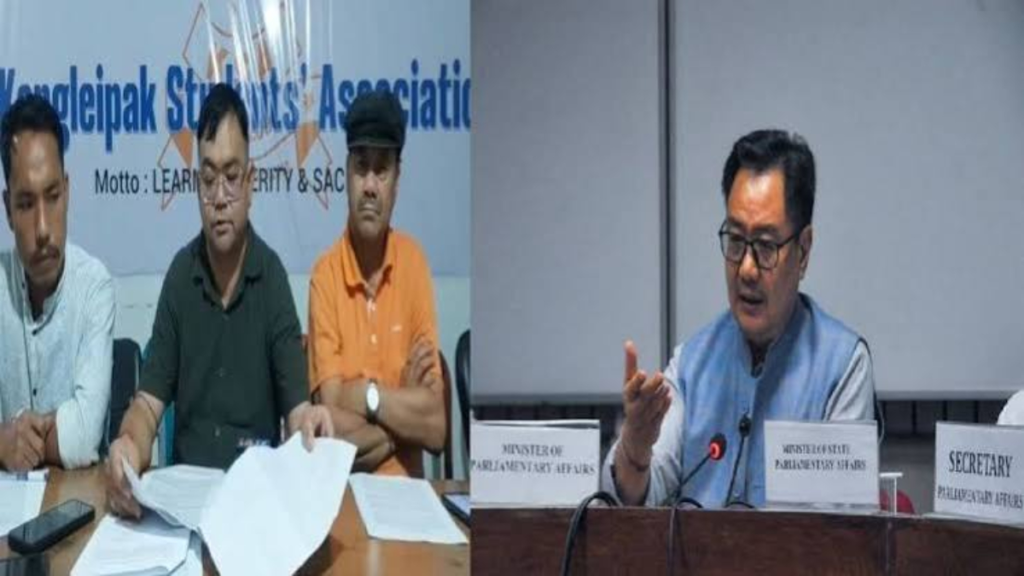
The Manipur crisis has triggered fresh questions over the Centre’s approach after a coalition of 14 civil society organisations (CSOs) in Kangleipak challenged Union Minister Kiren Rijiju’s description of the violence as a conflict requiring dialogue among communities.
The Corresponding Committee of CSOs, Manipur, said the prolonged unrest should not be viewed only through a communal lens. During a press conference, convenor Shanta Nahakpam argued that the role of armed groups and the security dimension also needed greater attention.
CSOs challenge view of Manipur crisis
The latest criticism followed Rijiju’s remarks at a conclave in New Delhi on September 27. According to reports, the Union Parliamentary Affairs and Minority Affairs Minister said lasting peace would require dialogue among the Meitei, Kuki and Naga communities.
Rijiju also said the Centre could not rely on military force to end the conflict and stressed dialogue as part of the process. The CSO coalition questioned whether that approach fully reflects the nature of the violence reported in the state.
Nahakpam said the Manipur crisis involved armed groups and attacks affecting civilians and villages. He questioned whether incidents involving armed organisations elsewhere in the Northeast would also be described primarily as community conflicts.
However, the CSOs’ assertions represent their position and should not be treated as an independent finding about responsibility for individual attacks.
Focus turns to armed groups and SoO
A major part of the CSOs’ criticism concerns the Suspension of Operations (SoO) arrangement involving Kuki armed groups. The coalition questioned why the agreement has continued despite concerns raised by authorities and organisations in Manipur.
The Manipur Assembly passed a resolution on February 29, 2024, seeking abrogation of the agreement. The arrangement was later extended in September 2025 between the Centre, the state government, the Kuki National Organisation and the United People’s Front, with revised ground rules.
The issue remains contested. Different groups have made allegations about violations and violence involving armed organisations covered by the arrangement. Those allegations require investigation and legal determination before responsibility can be established.
Recent violence adds to concerns
The debate comes amid renewed violence in parts of Manipur. Recent reports have recorded killings involving Naga civilians, including attacks in Senapati and Kamjong districts.
Naga organisations have attributed some incidents to armed groups, but such claims remain allegations unless independently established.
Meanwhile, the wider Manipur crisis has continued to involve security concerns, displacement and tensions among different communities. Recent developments have also shown that the conflict landscape has become more complex, with violence affecting communities beyond the original fault lines.
Humanitarian concerns remain
The CSO coalition also raised concerns about people displaced by the prolonged violence. It called for a broader policy covering financial assistance, reconstruction of damaged homes, restoration of livelihoods and the safe and dignified return of displaced people wherever conditions allow.
These demands come as civil society groups continue to press both the Centre and the Manipur government for stronger civilian protection and rehabilitation measures.
At the same time, the government’s stated emphasis on dialogue reflects the view that political and community engagement remains necessary alongside security measures. The challenge is to address both concerns without treating allegations as established facts.
Manipur crisis demands wider response
While Rijiju has emphasised dialogue between communities, the coalition is seeking greater attention to armed groups, security and accountability.
Therefore, the debate now extends beyond reconciliation alone. It also involves questions about civilian protection, the SoO framework, displacement and the state’s response to armed violence.
As fresh incidents continue to shape public concern, the competing positions underline the complexity of restoring stability in Manipur. Any lasting response will require attention to security, humanitarian needs and dialogue, while allegations against individuals or organisations remain subject to due process and verification.
Tea Garden Land Rights Dispute Intensifies as Tripura Workers Allege Threats and Livelihood Loss