


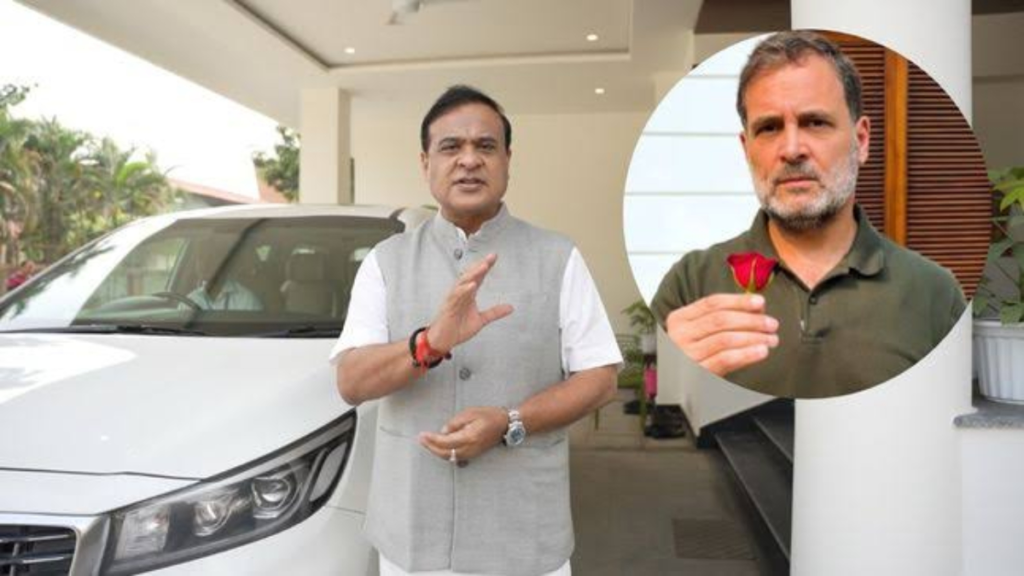
The Rahul debate controversy gained fresh momentum on Wednesday after Assam Chief Minister Himanta Biswa Sarma responded to Congress leader Rahul Gandhi’s challenge to Prime Minister Narendra Modi for an open public discussion. Sarma urged Gandhi to take the debate to Parliament instead of seeking a confrontation on the streets.
In a pointed remark, the Assam chief minister said roses were meant for Valentine’s Day, not Diwali. His response followed Gandhi’s social media post in which the Congress leader used a red rose while extending Diwali greetings to the prime minister and renewing his demand for a public debate.
Himanta’s Valentine’s Day remark sparks political exchange
Sarma responded to Gandhi through a video shared on social media platform X on November 4. He referred to the rose held by Gandhi in his Diwali greeting and used it to make a political point.
“Dear Rahul ji, Rose Valentine’s Day par dete hain, Diwali par nahi. Khair, BJP will see you in Parliament,” Sarma wrote in his post.
The remark quickly drew attention because it combined a personal jab with a direct challenge to the Congress leader over the venue for political discussions.
However, Sarma’s central argument focused on Gandhi’s responsibility as the Leader of the Opposition in the Lok Sabha. He questioned why Gandhi was seeking a public debate outside Parliament when the legislature provides an established forum for discussions.
Rahul debate: Sarma asks Gandhi to use Parliament
In his video message, Sarma asked Gandhi whether he recognised the responsibilities attached to his position as the Leader of the Opposition.
The Assam chief minister argued that Parliament was the appropriate place for the proposed discussion. He pointed out that the House has a Speaker and established procedures to facilitate debates between elected representatives.
Moreover, Sarma said several important national issues were available for discussion. He specifically mentioned the Bofors controversy and the Bhopal gas tragedy as subjects that could be raised during a parliamentary debate.
He also urged Gandhi to ensure that the proceedings remained peaceful and free from disruptions.
According to Sarma, Gandhi could initiate the discussion, while Prime Minister Narendra Modi could respond to the questions raised. He maintained that parliamentary proceedings would provide an opportunity to examine political claims through an institutional process.
The chief minister also criticised what he described as Gandhi’s repeated public confrontations. He advised the Congress leader against always adopting an aggressive political image and said a serious politician should engage in constructive discussions.
What prompted the Rahul debate controversy?
The exchange followed Gandhi’s renewed challenge to Modi to participate in an open debate on several political and national issues.
On November 3, Gandhi said 24 hours had passed since his initial challenge. He asked the prime minister to select any venue for a discussion and proposed that the two leaders sit together in front of the media and young people.
Gandhi also suggested that Modi could choose anyone to oversee the discussion. He even mentioned Rashtriya Swayamsevak Sangh (RSS) chief Mohan Bhagwat as a possible judge.
The Congress leader wanted the proposed debate to cover several contentious subjects. These included India’s financial system, the country’s trade agreement with the United States, the Adani controversy and questions surrounding alleged foreign connections.
Gandhi also questioned the circumstances surrounding the US trade agreement and raised concerns about why the Cabinet was allegedly not informed before its finalisation.
Furthermore, he challenged the prime minister to respond to his allegations and argued that an open discussion would help clarify the issues.
The exchange has therefore developed into a wider political disagreement over accountability, public debate and the appropriate forum for questioning the government.
BJP leaders push for parliamentary discussions
Sarma’s response came amid similar criticism from other senior BJP leaders. Union Finance Minister Nirmala Sitharaman had also asked Gandhi to raise his questions inside Parliament rather than issue public challenges on social media.
In her November 3 response, Sitharaman argued that Parliament was already the appropriate venue because Gandhi serves as the Leader of the Opposition in the Lok Sabha.
She also questioned the Congress party’s participation in parliamentary proceedings, referring to opposition walkouts and disruptions. Sitharaman maintained that demanding answers also required political leaders to remain present and listen to the government’s response.
Meanwhile, Union Home Minister Amit Shah had expressed the government’s willingness to convene a special parliamentary session to discuss allegations concerning the Special Intensive Revision (SIR) of electoral rolls and electronic voting machines.
Shah challenged the opposition to participate in a parliamentary discussion on these issues.
These statements indicate that the BJP leadership wants Gandhi to use parliamentary proceedings to raise questions against the government.
Political disagreement raises questions about parliamentary accountability
The Rahul debate exchange highlights the continuing differences between the BJP and Congress over political accountability and the functioning of democratic institutions.
For the Congress, an open debate offers an opportunity to question the prime minister directly on matters that the party considers important. Gandhi has repeatedly argued that the government should respond to concerns surrounding economic decisions, corporate affairs and alleged foreign influence.
The BJP, however, maintains that Parliament provides the proper platform for such discussions. Its leaders have questioned the opposition’s approach of issuing public challenges while demanding that the government answer questions.
Both sides have used the disagreement to reinforce their political positions. However, the proposed face-to-face discussion between Gandhi and Modi has not been confirmed.
Political disagreement puts focus on parliamentary accountability
The Rahul debate exchange highlights continuing differences between the BJP and Congress over political accountability and democratic institutions.
For the Congress, an open debate offers an opportunity to question the prime minister directly on matters the party considers important. Gandhi has sought answers on economic decisions, corporate affairs and alleged foreign influence.
The BJP, however, maintains that Parliament provides the proper platform. Its leaders have questioned the opposition’s approach of issuing public challenges while demanding answers from the government.
Both sides have used the disagreement to reinforce their political positions. The Rahul debate has also brought renewed attention to how elected leaders address allegations in public. However, no face-to-face debate between Gandhi and Modi has been confirmed.
Tripura CM Reviews Urban Welfare Policies with Local Body Representatives