


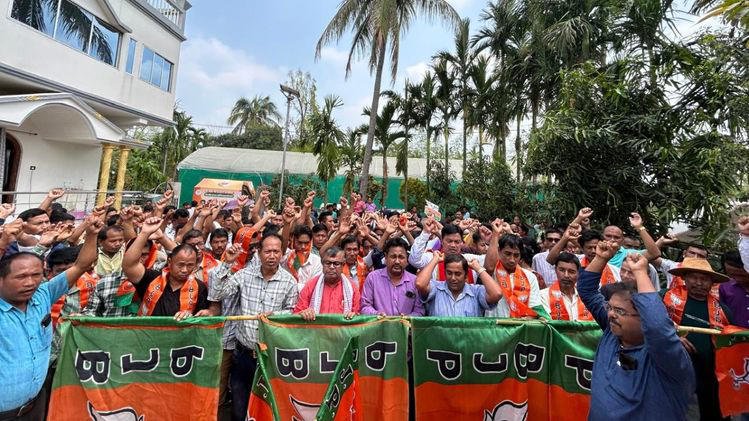
Tripura minister Ratan Lal Nath has strongly criticised the raising of ‘Tipraland’ slogans, calling them a political gimmick ahead of the Tripura Tribal Areas Autonomous District Council (TTAADC) polls. His remarks have added fresh momentum to the political discourse surrounding tribal politics in the state.
Speaking at a public event, Nath alleged that such slogans are being used to mislead voters. He stated that the demand is not rooted in practical governance but rather in political strategy. As a result, the issue has once again become a focal point in Tripura’s electoral landscape.
Read More: Guwahati Floods Recede Within Hours, Says Pijush Hazarika
Tipraland demand sparks political debate
The demand for Tipraland, primarily raised by Tipra Motha, seeks greater autonomy for tribal areas. It has been a significant issue in recent years, especially in the context of TTAADC elections.
However, Ratan Lal Nath argued that the demand lacks clarity. He questioned how such a proposal would be implemented and what its implications would be for the state.
Moreover, he claimed that the slogans are being used to create emotional appeal among voters. According to him, this approach diverts attention from real development issues. Therefore, he urged people to focus on practical solutions rather than rhetoric.
TTAADC polls and political stakes
The TTAADC polls are crucial for political parties in Tripura. The council governs a large portion of the state’s tribal areas, making it a key centre of influence.
Ratan Lal Nath emphasized that development should be the main agenda in these elections. He stated that the government has undertaken several initiatives to improve infrastructure, education, and healthcare in tribal regions.
At the same time, opposition parties are using the Tipraland issue to mobilise support. This has intensified the competition, with both sides trying to shape public opinion.
Government highlights development initiatives
The Tripura government has highlighted its efforts in tribal development. According to Ratan Lal Nath, various schemes have been implemented to improve living conditions in TTAADC areas.
He pointed out that investments have been made in road connectivity, schools, and healthcare facilities. In addition, welfare programmes have been introduced to support local communities.
Furthermore, Nath stressed that these initiatives demonstrate the government’s commitment to inclusive growth. Therefore, he argued that development should take precedence over divisive slogans.
Tipra Motha defends its stance
In response, leaders of Tipra Motha have defended the Tipraland demand. They maintain that it reflects the aspirations of tribal communities seeking greater autonomy and protection of their rights.
Party representatives have stated that the demand is not merely a political tool. Instead, they argue that it addresses long-standing concerns related to identity, land, and governance.
They have also accused the ruling government of ignoring these issues. Consequently, the exchange of allegations has further intensified the political climate.
Public reaction and voter sentiment
The debate over Tipraland slogans has elicited mixed reactions among voters. Some people support the demand, viewing it as a step towards safeguarding tribal interests.
On the other hand, others agree with Ratan Lal Nath that development should be the priority. They believe that focusing on infrastructure and services can bring tangible benefits.
Despite differing opinions, there is a shared concern about the future of tribal areas. Voters are keen to see solutions that address both development and identity issues.
Challenges in balancing development and identity
The controversy highlights the broader challenge of balancing development with cultural and political aspirations. In Tripura, this balance is particularly important due to its diverse population.
Ratan Lal Nath stated that unity and progress must go hand in hand. He warned that divisive politics could hinder growth and create instability.
Experts also note that addressing such issues requires careful planning and dialogue. Both government and opposition must work towards solutions that benefit all communities.
Political strategies ahead of elections
As the TTAADC polls approach, political strategies are becoming more visible. Parties are focusing on key issues to attract voters and strengthen their positions.
Ratan Lal Nath reiterated that the ruling government will continue to highlight its achievements. At the same time, opposition parties are expected to keep raising the Tipraland issue.
This dynamic has made the upcoming elections highly competitive. Observers believe that the outcome will have significant implications for Tripura’s political future.
The road ahead
The remarks by Ratan Lal Nath on Tipraland slogans have added a new dimension to the ongoing political debate. As discussions continue, the focus will remain on how these issues influence voter behaviour.
Moving forward, it will be crucial for all stakeholders to engage in constructive dialogue. Addressing the concerns of tribal communities while ensuring development will require a balanced approach.
In conclusion, the debate over Tipraland slogans political gimmick reflects deeper issues in Tripura’s politics. As the TTAADC polls draw closer, the emphasis will be on finding solutions that promote stability, growth, and inclusivity.
Read More: Subansiri Lower Hydroelectric Project Reaches Milestone with Unit-4 Commissioning