


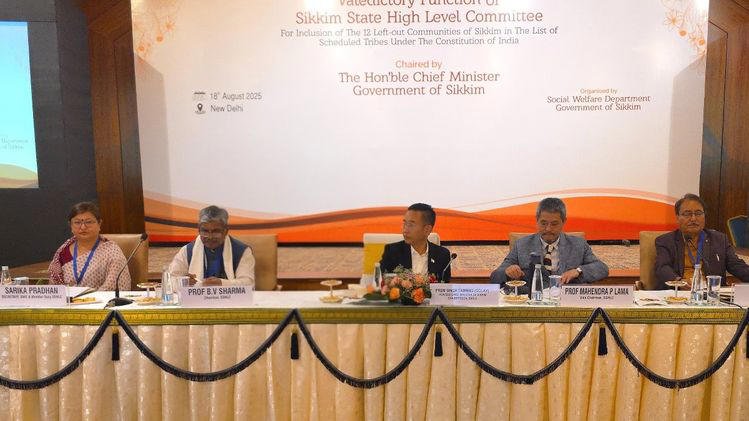
Sikkim ST status communities have once again come into the spotlight as Chief Minister Prem Singh Tamang chaired the valedictory meeting on the issue. The meeting, attended by officials, community leaders, and representatives from the concerned groups, focused on reviewing the progress made toward securing Scheduled Tribe recognition for the 12 left-out communities of the state.
The valedictory session, described as both symbolic and significant, underscored the government’s ongoing commitment to inclusivity and fairness. By leading the discussion himself, the Chief Minister demonstrated the state’s political will to address the long-standing demand of these communities.
Read More: Sikkim CM Confirms Proper Process on 12+1 Communities’ Tribal Status
Government’s Commitment to Recognition
In his address, the Chief Minister reiterated that the Sikkim ST status communities will not be left behind in the process of recognition. He emphasized that the government has already completed extensive groundwork, including socio-economic surveys, anthropological studies, and consultations with experts. These details, according to him, have been submitted to the Union government for consideration.
The CM reminded participants that recognition as Scheduled Tribes carries immense social, educational, and economic benefits. For the 12 communities, it would mean access to reserved seats in education and jobs, as well as representation in legislative institutions. He assured that the state government remains fully committed to ensuring their rightful place in the tribal list.
Valedictory Meet: A Platform of Dialogue
The valedictory meeting was not just a formal gathering but a platform for open dialogue. Representatives of the 12 communities expressed both their hopes and concerns. Many highlighted that their cultural identity and traditions have long deserved recognition at the national level. Others pointed to the economic hardships faced by their groups, stressing how Scheduled Tribe status could bring much-needed relief.
Officials from various departments presented progress reports, explaining how the data and recommendations had been compiled and forwarded to the central government. They clarified that all necessary procedural steps were followed to ensure the proposal’s strength.
By chairing the session personally, the CM sent a clear message: the aspirations of the Sikkim ST status communities remain a priority.
Historical Background of the Demand
The demand for recognition of 12 left-out communities dates back decades. These groups have argued that their cultural practices, historical roots, and socio-economic conditions align with the characteristics of recognized Scheduled Tribes. Despite repeated representations to the state and central governments, their inclusion has been delayed.
The term “left-out” emerged because other groups in Sikkim had already gained Scheduled Tribe recognition, while these 12 remained outside the ambit. This imbalance, according to community leaders, has created inequality in access to opportunities. The valedictory meeting, therefore, was seen as an important milestone in addressing a grievance that has persisted for generations.
Political and Social Importance
The discussion around Sikkim ST status communities carries weight beyond cultural identity. Politically, recognition could reshape representation within the state’s democratic institutions. Socially, it promises to bridge divides and foster inclusivity.
For the government, recognition of the 12 communities strengthens its image as one that values fairness and equality. It also addresses a key election issue, as political parties have often made promises regarding tribal status. The CM’s decision to lead the valedictory meeting underlines the seriousness with which his administration treats the matter.
Role of the Central Government
Although the state government has been proactive, the final decision on granting ST status rests with the central government. The Union government consults bodies like the Registrar General of India (RGI) and the National Commission for Scheduled Tribes before placing a proposal in Parliament.
Officials reminded participants at the valedictory meeting that this multi-layered process ensures fairness and avoids arbitrary decisions. The CM stressed that his government has done everything within its authority. He expressed confidence that the Union government will act positively on the proposal for Sikkim ST status communities.
Voices from the Communities
Community leaders welcomed the valedictory meeting as a sign of progress. They appreciated the CM’s direct involvement and praised the government for taking their concerns seriously. Many said the platform gave them a chance to express their struggles and aspirations.
Some leaders, however, also cautioned against complacency. They noted that promises have been made before, but results remain pending. Until Parliament formally approves the inclusion, they urged their members to remain engaged and vocal. Still, the general mood was one of cautious optimism.
Impact on Development and Equality
If approved, ST status for the 12 communities would have far-reaching impacts on Sikkim’s development. Recognition ensures access to targeted welfare schemes, scholarships, and financial assistance. For communities facing economic disadvantages, these benefits can pave the way toward upward mobility.
From a governance perspective, the move also helps balance representation, ensuring that no community feels marginalized. Inclusivity, in turn, strengthens unity and stability, both of which are vital for a small but diverse state like Sikkim.
Looking Forward
The valedictory meeting marked the conclusion of a phase of consultations but also signaled the beginning of anticipation for the central government’s response. The Sikkim CM reiterated his government’s readiness to provide any additional clarifications or documents that the Union may require.
Community members now wait for the next steps, hopeful that their long struggle will finally yield results. The recognition of Sikkim ST status communities would not only honor their cultural identity but also open doors to opportunities long denied.
The valedictory meet chaired by Chief Minister Prem Singh Tamang has reaffirmed the government’s commitment to Sikkim ST status communities. By reviewing progress, engaging directly with leaders, and assuring that all procedural steps have been taken, the session gave a fresh sense of hope.
As the proposal rests with the central government, the people of Sikkim now await a decisive outcome. For the 12 left-out communities, this moment represents a chance to secure both recognition and equality. The Chief Minister’s leadership at the valedictory meeting has sent a strong signal that their aspirations remain central to Sikkim’s future.
Read More: Assam DGP Urges Public to Join I-Day Celebrations