


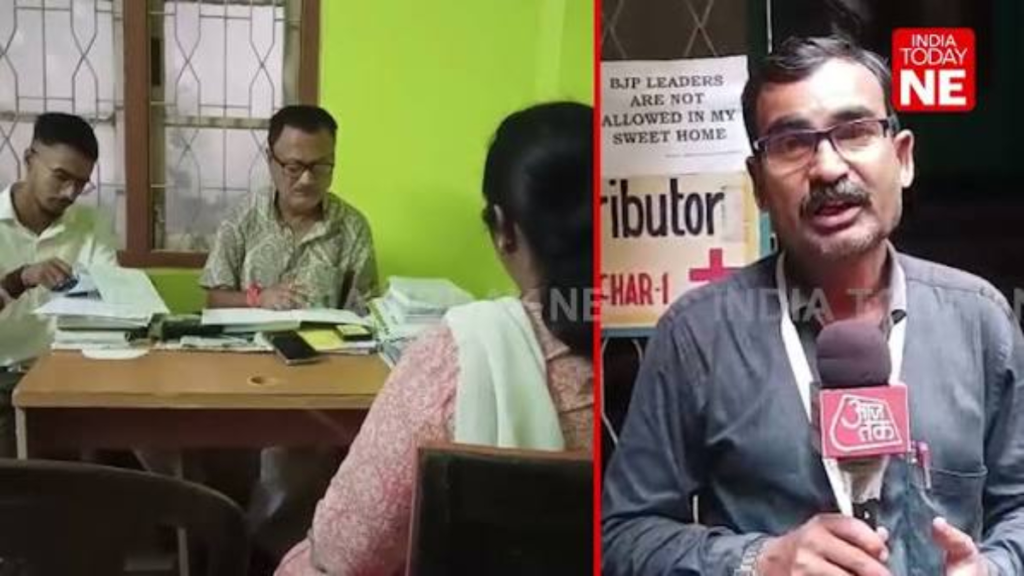
Silchar BJP ticket row has triggered a fresh protest after party worker Rathindranath Saha decided to contest the upcoming civic election as an Independent candidate from Ward 11. He also put up a banner outside his residence declaring that BJP leaders could not enter his “sweet home”.
Saha took the step after the BJP denied him a ticket for the first election to the newly formed Silchar Municipal Corporation. He has questioned the party’s candidate selection and alleged that senior workers received unfair treatment.
Silchar BJP ticket row turns into public protest
Saha has turned his anger over the ticket into a highly visible campaign against the party’s local leadership. The banner outside his house directly targets BJP leaders and reflects the depth of his dissatisfaction.
According to a report by India Today NE, Saha told Aaj Tak Bangla that his family had maintained a long association with the BJP. He said his father and grandfather had links with the party and claimed that he had also worked with organisations connected to the broader Sangh network.
However, these claims represent Saha’s own account of his political background. The central dispute concerns the BJP’s decision to deny him the Ward 11 nomination.
BJP worker chooses Independent route
The Silchar BJP ticket row has now entered the election campaign. Instead of withdrawing from the contest, Saha decided to challenge the BJP candidate as an Independent.
Saha also criticised the party’s wider candidate selection process. He alleged that several long-serving BJP workers across Silchar failed to secure tickets.
He further questioned the role of leaders who joined the BJP after earlier associations with other political parties. Saha named former Congress leaders, including Sushmita Dev and Gautam Roy, while making his criticism.
Those comments reflect Saha’s political position. They do not establish wrongdoing by the leaders he mentioned.
Ticket distribution creates tension
The Silchar BJP ticket row comes as parties prepare for the city’s first municipal corporation election. The Assam State Election Commission has fixed October 3 for polling across 42 wards and October 6 for counting.
The BJP announced candidates for 38 wards on September 8. Its alliance partner, the Asom Gana Parishad, will contest four wards.
Candidate selection has already created friction within the BJP’s local organisation. Earlier, party workers in Ward 41 also voiced dissatisfaction over the choice of candidate.
The developments show how ticket distribution can quickly create internal competition during an election. Aspirants who lose nominations must then decide whether to support the official candidate, remain outside the contest or challenge the party nominee independently.
Saha takes his fight to the ballot
Saha has chosen the third path. His Independent candidature gives voters in Ward 11 another option while creating a direct contest between him and the BJP nominee.
His protest also carries a wider political message about the place of long-serving workers within the party. By publicly questioning the selection process, Saha has moved his disagreement beyond an internal organisational dispute.
Meanwhile, the BJP has continued with its preparations for the civic election. The party must now manage its campaign across the corporation’s 42 wards while dealing with dissent among some local workers.
Silchar heads towards first civic poll
Silchar will hold its first election as a municipal corporation on October 3. Voters will choose representatives for all 42 wards, while officials will count the votes three days later.
The election will establish the elected civic body for the corporation and could shape local political competition in Silchar.
For Saha, however, the contest has already become a test of his stand against the BJP’s ticket decision. The Silchar BJP ticket row has taken him from an unsuccessful ticket aspirant to an Independent candidate challenging the party in Ward 11.
As campaigning progresses, voters will decide whether his protest translates into electoral support. The outcome will also show how much impact internal dissent can have when party workers take their grievances directly to the ballot box.