


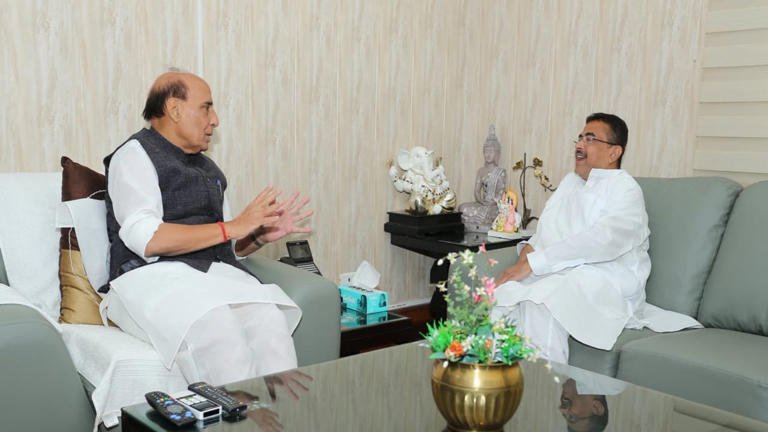
West Bengal Chief Minister Suvendu Adhikari held separate meetings with Defence Minister Rajnath Singh and President Droupadi Murmu in New Delhi, drawing attention to the state’s ongoing engagement with national leadership and institutional coordination.
The meetings formed part of the chief minister’s engagements in the national capital and reflected continued interaction between state and central leadership on governance-related matters and broader developmental priorities.
Officials indicated that discussions focused on issues linked to administration, public welfare, and areas of mutual interest.
Read More: Assam To Introduce UCC Bill In Assembly Session, Cabinet Expansion Likely In June
Suvendu Adhikari Holds High-Level Meetings in New Delhi
During his visit to New Delhi, Suvendu Adhikari met senior national leaders as part of official interactions and institutional engagement.
The meetings highlighted continued coordination between constitutional offices and elected leadership.
Officials stated that interactions between state governments and national leadership remain important for discussing administrative priorities and strengthening governance mechanisms.
According to sources, the engagements provided an opportunity to exchange views on issues connected to development and public administration.
The visit also attracted attention due to the political significance attached to meetings involving senior leaders.
Observers noted that such interactions often carry both administrative and symbolic value.
Meeting With Rajnath Singh Focuses on Governance and Coordination
Suvendu Adhikari’s meeting with Rajnath Singh formed an important part of his New Delhi engagements.
Officials stated that discussions covered governance-related matters and issues of broader public interest.
Coordination between different levels of government remains important for ensuring effective implementation and improving outcomes.
The interaction reflected the importance of regular communication between national and state leadership.
According to officials, such meetings create opportunities for exchanging perspectives and strengthening institutional cooperation.
The engagement also highlighted the role of dialogue in addressing evolving priorities.
Observers noted that interactions of this nature often support stronger policy coordination.
Courtesy Meeting With President Murmu Draws Attention
The chief minister also met President Droupadi Murmu during his visit to the national capital.
Officials described the interaction as an important engagement reflecting constitutional and institutional traditions.
Meetings with the President often carry symbolic significance while reinforcing communication across different levels of governance.
According to observers, such interactions create opportunities to discuss broader perspectives related to development and administration.
The meeting also attracted public interest because of the importance attached to engagements with the office of the President.
Officials highlighted the value of maintaining institutional dialogue and engagement.
Discussions Highlight Governance Priorities
Although detailed information regarding the discussions was not publicly outlined, officials indicated that governance and developmental priorities remained central themes.
Interactions between state leaders and national leadership often focus on improving implementation, coordination, and policy outcomes.
Authorities stated that stronger engagement supports more effective governance systems.
Moreover, institutional communication helps strengthen administrative responsiveness.
Officials also emphasised the importance of maintaining collaborative approaches in addressing public priorities.
The meetings reflected continued efforts to strengthen engagement through formal dialogue.
Observers noted that governance discussions increasingly involve coordination across multiple sectors.
Institutional Engagement Remains Important
State and central interactions continue to play an important role in India’s federal structure.
Officials stated that regular communication helps improve policy alignment and supports implementation processes.
According to observers, engagement among leaders contributes to smoother institutional functioning.
The government has repeatedly emphasised coordination and communication as important elements of administration.
Additionally, meetings at senior levels often provide opportunities to review priorities and strengthen cooperation.
Officials noted that stronger institutional relationships can improve long-term outcomes.
Such interactions also reinforce administrative continuity.
Political and Administrative Significance of the Visit
Political observers viewed the meetings as significant because they combined administrative engagement with broader public interest.
Visits involving meetings with senior national leaders often receive attention due to their institutional and political implications.
Observers stated that leadership interactions provide opportunities for discussion and relationship building.
At the same time, such meetings contribute to public perceptions of governance and coordination.
Officials emphasised that engagement and dialogue remain important aspects of democratic administration.
The meetings therefore generated attention both politically and institutionally.
Observers continue to watch developments linked to leadership interactions.
Focus on Cooperative Governance
Officials reiterated that cooperative governance remains an important principle in ensuring effective administration.
Interactions between state leadership and national institutions support communication and encourage stronger coordination.
According to observers, regular engagement creates opportunities to exchange views and improve governance outcomes.
Authorities have increasingly highlighted the value of maintaining institutional relationships.
The government believes stronger coordination supports development goals and improves responsiveness.
Additionally, dialogue remains important in adapting to changing priorities and public expectations.
Officials stated that collaborative approaches contribute to better implementation.
Meetings Reflect Broader Governance Approach
Observers noted that meetings between state leaders and national leadership often represent more than ceremonial engagements.
Such interactions provide platforms for communication, discussion, and institutional cooperation.
Officials stated that governance increasingly depends on coordinated action and shared priorities.
The visit therefore reflected broader efforts to maintain engagement across administrative structures.
Moreover, institutional interaction remains important in strengthening governance frameworks.
Authorities continue to encourage dialogue and structured communication.
These meetings formed part of that larger process.
Continued Engagement With National Leadership
Suvendu Adhikari’s meetings with Rajnath Singh and President Droupadi Murmu highlighted the importance of continued interaction between state and national institutions.
Officials stated that such engagements contribute to stronger communication and support governance processes.
The visit also reflected the importance of maintaining regular dialogue across different levels of leadership.
Observers noted that meetings involving senior leaders often carry both practical and symbolic significance.
According to officials, engagement remains essential for addressing priorities and strengthening institutional coordination.
As governance continues to evolve, interactions of this nature are expected to remain an important component of public administration.
The New Delhi meetings therefore reinforced the importance of communication, coordination, and institutional engagement in shaping governance priorities and supporting long-term development objectives.
Read More: British Tried to Dilute Assamese Identity Before Independence: BJP MLA Pradyut Bordoloi