


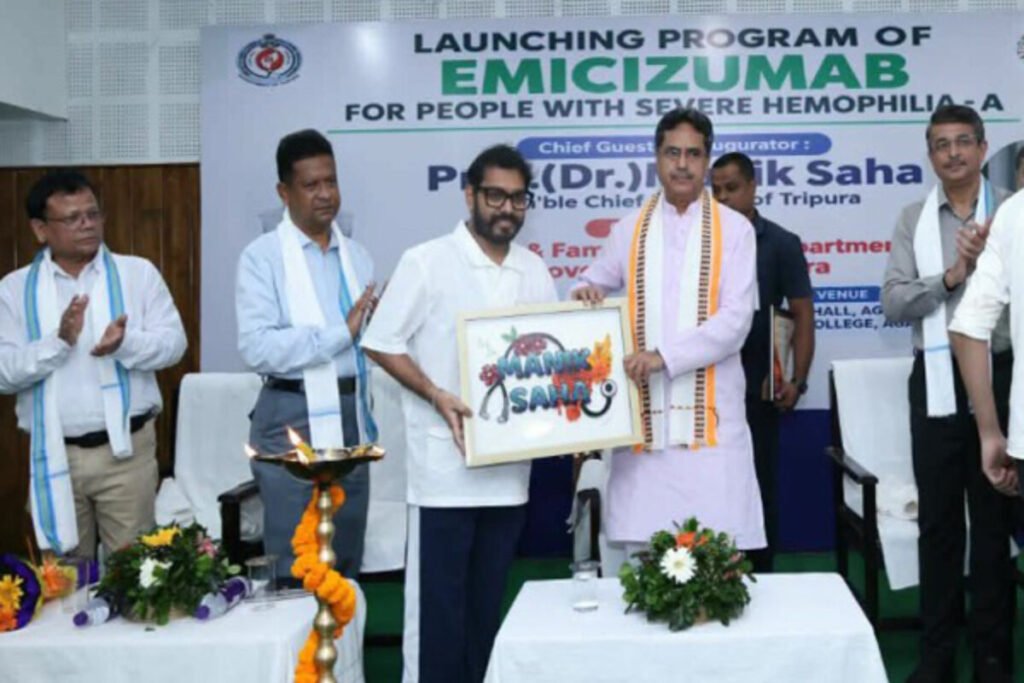
The launch marks an important development in Tripura’s efforts to strengthen healthcare services for people with inherited bleeding disorders. Emicizumab prophylaxis can help reduce bleeding episodes in eligible patients with Haemophilia A. The government intends to make this treatment available without charging patients.
Chief Minister Manik Saha formally launched the service by symbolically administering an Emicizumab injection to a patient. During the programme, he recalled his earlier career as a medical practitioner and his long association with the Haemophilia Society.
The Chief Minister also highlighted the difficulties that patients previously faced while obtaining treatment. Some families struggled to procure Factor VIII from outside the state and maintain it at the required temperature. These challenges created additional burdens for patients and their caregivers.
Tripura Education Department Distributes Scooties to Meritorious Female Students
Emicizumab offers a different approach to preventive care. Unlike conventional Factor VIII replacement therapy, it mimics part of Factor VIII’s function and helps the blood clot more effectively. Doctors prescribe it according to the patient’s medical needs and an appropriate treatment schedule.
The introduction of this therapy could reduce treatment-related inconvenience for eligible patients. However, each patient requires an individual clinical assessment, and specialist teams must determine the appropriate treatment plan.
Tripura Emicizumab Treatment Targets Patients with Severe Haemophilia A
Haemophilia is an inherited bleeding disorder that affects the body’s ability to form blood clots. Haemophilia A results from a deficiency or dysfunction of clotting Factor VIII, while Haemophilia B involves Factor IX.
People with severe Haemophilia A face a particularly high risk of bleeding episodes. Bleeding can occur after injuries and may also affect joints, muscles or internal tissues. Without appropriate care, repeated bleeding can cause significant complications.
Preventive treatment, also known as prophylaxis, aims to reduce the frequency of bleeding episodes. Emicizumab supports this goal by helping restore part of the clotting process affected by the lack of functional Factor VIII.
According to figures shared by the Chief Minister, Tripura has 97 registered patients with Haemophilia A and 13 with Haemophilia B. He also indicated that the actual number of people living with these conditions could be higher because broader screening may identify additional cases.
The government spends approximately ₹5 crore to ₹6 crore annually on haemophilia treatment, according to the figures reported at the launch. This expenditure reflects the continuing need for specialised medical care and long-term support.
The new programme specifically addresses people with severe Haemophilia A. It does not mean that Emicizumab treats every type of haemophilia or that all patients can automatically receive the same treatment. Specialist doctors must assess eligibility and monitor each patient’s response.
Tripura Emicizumab Treatment Identifies IGM Hospital as Nodal Centre
The government has designated Indira Gandhi Memorial (IGM) Hospital in Agartala as the nodal centre for the Emicizumab programme. The hospital will play a central role in coordinating access to the treatment and supporting patients who require specialist care.
The state government also plans to extend treatment facilities to district hospitals according to local requirements. This approach could reduce the need for patients from distant areas to travel to Agartala for every stage of care.
For families living outside the capital, travel can involve transport expenses, time away from work and difficulties arranging repeated hospital visits. Expanding access closer to patients’ homes could help reduce some of these burdens.
However, the authorities have not confirmed a complete district-wise rollout schedule in the available reports. Patients and families should therefore obtain current guidance from their treating doctors or the designated hospital.
Clinical supervision remains essential even when treatment becomes more accessible. Healthcare teams must determine suitable dosing schedules, review patients’ medical histories and monitor for potential adverse effects.
The introduction of Emicizumab also creates an opportunity to strengthen awareness and diagnosis. Better identification of affected individuals can help healthcare providers assess treatment needs and connect patients with appropriate specialist services.
Tripura Emicizumab Treatment Forms Part of Wider Healthcare Expansion
The programme forms part of the state government’s wider efforts to improve access to specialised medical services. During the launch event, Manik Saha discussed ongoing investments in district hospitals and the expansion of healthcare facilities across Tripura.
The Chief Minister said trauma care centres had been established in almost all district hospitals. He also highlighted the introduction of cardiac care services at several locations and ongoing work to strengthen specialist treatment.
According to the Chief Minister, referrals of patients outside Tripura for medical treatment had declined by approximately 80 per cent. However, he did not provide comparative figures during the reported remarks, so the claim should be understood as his assessment rather than an independently verified measurement.
The government is also developing additional medical infrastructure. These projects include a dedicated mother-and-child hospital at Agartala Government Medical College and a new building associated with the Dental College.
In addition, the state is working to establish drug rehabilitation facilities in different districts. The Chief Minister said construction of the Drug Rehabilitation Centre at Bishramganj was progressing.
Such initiatives address different healthcare needs, from emergency treatment to specialist services and rehabilitation. Their effectiveness will depend on staffing, equipment, patient access and the quality of care delivered.
The Emicizumab programme adds a specialised treatment option for people with severe Haemophilia A. Continued coordination between the nodal hospital, district facilities and public health authorities will be important as the programme develops.
Conclusion
The Tripura government has launched free Emicizumab treatment for people with severe Haemophilia A under a programme inaugurated by Chief Minister Manik Saha on October 11, 2026. The initiative aims to improve access to preventive treatment and reduce the difficulties associated with managing this inherited bleeding disorder. IGM Hospital in Agartala will serve as the nodal centre.
The state has 97 registered patients with Haemophilia A and 13 with Haemophilia B, according to figures shared at the launch. Emicizumab can help reduce bleeding episodes in eligible patients, while its prescribed dosing schedule may make preventive care more convenient. Doctors must still assess each patient individually and provide appropriate clinical monitoring.
The government also plans to expand access to the treatment through district hospitals according to local requirements. Further information about the rollout will help patients understand where they can receive care and how to access the programme. The initiative’s long-term impact will depend on effective implementation, specialist supervision and continued support for people living with haemophilia.
FAQs
1. What is the Emicizumab treatment programme in Tripura?
It is a government initiative launched to provide Emicizumab prophylaxis to eligible people with severe Haemophilia A free of cost.
2. Who launched the programme?
Chief Minister Dr Manik Saha launched the programme on October 11, 2026, at the Nursing College auditorium in the Agartala Government Dental College and IGM Hospital complex.
3. Which hospital is the nodal centre for Emicizumab treatment?
IGM Hospital in Agartala has been designated as the nodal centre for the programme.
4. How many registered haemophilia patients does Tripura have?
Figures shared at the launch identified 97 registered patients with Haemophilia A and 13 with Haemophilia B. The actual number may be higher.
5. Will patients receive Emicizumab treatment at district hospitals?
The government plans to extend treatment facilities to district hospitals according to requirements. However, the available reports do not confirm a complete rollout schedule.