


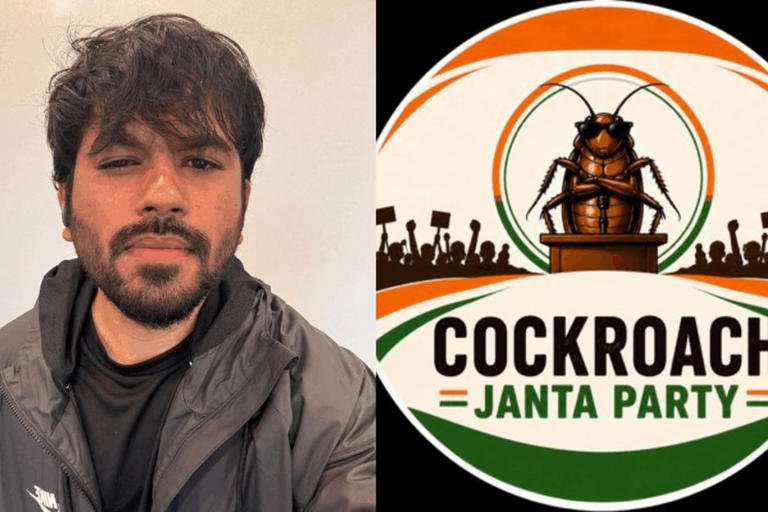
In just a few days, Cockroach Janta Party (CJP) has emerged as one of India’s biggest internet sensations, turning political satire into a nationwide online phenomenon. The platform gained more than 11 million followers on Instagram within five days of its launch and quickly became one of the most talked-about topics across social media.
As memes, reels, and satirical political content flooded timelines, public curiosity shifted toward one question — who is the person behind the movement?
The answer is Abhijeet Dipke, a 30-year-old political communication strategist whose experiment in digital satire has evolved into a rapidly growing online movement.
What began as a sarcastic reaction to a controversial public discussion soon transformed into a platform that attracted followers, sign-ups, and widespread engagement.
Read More: Tripura Unveils Rooftop Solar Push, 1.5 Lakh Families To Get Systems For Rs 1,000
Who Is Abhijeet Dipke?
Abhijeet Dipke studied journalism in Pune before moving to the United States to continue higher education.
He later pursued a master’s degree in Public Relations at Boston University and recently completed the programme.
According to Dipke, he is currently applying for jobs while continuing his engagement with digital communication and online political discourse.
His academic background combines journalism, media understanding, and public communication. These experiences later influenced the style and execution of his social media campaigns.
Before becoming widely known through CJP, Dipke had already built experience in political communication and digital campaigning.
His work focused on understanding online behaviour, audience engagement, and how digital narratives influence public conversations.
From Political Campaigning To Viral Internet Strategy
Before launching Cockroach Janta Party, Dipke worked with Aam Aadmi Party between 2020 and 2023.
During his time there, he reportedly worked on social media campaigns and election communication strategies.
His role included creating digital content and developing online engagement approaches targeted at younger audiences.
During the 2020 Delhi Assembly elections, Dipke reportedly contributed to meme-driven campaign communication designed to simplify political messaging and increase online reach.
That experience appears to have shaped the methods later seen in CJP’s growth.
Observers noted similarities in the use of humour, fast-moving content, visual storytelling, and direct audience interaction.
However, unlike traditional campaign communication, CJP adopted satire as its central identity.
How Cockroach Janta Party Was Created
The idea behind Cockroach Janta Party reportedly emerged following comments linked to Chief Justice of India Surya Kant.
During a court hearing on May 15, remarks were widely circulated online claiming that some unemployed youngsters become journalists, RTI activists, or social media users and “start attacking everyone.”
Later, clarification followed stating that the remarks had been misquoted and taken out of context.
Instead of rejecting the “cockroach” label that spread online, Dipke chose to turn it into satire.
He created Cockroach Janta Party and built an entire digital identity around irony and political humour.
According to the platform’s website, the group describes itself as the “Voice of the Lazy and Unemployed Youth.”
The branding, language, and presentation quickly caught public attention.
Why Cockroach Janta Party Went Viral
CJP’s rapid growth surprised many observers.
Within days of launch, the platform reportedly crossed more than one lakh sign-ups while building a strong presence across social media platforms.
The movement also introduced its own website, original content formats, and even a themed anthem.
Its posts combined humour, satire, memes, and commentary on contemporary issues.
Rather than functioning like a conventional political organisation, CJP positioned itself as an internet-led satire movement.
Many users viewed the content as entertainment, while others interpreted it as commentary on youth frustration, unemployment discussions, and public discourse.
As engagement increased, millions of users interacted with posts through comments, shares, and short-form videos.
The speed of growth turned CJP into one of India’s most visible online trends.
A New Age Of Political Satire?
The rise of Cockroach Janta Party reflects a broader shift in how younger audiences engage with politics and public conversations.
Digital platforms increasingly allow creators to blend humour with commentary and attract large audiences within short periods.
For many internet users, satire has become a way to participate in discussions without formal political affiliation.
Abhijeet Dipke’s project appears to fit into this changing landscape.
His background in journalism, public relations, and campaign communication helped shape a format that connected quickly with online audiences.
At the same time, the movement’s rise also shows how social media can amplify unconventional ideas at remarkable speed.
Whether CJP remains a temporary internet trend or evolves further, its rapid emergence has already sparked discussion across digital spaces.
For now, Abhijeet Dipke has become one of the most recognised names behind India’s latest viral political satire phenomenon.
Read More: Rahul Gandhi Attacks PM Modi Again, BJP Launches Sharp Counterattack