


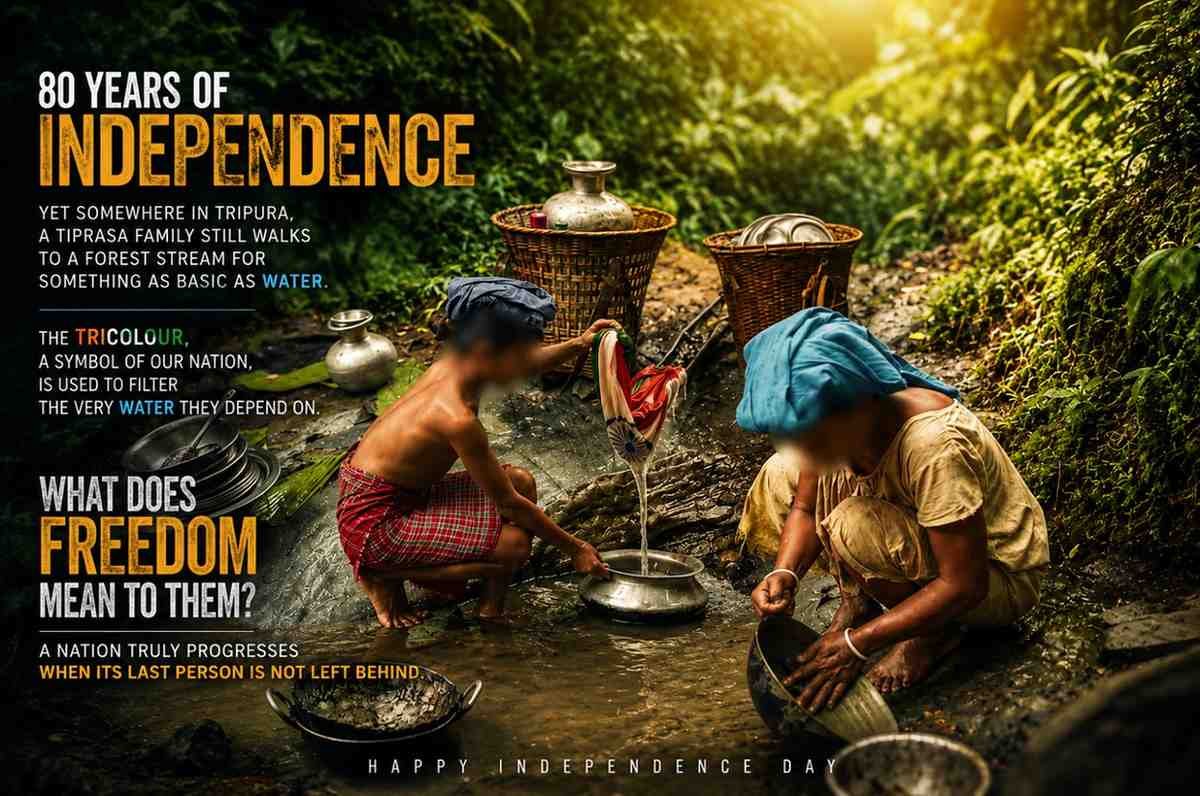
Tripura, 80 years after Independence — are we truly free if some families still struggle for something as basic as drinking water?
India celebrates 80 years of Independence with pride. Across the country, the Tricolour represents freedom, dignity, opportunity and the promise of a better future.
But somewhere in Tripura, a Tiprasa family still has to walk to a forest stream to collect water.
And perhaps the most painful part of this image is not only the difficult journey for water. It is seeing the Tricolour being used to filter the very water on which the family depends.
It is a picture that raises uncomfortable questions.
What Does Independence Mean Without Access to Clean Water?
For many of us, turning on a tap and getting drinking water is an ordinary part of everyday life.
But for families living in remote and forested areas of Tripura, access to safe drinking water can still be a serious challenge.
This forces us to ask:
Can we truly talk about development when some communities are still struggling for basic drinking water?
Can Independence Day be celebrated only through ceremonies, speeches and flags, while some citizens continue to wait for basic necessities?
And perhaps the biggest question:
What does freedom mean to a family that still has to walk to a forest stream for water?
These questions are not meant to attack any government, political party, department or individual.
They are questions that deserve to be asked because development should ultimately be measured by how it changes the lives of ordinary people.
Tripura’s Development Must Reach Its Most Remote Communities
Tripura has changed significantly over the decades. Roads, electricity, mobile connectivity, education, healthcare and other infrastructure have expanded across the state.
But development is never complete.
Remote villages and indigenous communities can face unique challenges because of geography, terrain and limited infrastructure. Ensuring reliable access to safe drinking water in rural Tripura should therefore remain one of the most important development priorities.
A household should not have to depend on an unsafe stream simply because it is located far away from an urban centre.
Clean drinking water is not a luxury.
It is a basic human necessity.
The Tricolour Makes This Image Even More Powerful
The Tricolour is one of the strongest symbols of India’s freedom.
It represents a nation that fought for the right to determine its own future.
Seeing the national flag being used to filter water therefore creates a deeply emotional contradiction.
The same flag that we proudly raise on Independence Day is being used by a family simply because they need to make water drinkable.
Perhaps that is why this image deserves more than a social media reaction.
It deserves a conversation.
Development Should Not Leave the Last Person Behind
The real test of development is not only how advanced our cities become.
It is also whether a child in a remote village can drink safe water.
Whether a mother can access basic healthcare without travelling for hours.
Whether families in remote areas have reliable roads and electricity.
Whether indigenous communities can experience development without being forgotten.
The progress of a state should not be measured only by its biggest projects. It should also be measured by the dignity and quality of life available to its most vulnerable and geographically isolated citizens.
This Independence Day, Perhaps We Should Ask a Different Question
Instead of asking only “How far have we come?”, perhaps we should also ask:
“Who is still waiting to move forward?”
There is nothing wrong with celebrating India’s Independence.
But celebration and reflection can exist together.
We can be proud of the country we have built while acknowledging the work that remains.
We can respect the people working to improve infrastructure while still asking whether more needs to be done.
And we can celebrate the Tricolour while remembering what it represents — freedom, equality, dignity and hope.
A Question for Tripura
If an Indian citizen in a remote part of Tripura still has to walk to a forest stream for drinking water, then perhaps Independence Day gives us an opportunity to pause.
Not to blame.
Not to politicise.
But to ask:
How many more families are still waiting for clean drinking water?
How many remote communities remain outside the reach of basic infrastructure?
And what can we do to ensure that the benefits of development reach them too?
A nation truly progresses when its last person is not left behind.
So, Happy Independence Day, India.
But today, this picture makes us think more than it makes us celebrate.
Perhaps that is exactly why it needs to be seen, discussed and remembered.