


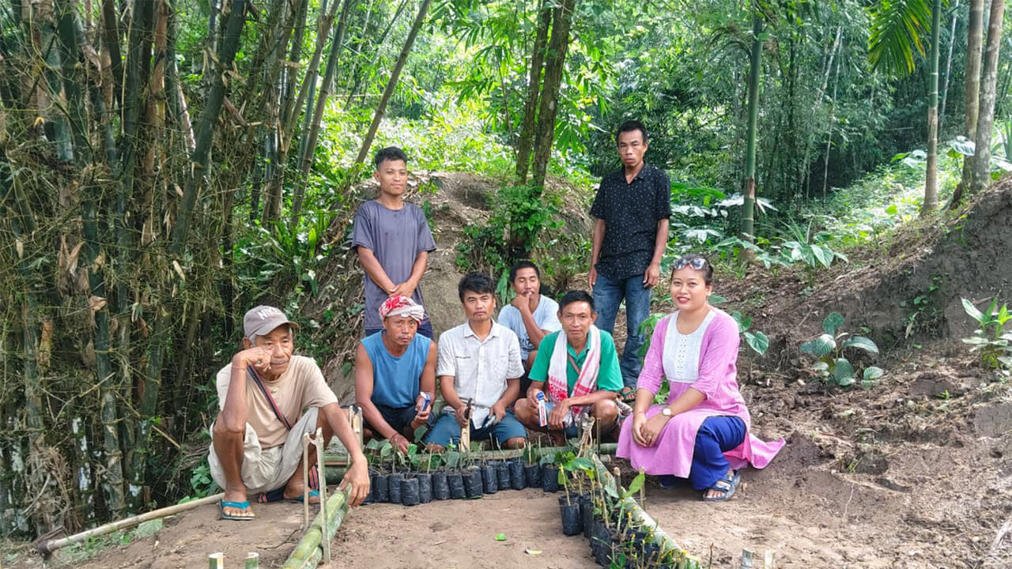
Biodiversity conservation organisation Aaranyak has organised a one-day training programme for six marginalised farmers in Assam’s Kohora River Basin, focusing on the propagation of Assam lemon and black pepper through cutting techniques. The initiative aims to strengthen rural livelihoods by equipping farmers with practical skills in plant propagation and backyard nursery management.
Held at Englepathar village on September 25, 2026, the programme focused on helping participants produce quality planting materials at their homes and explore small-scale nursery enterprises. The initiative is expected to provide an additional income opportunity for households dependent on subsistence farming, seasonal agricultural work and daily-wage employment.
Read More: Tripura CM Launches Tech-Driven Initiatives to Accelerate Innovation, Digital Empowerment
Farmers Receive Hands-on Training in Plant Propagation
Progressive farmer Phumen Terang served as the resource person during the training, demonstrating different stages of lemon and black pepper propagation.
The participants learned how to select suitable mature shoots and runners, prepare soil mixtures, fill polybags, prepare and plant cuttings, and maintain nursery plants.
The practical sessions were designed to help farmers understand the techniques required to establish small nurseries using locally available resources. By learning these methods, participants can produce saplings for their own agricultural needs and potentially sell surplus planting materials.
The training also introduced farmers to the importance of proper nursery maintenance in supporting healthy plant growth and developing a sustainable source of planting materials.
Backyard Nurseries Offer Additional Income Opportunities
For many rural households in Assam, agriculture remains a primary source of livelihood. However, dependence on seasonal farming and daily-wage employment can create financial challenges, particularly for marginalised communities.
Backyard nurseries offer an alternative income-generating activity that requires comparatively little land and investment. Farmers can begin on a small scale using available household space before gradually expanding their activities.
Through the propagation of Assam lemon and black pepper, the programme seeks to transform traditional agricultural knowledge into practical entrepreneurial skills.
The initiative also highlights how local horticultural resources can contribute to livelihood diversification while encouraging sustainable use of available land.
Farmer Hopes to Sell Saplings Through PIRBI
The training has already encouraged participants to consider applying their newly acquired skills at the household level.
Dorsing Engti, a farmer from Englepathar village, said that previously, farmers mainly relied on seed-based propagation and had limited knowledge of growing plants through cuttings.
He said the programme helped him learn how to prepare and plant Assam lemon and black pepper cuttings and manage a nursery.
Engti expressed hope that he would apply the techniques at home and sell saplings to PIRBI, creating an additional source of income for his family.
His experience reflects the programme’s broader objective of connecting practical agricultural training with opportunities for small-scale rural entrepreneurship.

Asianet Newsable
+1
Aaranyak Explores Market Linkages and Value Addition
The programme also introduced participants to potential market opportunities through PIRBI, a community-based business initiative operating in the Kaziranga–Karbi Anglong Landscape.
Aaranyak representative Larbeen Teronpi discussed opportunities related to homestead cultivation, backyard nursery enterprises, value addition and market demand.
She encouraged farmers to start their nursery activities on a small scale and gradually expand them according to their capacity and available opportunities.
The discussion highlighted the importance of connecting agricultural production with reliable market channels to help farmers generate income beyond traditional cultivation.
Community Food Processing Centres to Support Rural Livelihoods
Teronpi also highlighted the role of PIRBI’s Community Food Processing Centres in the Diring River and Kohora River Basin regions.
These centres support local communities in processing and adding value to agricultural products, including turmeric, ginger, tapioca, black pepper and moringa.
Value addition can help rural producers explore opportunities beyond selling raw agricultural produce while strengthening community-based economic activities.
The training witnessed participation from communities in Sivoram Terang, Phumen Engti and Englepathar villages.
Strengthening Sustainable Agriculture in Assam
Aaranyak’s initiative reflects the growing importance of combining conservation efforts with sustainable livelihood opportunities for rural communities.
By promoting backyard nurseries, plant propagation and potential market linkages, the programme seeks to encourage farmers to diversify their income sources while making productive use of locally available resources.
The training on Assam lemon and black pepper propagation represents a community-level effort to strengthen agricultural knowledge, encourage small-scale entrepreneurship and support long-term livelihood development in the Kohora River Basin.
As farmers begin applying these techniques, backyard nurseries could emerge as an additional avenue for household income and locally driven agricultural development.