


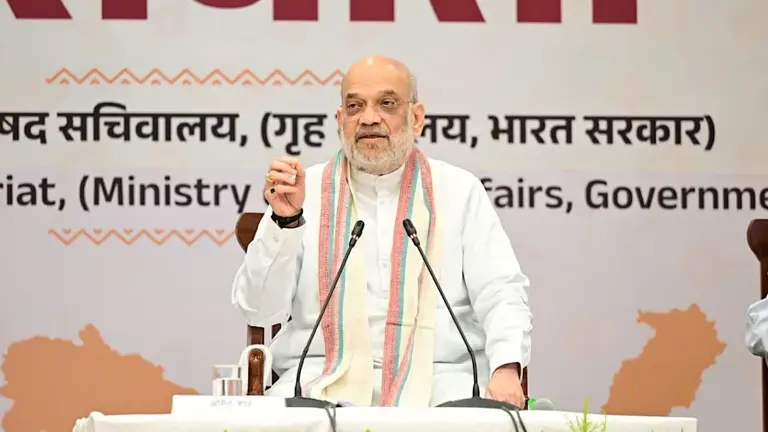
Amit Shah unveiled a broad development vision for regions previously affected by Maoist violence, stating that the decline in extremist activities has created new opportunities for infrastructure growth, welfare expansion, and economic progress.
The Union Home Minister said the government now aims to focus more aggressively on roads, education, healthcare, connectivity, employment generation, and social welfare in areas that had long suffered because of insurgency and security challenges.
According to Amit Shah, improved security conditions and stronger administrative presence have helped restore public confidence in several Maoist-affected regions across the country.
Read More: Rahul Gandhi Warns of Economic Shock, Targets PM Modi
He also praised security forces and local administrations for their role in reducing violence and strengthening governance in previously disturbed areas.
Officials stated that the government now plans to accelerate development programmes and strengthen long-term stability through economic and social initiatives.
Amit Shah highlights decline in Maoist violence
During his address, Amit Shah said Maoist violence has declined significantly in several regions due to coordinated security operations and stronger administrative measures.
The Home Minister stated that improved intelligence coordination, infrastructure expansion, and sustained security efforts have weakened extremist influence in many affected districts.
According to officials, incidents linked to Maoist violence have reduced considerably over recent years compared to earlier periods.
Amit Shah said the decline in violence has created conditions necessary for development and public welfare programmes to reach remote communities more effectively.
He also praised security personnel for their dedication and sacrifices during anti-Maoist operations in difficult terrain and sensitive regions.
Officials stated that improved security has encouraged greater administrative activity and infrastructure development in previously inaccessible areas.
Government shifts focus towards development
The Union Home Minister said the government now intends to strengthen development initiatives in areas emerging from years of insurgency and instability.
Authorities plan to focus on road connectivity, education, healthcare services, mobile networks, drinking water supply, and employment generation.
Amit Shah stated that development remains the most effective long-term solution for ensuring stability and preventing the return of extremist influence.
Officials believe improved infrastructure and public services can strengthen trust between local communities and administrative institutions.
The government has already launched several welfare and infrastructure projects in formerly Maoist-affected regions.
Experts noted that development programmes often play an important role in supporting peace and reducing social alienation in conflict-prone areas.
Infrastructure projects receive major attention
Infrastructure expansion formed a major part of the development vision outlined by Amit Shah.
Officials said the government plans to improve road networks, transportation systems, and digital connectivity in remote districts affected by past violence.
Authorities believe better infrastructure can strengthen economic opportunities and improve access to public services for local residents.
The Home Minister stated that improved connectivity can help integrate remote communities with mainstream economic and social systems.
Officials also discussed projects related to schools, healthcare facilities, irrigation systems, and rural electrification in affected areas.
Experts explained that infrastructure development often becomes difficult in conflict-prone regions because of security concerns and logistical challenges.
However, improved security conditions now allow faster project implementation in several districts.
Welfare and employment initiatives discussed
Amit Shah also highlighted welfare schemes and employment initiatives aimed at improving living standards in affected communities.
Officials said the government plans to strengthen skill development programmes, self-employment opportunities, and livelihood support initiatives for local youth.
Authorities believe employment generation remains important for preventing radicalisation and strengthening social stability.
The Home Minister reportedly encouraged local administrations to improve delivery of welfare schemes related to housing, healthcare, education, and financial inclusion.
Officials stated that several government schemes have already expanded into previously inaccessible regions following improvements in security conditions.
Experts noted that economic empowerment and education often play crucial roles in reducing support for extremist ideologies.
Security forces praised for operations
Amit Shah praised security agencies and police forces for their role in reducing Maoist violence and restoring stability in affected areas.
He said coordinated operations and better intelligence-sharing significantly improved the effectiveness of anti-insurgency measures.
Officials stated that central and state security forces worked together to strengthen administrative control and improve law enforcement in vulnerable regions.
The Home Minister also acknowledged the sacrifices made by security personnel during operations conducted in difficult and forested areas.
Authorities believe sustained security presence remains necessary to prevent extremist groups from regrouping in remote regions.
Experts explained that security operations alone cannot ensure long-term peace without parallel development and governance efforts.
Government stresses inclusive development
The Union government also emphasised inclusive development during discussions on post-conflict planning.
Amit Shah stated that development initiatives must benefit tribal communities, rural populations, and economically weaker groups living in affected districts.
Officials explained that many Maoist-affected regions historically suffered from inadequate infrastructure, limited economic opportunities, and administrative neglect.
Therefore, the government now plans to strengthen public services and increase state presence in remote areas through welfare and infrastructure programmes.
Authorities also discussed improving educational access and healthcare delivery in tribal and rural districts.
Experts believe inclusive governance and social welfare remain important for addressing long-standing developmental imbalances.
Technology and governance reforms highlighted
Officials also discussed the role of technology and governance reforms in improving administration in former Maoist-affected areas.
Authorities stated that digital governance systems, improved communication networks, and technology-based monitoring can strengthen public service delivery.
Amit Shah reportedly encouraged local administrations to improve efficiency and transparency through modern administrative systems.
The government also plans to strengthen banking access, digital services, and mobile connectivity in remote districts.
Experts believe technology can help improve governance and reduce isolation in previously underdeveloped regions.
Officials added that digital infrastructure may also support education, healthcare, and financial inclusion initiatives more effectively.
Experts view development as long-term strategy
Political and security experts noted that the government’s development-focused approach reflects a long-term strategy for maintaining peace in former conflict zones.
They explained that infrastructure, employment, and social welfare initiatives can reduce conditions that often contribute to extremism and instability.
Experts also stressed that local participation and community engagement remain essential for successful implementation of development programmes.
Observers believe sustained administrative presence and transparent governance will remain important for maintaining public trust in affected regions.
At the same time, analysts cautioned that authorities must continue monitoring security conditions carefully despite improvements.
Vision reflects shift from conflict to growth
Amit Shah’s development vision reflects the government’s attempt to shift focus from conflict management towards long-term growth and stability in former Maoist-affected regions.
The Home Minister argued that declining violence now creates opportunities for faster infrastructure development, welfare expansion, and economic integration.
Officials believe improved security conditions can help accelerate public investment and strengthen governance in remote districts.
The government plans to continue combining security measures with development programmes to ensure lasting stability and social progress.
As authorities intensify infrastructure and welfare initiatives, the focus will likely remain on balancing security, development, and inclusive governance in areas once heavily affected by Maoist violence.
Read More: Meghalaya Begins Phase-III Voter Roll Revision Preparations