


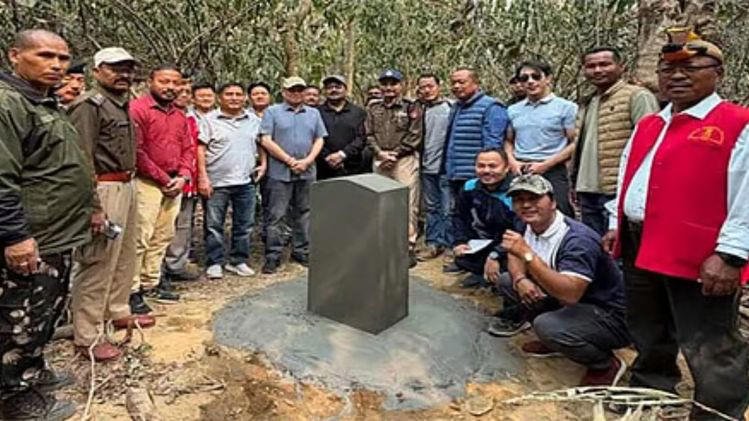
Arunachal Pradesh has begun the process of installing boundary pillars along its inter-state border with Assam following the historic agreement between the two states to resolve their long-standing territorial dispute. Chief Minister Pema Khandu announced that the work has officially started and described it as a major step toward lasting peace and clarity along the border.
The installation of boundary pillars marks the next phase of implementing the boundary settlement agreement signed between Arunachal Pradesh and Assam in 2022. The agreement aimed to resolve decades-old disputes that involved several villages located along the interstate boundary.
Khandu stated that the pillar installation will provide clear physical demarcation on the ground. This process will help prevent future misunderstandings and ensure that administrative control remains well defined.
Officials from both states have begun joint verification and survey work before placing the pillars. Authorities believe the process will strengthen cooperation between the neighboring states.
Read More: Tripura Transport Minister Reviews Key Infrastructure Projects
Pema Khandu says Arunachal secured net territorial gain
Chief Minister Pema Khandu emphasized that the boundary settlement ultimately resulted in a net territorial gain for Arunachal Pradesh. According to him, the agreement protected the interests of the state while ensuring a practical resolution to a complex issue.
Khandu said that the negotiations involved careful assessment of historical records, administrative control, and the wishes of local residents. The discussions focused on areas where both states had overlapping claims for decades.
He explained that Arunachal Pradesh gained control of several areas under the final arrangement. At the same time, both states agreed to make adjustments in certain locations to reach a mutually acceptable settlement.
The chief minister also highlighted that resolving the dispute required political will and cooperation between the governments of both states. He praised the leadership of Assam and the support of the central government for facilitating the process.
According to Khandu, the agreement demonstrates how dialogue and consensus can resolve complex interstate disputes.
Long-standing border dispute between the two states
Arunachal Pradesh and Assam have shared a complicated boundary relationship since Arunachal was carved out as a separate state. The border stretches for more than 800 kilometres and includes several forested and remote areas.
For many years, both states had claims over dozens of villages located along the boundary. These disputes often created administrative challenges and occasionally led to tensions between local communities.
The disagreement largely originated from differences in interpretation of historical maps and administrative boundaries drawn during the colonial period. As a result, both states exercised control over certain areas at different times.
Efforts to resolve the dispute had taken place for decades through committees and negotiations. However, a comprehensive settlement remained elusive until recent years.
The 2022 agreement between the two states finally provided a structured framework to address the issue.
Boundary pillar installation to prevent future disputes
The installation of boundary pillars serves as a crucial step in implementing the settlement. Once completed, the pillars will provide visible and legally recognised markers along the interstate border.
Officials from both states have formed joint teams to carry out the demarcation work. Survey teams are verifying locations before placing the pillars to ensure accuracy.
This process will also involve mapping the boundary using modern technology. Clear documentation will help both administrations maintain proper records.
Authorities believe that the pillar installation will reduce confusion among residents living near the border. It will also help local administrations coordinate development and governance more effectively.
The physical demarcation will make it easier for law enforcement and local authorities to manage their jurisdictions.
Cooperation between Assam and Arunachal governments
The successful implementation of the boundary settlement reflects improved cooperation between the governments of Assam and Arunachal Pradesh. Both states worked together to address sensitive issues that had remained unresolved for many years.
The agreement was reached after several rounds of discussions between leaders and officials from both states. The process also involved consultations with local communities and district administrations.
Both governments agreed that resolving the dispute would benefit people living in the border regions. The settlement allows the states to focus more on development and infrastructure rather than territorial disagreements.
Officials say the collaboration also strengthens regional stability in the Northeast.
Impact on development in border areas
The resolution of the boundary issue is expected to accelerate development in the border regions. For many years, uncertainty over administrative control slowed infrastructure projects and government initiatives.
With the dispute resolved, both states can now implement development programs more efficiently. Authorities plan to focus on improving roads, education facilities, and healthcare services in border villages.
Local residents have welcomed the clarity brought by the agreement. Many believe that clear administrative control will lead to better governance and access to government schemes.
Improved cooperation between the states may also promote economic activities in border areas. Markets, transport routes, and trade links could expand once administrative boundaries become clearly defined.
A milestone in Northeast interstate relations
The boundary pillar work between Arunachal Pradesh and Assam represents a significant milestone in resolving interstate disputes in Northeast India. The settlement demonstrates that dialogue and cooperation can address complex territorial issues.
Chief Minister Pema Khandu has repeatedly stated that the agreement protects the interests of Arunachal Pradesh while ensuring peace along the border.
By completing the demarcation process, both states aim to close a chapter of uncertainty that lasted for decades.
As the boundary pillar installation progresses, officials hope the agreement will serve as a model for resolving similar disputes in other parts of the region. The process highlights the importance of negotiation, mutual respect, and strong political commitment in achieving lasting solutions.
Read More: Indian Mission In Houston Celebrates 150 Years Of National Song