


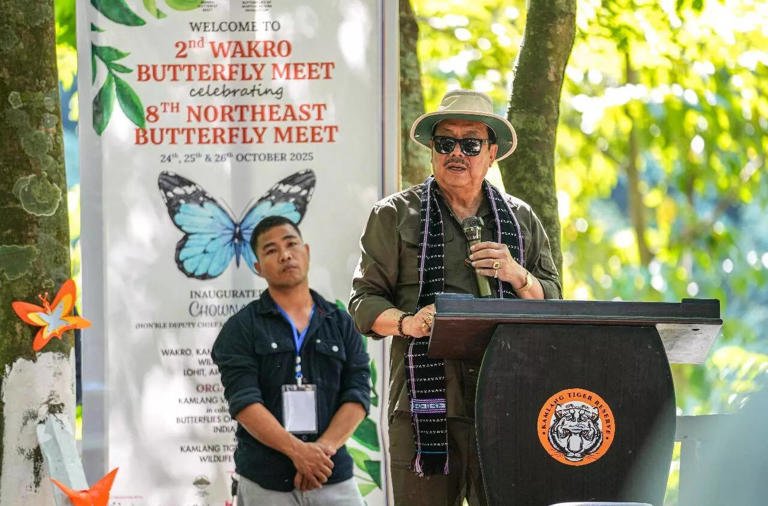
Arunachal Pradesh Deputy Chief Minister Chowna Mein commended the ongoing butterfly conservation efforts during a public meeting held in Wakro, Lohit district. The event brought together environmentalists, local communities, and researchers who are working to preserve the state’s rich butterfly diversity. Mein’s participation underlined the government’s commitment to promoting sustainable eco-tourism and safeguarding Arunachal’s ecological heritage.
The Wakro meet, organized by local environmental groups in collaboration with the state forest department, celebrated years of grassroots initiatives that have helped protect endangered butterfly species. Mein praised the dedication of villagers, researchers, and NGOs who have turned the small town of Wakro into one of India’s prominent butterfly hotspots.
He highlighted that Arunachal Pradesh, known as the “Land of the Rising Sun,” is also the “Land of Butterflies,” with over 700 species documented across its forests and valleys.
Read More: Arunachal CM pushes for stronger India–Japan partnership during Tokyo visit
Community-Led Conservation Inspires Recognition
During his address, Chowna Mein emphasized that the success of butterfly conservation efforts in Wakro reflects the power of community-driven initiatives. He said that local participation has been the backbone of the state’s biodiversity protection programs. Communities in the region have taken proactive steps to protect butterfly habitats, limit deforestation, and promote awareness among the youth.
Mein stated that the government aims to replicate Wakro’s conservation model in other biodiversity-rich regions of Arunachal. He added that empowering local communities through eco-tourism can generate sustainable income while preserving natural ecosystems.
The Deputy CM also urged the younger generation to take pride in their environment and continue the legacy of conservation. He mentioned that butterflies are not just symbols of beauty but also indicators of ecological balance, serving as pollinators and markers of environmental health.
Research and Documentation: A Key to Preservation
The Wakro event showcased new findings from environmental researchers who have been documenting rare butterfly species for over a decade. Experts shared that the region’s microclimate, diverse vegetation, and proximity to the Mishmi Hills make it a natural haven for butterflies.
Mein appreciated the scientific community’s dedication, stating that detailed research and continuous monitoring are essential to ensure the success of butterfly conservation efforts. He highlighted that collaboration between government agencies and academic institutions would strengthen conservation planning.
The Deputy CM also proposed the establishment of a dedicated “Butterfly Research and Eco-Education Centre” in Wakro. The center, he said, would not only focus on research but also promote environmental education and community outreach programs. Such an initiative could attract eco-tourists and researchers from across the country, giving a boost to the local economy.
Promoting Eco-Tourism and Green Livelihoods
Chowna Mein used the opportunity to link conservation with livelihood generation. He noted that eco-tourism centered around butterflies and wildlife can become a sustainable source of income for local people. Tourists visiting Wakro can witness the spectacular butterfly migrations and participate in guided nature trails led by trained community members.
He mentioned that the government plans to promote Wakro as a “Butterfly Village,” showcasing how conservation and tourism can coexist. Mein assured support for developing infrastructure that aligns with environmental principles, such as eco-lodges, nature trails, and visitor centers.
He further said that the butterfly conservation efforts have already drawn national attention, inspiring similar projects in neighboring states. Such initiatives not only protect biodiversity but also contribute to climate resilience and forest conservation.
Mein called on private stakeholders and conservation NGOs to collaborate with the state government in developing eco-tourism circuits across eastern Arunachal. He added that these efforts would help position the state as a leading destination for nature-based tourism in India’s Northeast.
Integrating Conservation with Education and Awareness
The Deputy CM stressed the importance of integrating environmental education into school curricula. He pointed out that awareness at the grassroots level is crucial to sustaining conservation in the long run. Encouraging students to participate in biodiversity surveys, butterfly walks, and plantation drives can foster environmental stewardship from an early age.
He announced that the state government would soon launch a “Youth for Nature” campaign to involve young volunteers in activities linked to forest protection and biodiversity monitoring. Mein said the campaign would include workshops on photography, documentation, and citizen science to promote greater community participation.
Additionally, Mein highlighted the importance of partnerships with universities and research organizations to study climate impacts on butterfly populations. Such studies could guide future policies to mitigate threats from habitat loss, pollution, and deforestation.
Preserving Arunachal’s Natural Heritage
In his concluding remarks, Chowna Mein reaffirmed the government’s commitment to protecting Arunachal Pradesh’s natural wealth through science-driven and community-oriented policies. He said that the butterfly conservation efforts at Wakro exemplify how harmony between humans and nature can lead to sustainable progress.
Mein also expressed hope that conservation in Arunachal would inspire a broader environmental movement across the Northeast. He called the event a “celebration of nature’s resilience” and praised the people of Wakro for becoming ambassadors of biodiversity conservation.
As the meeting ended, participants released butterflies as a symbolic gesture of freedom and renewal. The vibrant wings of the butterflies against the backdrop of the Mishmi Hills stood as a reminder of Arunachal’s rich ecological legacy — one that must be protected for generations to come.
Read More: Centre Proposes Article 371 Safeguards for Ladakh Amid 6th Schedule Stalemate