


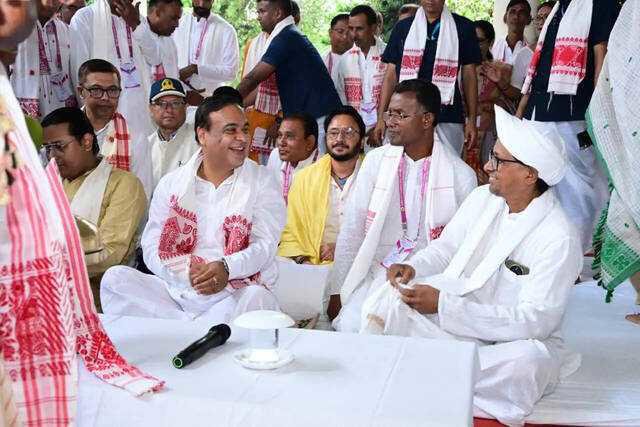
Assam Chief Minister Himanta Biswa Sarma on Friday announced a series of initiatives aimed at the development and preservation of Satras, the centuries-old Vaishnavite monasteries that hold deep cultural and spiritual importance in the state.
The chief minister said the government remains committed to protecting Assam’s rich spiritual heritage and strengthening institutions linked to the Neo-Vaishnavite movement founded by 15th-century saint-reformer Srimanta Sankardeva. According to him, the new initiatives will focus on infrastructure development, preservation of historical manuscripts, promotion of cultural activities, and welfare measures for Satra institutions.
Speaking at an official programme related to cultural heritage, Sarma said Satras are not only religious institutions but also centres of art, literature, music, and social harmony in Assam.
Read More: BJP Eyes Strong Regional Roots And Hard Hindutva Line With New Leaders
Government Focuses On Preserving Cultural Heritage
The chief minister stated that preserving the heritage of Satras remains one of the priorities of the Assam government. He said these institutions have played a major role in shaping Assamese identity and preserving the values of peace, devotion, and cultural unity for generations.
According to Sarma, the government plans to undertake restoration and renovation works in several historic Satras across the state. He added that many institutions require urgent conservation efforts because of ageing infrastructure and environmental challenges.
The chief minister said financial assistance and technical support would be extended for the preservation of valuable artefacts, ancient manuscripts, and traditional architecture associated with Satras.
He also emphasised the need to document the rich history and traditions of the Vaishnavite institutions for future generations. According to him, modern technology can help preserve rare texts and cultural records connected to Assamese heritage.
Infrastructure Development For Satras
As part of the new initiatives, the government plans to improve roads, connectivity, and basic infrastructure surrounding important Satras in different districts. Officials said better connectivity would help devotees, tourists, and researchers access these religious and cultural centres more easily.
Sarma stated that improving infrastructure around Satras would also support cultural tourism in Assam. He said many visitors from different parts of India and abroad travel to Assam to learn about the state’s Vaishnavite traditions and cultural practices.
The chief minister added that the government aims to create better facilities for pilgrims and tourists visiting major Satras. This includes improvements in accommodation, sanitation, lighting, and public amenities.
According to officials, the development initiatives will also help local communities economically by promoting tourism-related activities and cultural programmes.
Promotion Of Assamese Culture And Traditions
The chief minister highlighted the important role played by Satras in preserving Assamese classical dance, music, drama, and literature. He said institutions associated with the Neo-Vaishnavite tradition have contributed significantly to the cultural development of the state.
Sarma noted that traditional art forms such as Sattriya dance continue to receive national and international recognition. He stated that the government would encourage more cultural activities and awareness programmes to promote Assam’s spiritual and artistic heritage.
The chief minister also spoke about the importance of engaging younger generations with the traditions and teachings of the Satras. According to him, educational and cultural programmes can help create awareness among youth regarding Assam’s historical legacy.
Officials said plans are being considered to organise more festivals, exhibitions, and workshops focused on Satra culture and Assamese heritage.
Welfare Measures For Satra Institutions
Sarma announced that the government is also working on welfare measures for monks, caretakers, and individuals associated with Satra institutions. He said many Satras require additional support to maintain daily activities and preserve traditional practices.
The chief minister added that the government remains in regular contact with representatives of different Satras to understand their concerns and requirements. According to him, cooperation between religious institutions and the government is essential for effective heritage preservation.
Officials stated that schemes related to financial assistance and infrastructure maintenance may be expanded in the coming months. The government is also exploring ways to improve educational and cultural facilities within Satra premises.
Sarma said the administration wants to ensure that Satras continue functioning as centres of spirituality, education, and community service.
Importance Of Satras In Assam
Satras remain deeply connected to Assam’s cultural and spiritual identity. Established mainly by Srimanta Sankardeva and his disciple Madhavdeva, these institutions helped spread the Neo-Vaishnavite movement across the region centuries ago.
Over time, Satras evolved into centres for preserving literature, performing arts, and social reform. They also played an important role in strengthening Assamese language and cultural traditions.
Several famous Satras located in Majuli and other parts of Assam attract devotees, scholars, and tourists every year. Many of these institutions preserve ancient manuscripts, artefacts, and traditional performances linked to Assamese history.
The chief minister said protecting these institutions is essential for preserving the state’s cultural foundation and promoting harmony in society.
Tourism And Economic Opportunities
The Assam government believes that developing Satra infrastructure can also boost tourism and generate employment opportunities. Officials noted that heritage tourism has significant potential in the Northeast because of the region’s unique cultural diversity.
Sarma stated that better tourism infrastructure around Satras would encourage more visitors and researchers to explore Assam’s heritage. He added that local artisans and cultural performers could also benefit from increased tourism activities.
According to tourism officials, the government plans to integrate important Satra sites into broader tourism circuits to attract domestic and international travellers.
The chief minister said Assam’s cultural institutions represent the spirit of the state and deserve greater national recognition.
Government Reiterates Commitment
Concluding his address, Sarma reaffirmed the government’s commitment to preserving and developing Satras across Assam. He said cultural heritage and spiritual institutions form an important part of the state’s identity and social fabric.
The chief minister expressed confidence that the new initiatives would strengthen heritage preservation efforts and promote awareness regarding Assam’s Vaishnavite traditions.
He also urged citizens, cultural organisations, and religious institutions to work together for the protection of Assam’s historical and spiritual legacy.
According to the government, the planned initiatives mark another step toward safeguarding the rich traditions associated with the Satras while ensuring that future generations remain connected to the cultural roots of Assam.
Read More: Tripura CM Manik Saha Attends State-Level ASHA Convention In Agartala